When Will I Get My First Paycheck? (+ Free Date Calculator)
⚡ When will I get my first paycheck? — quick answer
Most new employees get their first paycheck 1–3 weeks after starting. Here is the breakdown by pay schedule:
- Weekly pay — usually 1–2 weeks after your start date
- Biweekly pay — usually 2–3 weeks after your start date
- Semi-monthly pay — usually 2–4 weeks depending on the 1st/15th cycle
- Monthly pay — usually 3–5 weeks depending on the employer’s payday
- Weekend or holiday payday — may shift to the preceding business day (usually Friday)
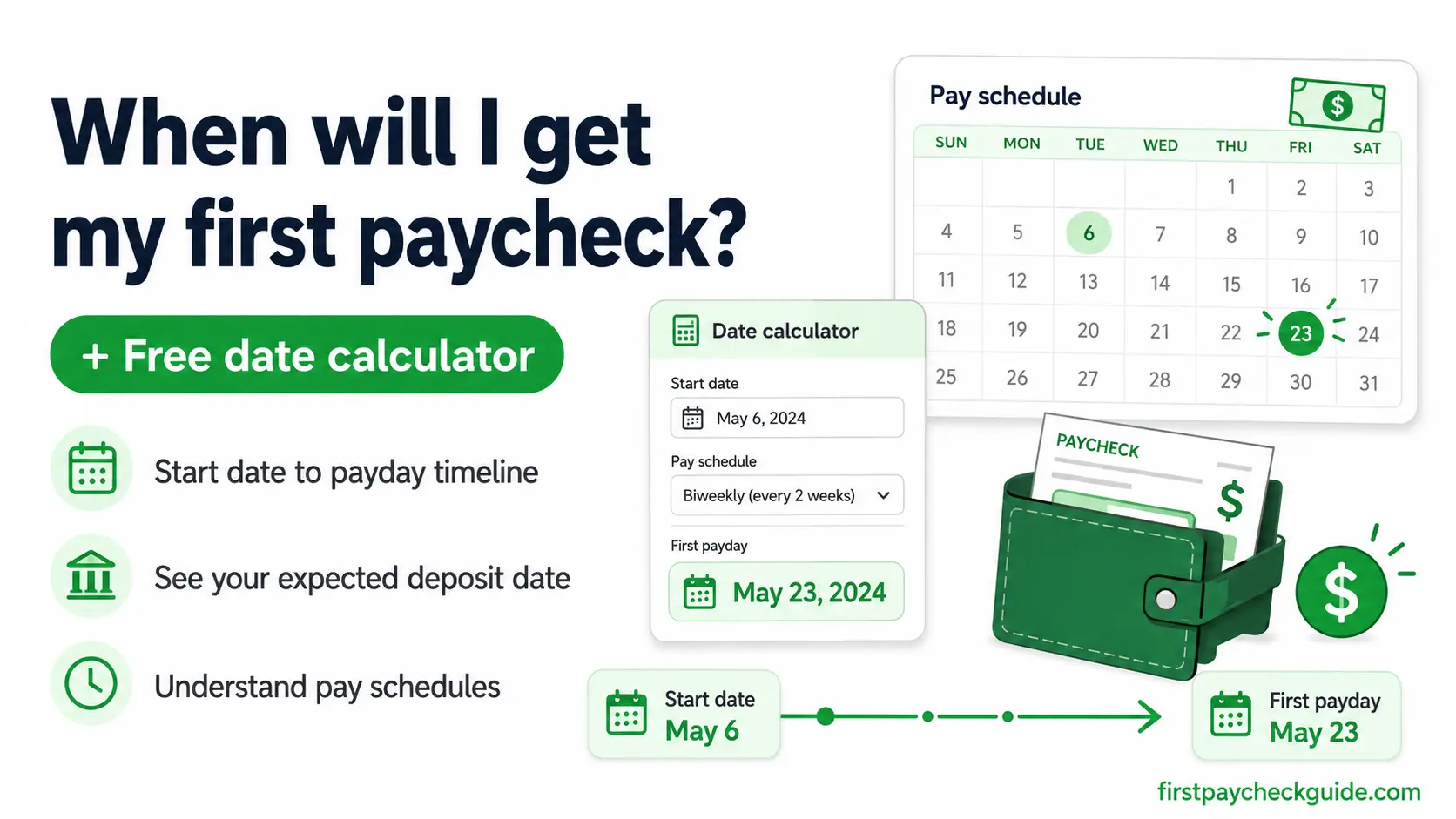
- Use the free calculator below to get your exact expected first deposit date
When will I get my first paycheck? You probably typed that into Google about ten minutes after realizing your bank account is not going to magically fill itself.
Here is the straight answer: it depends on your pay schedule and when you started relative to your employer’s payroll cutoff. For most people at biweekly jobs — which is most people — the wait is 2 to 3 weeks. That is not your employer holding anything back. It is just how payroll works. Your employer pays you for work you already completed, not work you are currently doing. This is called paying in arrears, and it is standard across almost every US employer.
The calculator below will give you your exact expected first deposit date. Below that is a breakdown of every pay schedule, what to expect at specific employers, and what to do if your deposit does not show up when it should.
Starting a temporary holiday role? Our holiday seasonal-jobs guide covers when to apply and the three payroll questions to ask during onboarding.
If your first recorded hours were orientation or required training, see when job orientation and training should be paid. Those hours normally follow the same pay-period and payroll-cutoff timing as your other work.
Table of Contents
When will I get my first paycheck? How long the wait really is
The wait for your first paycheck feels longer than it is because you are experiencing two things at once: the payroll processing window and the partial pay period. Here is how long each schedule typically takes:
| Pay schedule | Typical first deposit wait | Why |
|---|---|---|
| Weekly | 1–2 weeks after start date | Shortest cycle — period ends after 7 days, payroll processes in 2–3 business days |
| Biweekly | 2–3 weeks after start date | Most common US schedule — 14-day period plus payroll processing window |
| Semi-monthly | 2–4 weeks after start date | Depends on where in the month you started — may wait until next 1st or 15th cycle |
| Monthly | 3–5 weeks after start date | Longest wait — paid once per month at end of period |
📊 The 2–3 week wait is completely normal
Most new biweekly employees wait 2–3 weeks for their first deposit. This is standard payroll timing — not your employer holding your check. Your second paycheck arrives exactly 14 days later and every paycheck after that is on a regular schedule.
⚠️ What if payday falls on a weekend or holiday?
If your expected pay date falls on a Saturday, Sunday, or federal holiday, most employers move payday to the preceding business day (usually Friday). Direct deposit is not processed by banks on weekends or federal holidays. If your first paycheck is expected around a holiday, ask HR whether payroll will be processed early — most employers move it to the Friday before.
Worried your paycheck is being held? Read: Why Do Jobs Hold Your First Paycheck? →
How does biweekly pay work when you first start?
Biweekly is the most common US pay schedule — about 43% of US private employers use it. Here is exactly how it works for a new employee:
Biweekly pay — real calendar example
Your start date: Monday May 11, 2026
Pay period: May 11 – May 24 (14 days)
Period ends: Sunday May 24
Processing time: 3 business days (May 26, 27, 28)
Your first deposit: Thursday May 28 or Friday May 29
That is approximately 18 days from your start date. Your second deposit arrives June 12. Every deposit after that is exactly 14 days apart. That two-week rhythm is also what eventually lines up two or three paydays in the same calendar month, so it is worth checking your own three-paycheck months for 2026 once you know your regular payday.
| Schedule | How often | Paychecks per year | Common at |
|---|---|---|---|
| Weekly | Every 7 days | 52 | Amazon, UPS, FedEx, Kroger, fast food |
| Biweekly | Every 14 days | 26 (sometimes 27) | Walmart, Target, most office jobs |
| Semi-monthly | 1st and 15th (or similar) | 24 | Salaried office workers, some government |
| Monthly | Once per month | 12 | Some salary positions, academia |
McDonald’s is a special case in this comparison because the pay frequency is set by the individual franchise Owner/Operator, not by corporate, which is why crew members at different locations sometimes get paid on completely different cycles.
Weekly pay — when will I get my first paycheck weekly?
Weekly pay is the fastest schedule. Your first 7-day period ends after one week. After payroll processes in 2–3 business days, most weekly-pay employees see their first deposit within 10–12 days of their start date.
Weekly pay — real calendar example
Your start date: Monday May 11, 2026
Pay period: May 11 – May 17
Processing time: 3 business days (May 18, 19, 20)
Your first deposit: Wednesday May 20 or Friday May 22
That is approximately 11 days from your start date. Weekly pay is common at Amazon fulfillment, UPS, FedEx, Kroger, and many fast food employers.
Semi-monthly pay
Semi-monthly means paid twice per month — typically on the 1st and 15th, or 15th and last day of the month. Your first deposit arrives on whichever date comes after your first pay period ends.
Semi-monthly pay — real calendar example
Your start date: May 8, 2026
Pay periods: 1st–15th and 16th–end of month
Your first period ends: May 15
Processing time: 3 business days (May 18, 19, 20)
Your first deposit: Around May 20
If you started May 16 instead, your first period would not end until May 31 — making your first deposit arrive around June 5.
Monthly pay
Monthly pay means one paycheck per month, typically on the last business day of the month. If you start on May 3, your first period does not end until May 31 — and with processing time your first deposit arrives around June 5. Budget carefully before starting a monthly-pay job.
Monthly pay — real calendar example
Your start date: May 3, 2026
Period ends: May 31 (Sunday) — rolls to June 1
Processing time: 3 business days (June 2, 3, 4)
Your first deposit: Around Friday June 5
That is 33 days from your start date. Plan your finances carefully if you know you are on monthly pay before you start.
When will I get my first paycheck? Pay schedules by employer
Here is what to expect at major US employers for 2026. Always confirm with your specific location’s HR since franchise owners and managers can vary:
| Employer | Pay schedule | Typical first deposit wait | Notes |
|---|---|---|---|
| Amazon | Weekly for many hourly fulfillment roles | 1–2 weeks | Confirm in A to Z app — corporate roles may be biweekly |
| Walmart | Biweekly | 2–3 weeks | Early pay access via ONE@Work/Instapay — not DailyPay |
| McDonald’s | Weekly or biweekly (franchise) | 1–3 weeks | Franchise owner controls schedule — ask your manager |
| Target | Biweekly for most roles | 2–3 weeks | DailyPay earned wage access available for eligible team members |
| Costco | Biweekly | About 1–3 weeks depending on start date | Friday payday; confirm your actual pay period and pay stub in ESS |
| Home Depot | Biweekly at many U.S. locations | About 1–3 weeks depending on start date | Friday is commonly reported; verify your own store’s schedule and payslip in Self Service |
| Dollar General | Biweekly for most roles | 2–3 weeks | Confirm with store manager during onboarding |
| Walgreens | Biweekly for many roles | 2–3 weeks | Confirm locally |
| UPS (warehouse) | Weekly | 1–2 weeks | Weekly pay confirmed for package handlers and drivers |
| FedEx Ground | Weekly or biweekly (varies) | 1–3 weeks | Varies by location and ISP contractor — confirm with your terminal |
| Kroger | Weekly (hourly) / Biweekly (salaried) | 1–2 weeks hourly | Varies by banner, union contract, and location |
| Starbucks | Transitioning to weekly Aug 2026 | 1–3 weeks | Moving from biweekly to weekly for all US partners — rollout July–Aug 2026. Licensed stores may vary. |
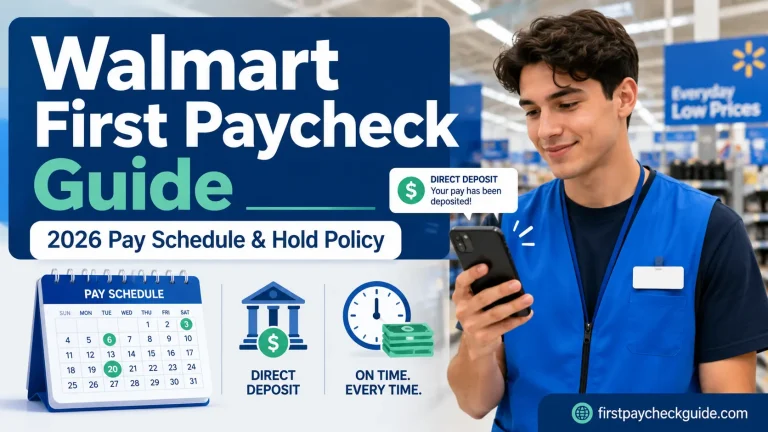
If you are specifically starting at Walmart, the Walmart first paycheck guide goes deeper on the 2026 bi-weekly pay schedule, Thursday deposit timing, what to do if your GTA hours aren’t approved, and how to set up OnePay for early wage access.
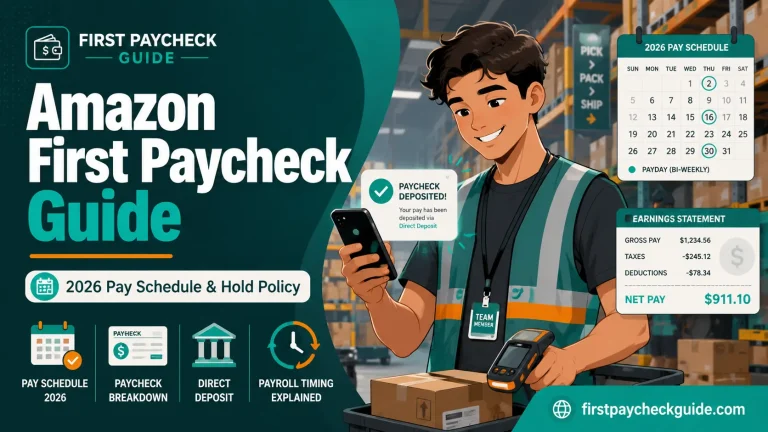
At Amazon specifically, the answer depends on your facility type — weekly-pay Fulfillment Centers and bi-weekly Sortation Centers follow different cycles, and the built-in payroll lag means the first Friday deposit can land anywhere from 1 to 3 weeks after your start date.
Employer-specific pay timing can vary a lot. For example, a new FedEx worker may need to confirm whether they are working under FedEx Ground, Express, Freight, Office, or a contractor. We explain that in more detail in the FedEx first paycheck guide.
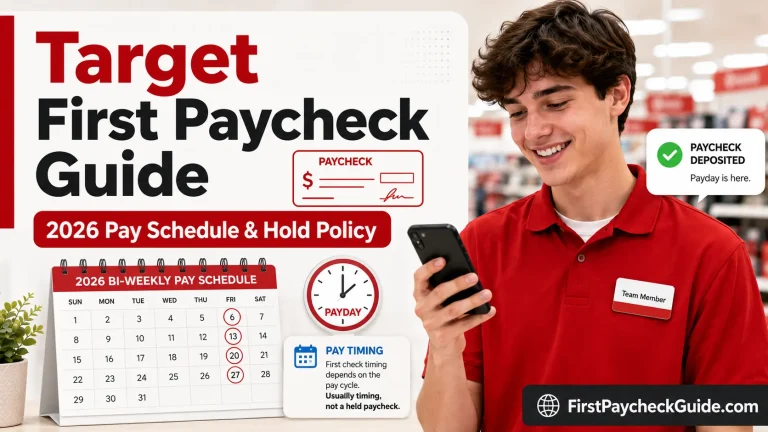
Starting at Target specifically? The Target first paycheck guide goes deeper on the 2026 bi-weekly pay schedule, Friday deposit timing, and how to use DailyPay if you need wages before payday.
Starting at Costco specifically? The Costco first paycheck guide covers the reported biweekly Friday cycle, expected 2026 paydays, and where to check your pay stub in ESS.
Starting at Home Depot? The Home Depot first paycheck guide explains the commonly reported biweekly schedule, Friday payday, Self Service payslips, direct deposit, and why your first check may be partial.
At Starbucks specifically, the answer in 2026 depends on both your state and your start date, since the company is mid-transition from bi-weekly to weekly pay for all U.S. company-operated partners starting in August 2026.
At Chick-fil-A, the timing is particularly hard to predict because the Operator at each location sets the pay frequency independently, and the Monday-through-Saturday pay period structure means the calendar looks different from every other employer in this series.
Publix stands out in this list because it pays weekly on Thursdays rather than the Friday that most other weekly or bi-weekly employers use, and because pay periods run Sunday through Saturday rather than the more common Monday-through-Sunday or Sunday-through-Saturday cycles.
UPS is unique in this series because the first paycheck experience involves three delays at once: the standard payroll lag, a direct deposit activation window of one to two pay cycles, and Teamsters union deductions that make the first few checks smaller than expected.
Trying to guess your own timeline from someone else’s schedule? The weekly or biweekly pay comparison of nine major employers lays out exactly which of these companies pay weekly and which pay biweekly, so you can check your own before assuming.
One factor that affects your first pay date is the payroll cutoff date — the point at which your employer locks payroll data before processing. Starting after the cutoff means your hours may not be included until the following paycheck.
Your first payday depends on your employer’s pay period schedule. Read: What Is a Pay Period? →Military pay — when will I get paid in the Army?
Military members are generally paid twice per month — on the 1st and 15th. When those dates fall on a weekend or federal holiday, the actual payday shifts to the preceding business day. For example, in 2026 several military paydays shift to the Friday before the 1st or 15th. Some military-friendly banks and credit unions (Navy Federal) may make funds available even earlier.
New recruits may not receive their first full pay until after in-processing and finance setup are complete — BAH and BAS typically start from your report date but may appear in your second pay cycle. Contact your unit’s finance office if pay does not arrive within one pay cycle of your report date.
For the official 2026 military pay calendar including all shifted dates: military.com/benefits/military-pay/military-pay-dates.html
What time does direct deposit hit on payday?
The timing depends on your bank, not your employer. Most direct deposits are available by the morning of payday — often by 9am — but exact timing varies.
| Bank type | Typical direct deposit time | Notes |
|---|---|---|
| Most major banks (Chase, BofA, Wells Fargo) | Midnight to 9am on pay date | Usually available before you wake up on payday |
| Credit unions | 6am–9am typically | Some process slightly slower than large banks |
| Chime | Up to 2 days early | May receive Thursday for a Friday payday — depends on when payroll file is sent |
| Other early-pay banks | 1–2 days early | Current, Axos, and other neobanks offer similar early access |
If your deposit has not arrived by noon on payday
Check these in order: confirm your bank routing and account numbers with HR are correct, check if a paper check was issued instead, verify no bank holiday is delaying processing, contact HR by end of business day if nothing resolves.
Will my first paycheck be direct deposited or come by mail?
✅ First check is likely direct deposit if:
- You submitted bank details during onboarding before the payroll cutoff
- Your employer confirmed direct deposit setup was processed
- You verified your routing and account numbers with HR before your first pay date
⚠️ First check may come by paper or pay card if:
- You submitted bank details after the payroll cutoff for your first period
- Your employer manually processes first-time direct deposits and needs one cycle to verify
- There was a data entry error in your routing or account number
- Your employer issues pay cards for new hires pending direct deposit setup
🚨 What if my direct deposit went to a closed bank account?
Do not panic. When a direct deposit is sent to a closed account, the bank typically rejects and returns the funds to your employer within 2–5 business days. Your employer then reissues payment by direct deposit to a new account, paper check, or pay card.
What to do immediately: Contact HR with your updated bank details — do not wait for them to contact you. Also call your old bank to confirm whether the deposit was returned, held, or rejected. Ask HR for a reissue timeline. Update your direct deposit information as soon as possible so future paychecks go to the right account.
If your paycheck is genuinely late, file a federal wage complaint at dol.gov — Wage and Hour Division.
Ask HR this on your first day
“Will my first paycheck be direct deposited or issued as a paper check or pay card? If paper, what address will it be mailed to and what date should I expect it?”
If your first payment is issued as a paper check, our guide to how to cash a paycheck explains where first-time workers can cash it, what ID to bring, and what fees to compare.
Early wage access — getting paid before payday
Some employers offer early wage access programs that let you access wages you have already earned before the official payday. These are not loans — they advance money you have already worked for.
- DailyPay — available at Target, McDonald’s, and other partners. Transfers to your bank, usually free for next-day or small fee for instant.
- ONE@Work / Instapay — available at Walmart and other partners
- EarnIn — works with any employer that uses direct deposit, no employer partnership needed
- PayActiv — available at select employers including some healthcare and retail chains
Availability depends on your employer, role, and onboarding status. Some transfers are free — instant transfers may have a small fee. Ask HR on your first day whether your employer offers any early wage access program.
What to do while waiting for your first paycheck
A 2–3 week wait with no income is stressful — especially if you left another job to start this one. Here is how to bridge the gap responsibly:
🗓️ First Paycheck Waiting Plan
- Ask HR: “When is the next payroll cutoff and when will I get my first direct deposit?”
- Confirm your bank routing and account numbers are in the system correctly
- Ask whether your first check is direct deposit, paper check, or pay card
- Write down the exact expected pay date — use the calculator above to confirm it
- Check whether your previous employer owes you a final paycheck — this bridges most of the gap
- Ask your landlord, utility company, or phone provider for a one-time extension before the due date — most will accommodate a new employee with a confirmed start date
- Ask HR whether your employer offers pay advances, earned wage access, or emergency payroll checks
- Prioritize food, transportation to work, rent, phone, and medication above everything else
- Use a local food pantry or community resource before taking on high-interest debt
- Avoid payday loans — fees often reach 400%+ APR and can trap you in debt before your first paycheck even arrives
- Check your bank account by 9am — most direct deposits arrive overnight or early morning
- If nothing by noon — contact HR immediately with your bank details to verify
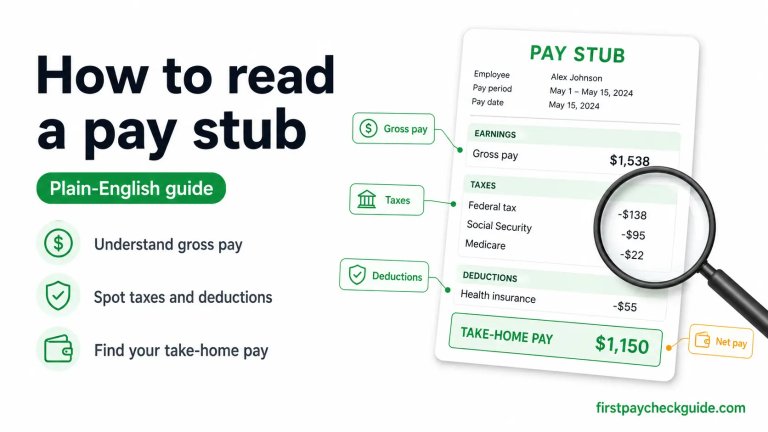
- Once received, check your pay stub using the guide below
Pay arrived but looks confusing? Read: How to Read a Pay Stub for the First Time →
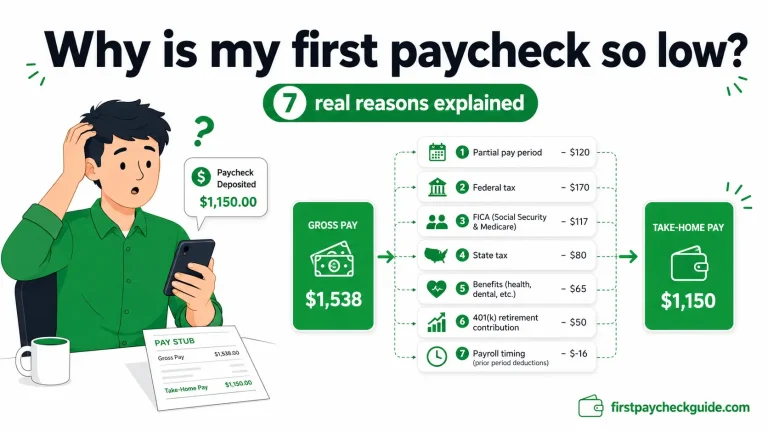
Pay arrived but smaller than expected? Read: Why Is My First Paycheck So Low? →
Frequently Asked Questions
When will I get my first paycheck?
Most new employees get their first paycheck 1–3 weeks after starting. Weekly-pay employees typically see their first deposit 1–2 weeks after starting. Biweekly employees wait 2–3 weeks. Semi-monthly and monthly employees may wait 2–5 weeks depending on their start date. Use the free calculator at the top of this page to get your exact expected first pay date.
When will I get my first paycheck calculator — how does it work?
The calculator at the top of this page takes your start date, pay schedule (weekly/biweekly/semi-monthly/monthly), and payroll processing window to calculate your expected first deposit date. It uses business days for processing and moves weekend results to the preceding Friday — matching how most US employers handle payday scheduling. Always confirm the result with HR since your employer’s specific cutoff date may differ.
How does biweekly pay work when you first start?
With biweekly pay, your first 14-day work period ends on a specific date, then payroll takes 2–3 business days to process your payment. Most new biweekly employees see their first deposit about 17–21 days after their start date. Your second paycheck arrives exactly 14 days later, and every paycheck follows that same schedule.
When will I get my first paycheck weekly?
With weekly pay, your first 7-day period ends after one week, then payroll processes in 2–3 business days. Most weekly-pay employees see their first deposit 10–12 days after their start date. Weekly pay is common at Amazon, UPS, FedEx, Kroger, and many fast food and retail employers.
How long does it take to get your first paycheck?
For most US employees: weekly pay takes 10–14 days, biweekly pay takes 14–21 days, semi-monthly pay takes 14–30 days depending on start date, and monthly pay takes 20–35 days. The wait is longer if you started after your employer’s payroll cutoff date — those first days roll into the next pay cycle.
Will my first paycheck be direct deposited?
It depends on when you submitted your bank details. If you provided them during onboarding before the payroll cutoff, your first check will likely be direct deposit. If submitted after the cutoff, many employers issue a paper check or pay card for the first cycle and switch to direct deposit from the second paycheck onward. Ask HR on your first day to confirm.
Does your first paycheck come in the mail?
Sometimes — especially if your bank details were not set up in time for your first pay period. Paper checks are mailed to the address on file with HR. Allow 3–5 business days after the pay date for it to arrive. If it has not arrived within 5 business days of the pay date, contact HR to verify the mailing address and request a reissue if needed.
When should I expect my first paycheck after starting a new job?
As a general rule: weekly pay employees receive their first check within 2 weeks, biweekly employees within 3 weeks, and monthly employees within 5 weeks. If you have not been paid within one full pay cycle after your official pay date, contact HR — something may need to be corrected in the payroll system.
You Know When It Is Coming — Now Plan What to Do With It
The wait is almost over. You know your expected first pay date, you know what schedule your employer uses, and you know what to ask HR. The next step is having a plan ready the moment that deposit hits your account.

About the Author
Ashief Mahmood is the Founder and Editor of First Paycheck Guide. He researches and explains first-paycheck topics for U.S. first-time workers using IRS publications, U.S. Department of Labor resources, official employer documentation, payroll sources, and carefully labeled estimates.
Ashief is not a financial advisor, tax professional, payroll provider, lawyer, or employer representative. First Paycheck Guide is an independent educational website.
The information in this article is for educational purposes only. Pay schedule timing estimates are based on standard US payroll processing practices and may vary by employer. The calculator provides estimates only and does not account for federal holidays or employer-specific payroll cutoff dates — always confirm your exact pay date with HR. Employer pay schedule information sourced from publicly available employer resources and is accurate as of May 2026 but may change. Starbucks weekly pay transition sourced from About Starbucks press release (April 2026).