Holiday Seasonal Jobs 2026: Hiring Timeline by Employer
Holiday seasonal jobs 2026: quick answer
Holiday seasonal jobs usually start appearing from August through October. Apply in September or early October if you want the best choice of retail, warehouse, stocking, package-handling, and customer-service shifts. November can still bring openings, but many employers will be filling last-minute schedules rather than building their main holiday team.
- Best time to apply: September and early October.
- Common employers: Amazon, Target, Walmart, UPS, USPS, FedEx, Kohl’s, Macy’s, Best Buy, Costco, and specialty retailers.
- Typical length: A few weeks to a few months, often ending in early January.
- First paycheck: Depends on the payroll cutoff and pay schedule, not only your first day.
- Permanent job chance: Possible, but never automatic.
Important: National employers do not always announce one fixed 2026 hiring date. Check the official careers page for your city, store, warehouse, or delivery hub before applying.
Holiday seasonal jobs can be a practical first job, a way to build savings, or a short-term income boost before the end of the year. The biggest mistake is waiting until Black Friday to start looking, because many good shifts have already been filled by then.
This guide explains when employers start hiring, where to look, how seasonal work operates, and what happens to your paycheck after you are hired. It is designed for first-time workers who want clear answers before applying.
When does holiday seasonal hiring start in 2026?
Holiday seasonal hiring often begins in August, becomes much more common in September, and reaches a major application period in October. Employers can keep hiring in November when they need more coverage for Black Friday, shipping deadlines, holiday events, or staff turnover.
The exact timeline differs by employer and local demand. A Halloween retailer may hire earlier than a department store, while a package hub may add workers closer to peak shipping weeks.
Retail hiring follows a familiar pattern. The U.S. Bureau of Labor Statistics’ 2025 analysis found that retail employment builds during the holiday period and is followed by January and February layoffs or retention decisions.
| Month | What usually happens | What you should do |
|---|---|---|
| August | Early listings may appear for fall retail, warehouse work, Halloween stores, and staffing pools. | Prepare a simple résumé, set official job alerts, and decide your available days and hours. |
| September | A major wave of store, fulfillment, stocking, and customer-service hiring often starts. | Apply early and respond quickly if an employer requests an interview, background check, or onboarding step. |
| October | Employers fill remaining shifts and adjust staffing around early holiday sales events. | Keep applying, especially if you can work evenings, weekends, overnight shifts, or peak dates. |
| November | Late openings can appear as demand rises or earlier applicants drop out. | Check official listings daily, but read the expected end date and schedule carefully. |
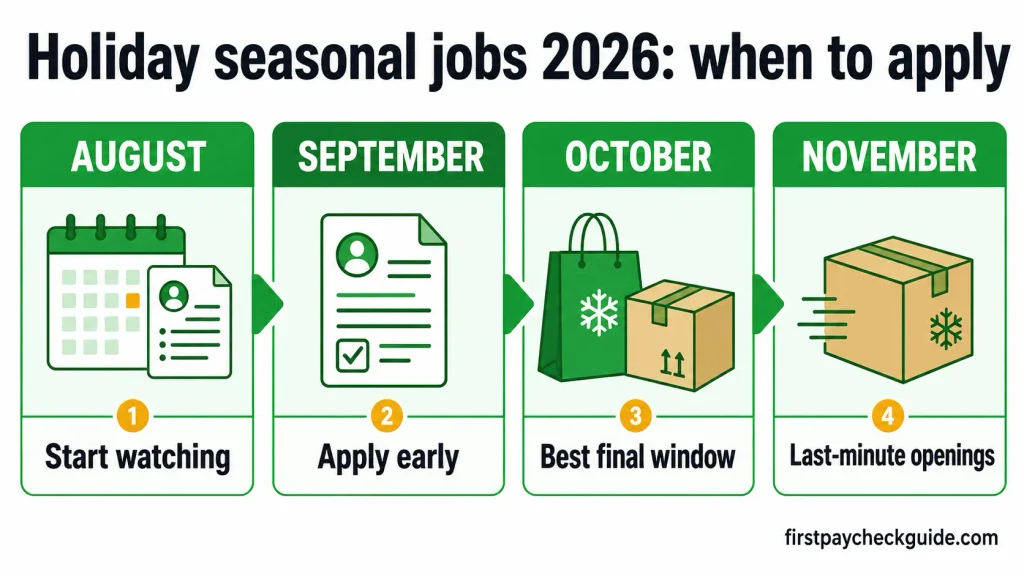
The practical rule is simple: start watching in August, apply seriously in September, and treat early October as your preferred deadline. You can still find a position later, but you may have fewer shifts and employers to choose from.
Do not wait for one big national announcement
Large employers may add openings city by city or release more shifts after the season begins. Amazon reported posting new job opportunities weekly during the 2025 holiday season, while the National Retail Federation noted that retailers can pull hiring forward to support October shopping events. A local listing is more useful than an old article about national hiring totals.
Which employers offer holiday seasonal jobs?
Start with an employer’s official careers page. That is where you can see whether a role is truly open, which shifts it covers, whether it is temporary, and who the legal employer is.
Job boards can help you discover possibilities, but they should not be your final source. A local listing from the employer is more likely to show the correct location, job type, shift, pay range where required, and application deadline.
| Employer or sector | Common seasonal roles | Useful FPG guide after an offer |
|---|---|---|
| Amazon Fulfillment, sortation, delivery support, and warehouse shifts. |
Verify location, physical requirements, assignment length, and whether the role is seasonal. | Amazon First Paycheck Guide |
| Target Sales floor, cashier, fulfillment, stocking, and customer service. |
Verify weekend availability, required peak dates, and whether the opening is temporary or regular. | Target First Paycheck Guide |
| Walmart Stocking, pickup, cashier, online order fulfillment, and store support. |
Verify store location, availability requirements, and your payroll group after onboarding. | Walmart First Paycheck Guide |
| UPS and FedEx Package handling, sorting, seasonal support, and delivery-related work. |
Verify the employer of record, work location, physical demands, and contractor status where relevant. | UPS First Paycheck Guide FedEx First Paycheck Guide |
| Kohl’s, Macy’s, Best Buy, Costco, and Bath & Body Works Sales, fulfillment, stockroom, cashier, and customer-assistance roles. |
Verify local pay range, expected end date, discount rules, and holiday availability requirements. | Ask the employer for the pay period and first-payday schedule during onboarding. |
Starting a seasonal role at Costco? Our Costco first paycheck guide explains the reported biweekly Friday pay cycle, expected 2026 payday dates, ESS pay-stub access, and what to expect from your first check.
Starting a seasonal retail role at Home Depot? The Home Depot first paycheck guide explains the commonly reported biweekly pay cycle, first-paycheck timing, Self Service payslip access, direct deposit, and what to verify if your first check is smaller or later than expected.
Amazon said it created 250,000 U.S. opportunities across full-time, part-time, and seasonal roles for the 2025 holiday season. That number is helpful context, not a promise for 2026, so use Amazon’s official seasonal-jobs search to find live openings near you.
Target also has an official seasonal careers page. For USPS roles, use the official USPS careers page rather than relying on reposted listings.
How to find seasonal jobs hiring near you safely
“Holiday seasonal jobs near me” can be a useful search, but it mainly returns job boards and aggregated listings. Use it to discover employers, then verify the job on the company’s official career site before submitting an application.
Never pay to apply for a normal job. A legitimate employer may collect tax and direct-deposit details after you are hired, but it will not ask you to buy gift cards, deposit a check, or pay an upfront fee to be considered.
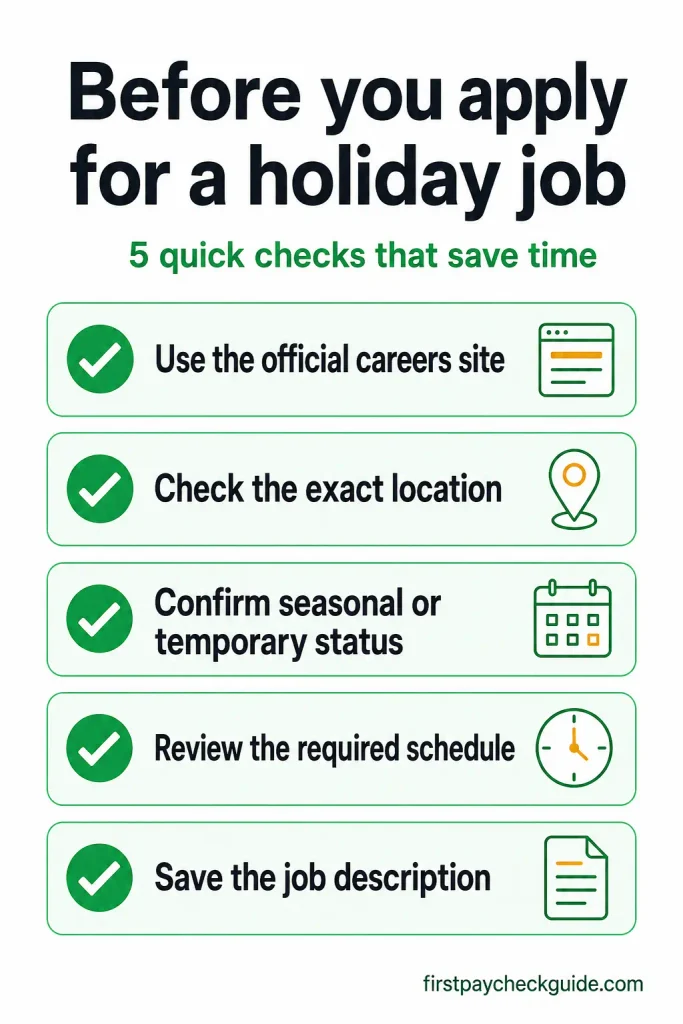
Five checks before you apply
- Check the employer domain. Apply through the company’s official site or a clearly identified hiring platform.
- Read the location. A national employer may have no suitable opening within commuting distance.
- Check the job type. Look for “seasonal,” “temporary,” “part-time,” or a stated expected end date.
- Confirm the schedule. Do not promise evenings, weekends, or holidays if you cannot actually work them.
- Save the job description. Keep a copy of the listing, pay range, and offer information for your records.
How long do holiday seasonal jobs last?
Holiday seasonal jobs often last from a few weeks to a few months. Someone hired in September or October may work through early January, while someone hired in late November may have a shorter assignment.
The job posting and offer information matter more than a general rule online. Before accepting, ask about the expected end date, typical weekly hours, and whether the employer guarantees any minimum schedule.
Seasonal work does not automatically mean full-time hours. You may receive part-time, full-time, or variable hours depending on store traffic, package volume, staffing needs, and your availability.
Can a seasonal job become permanent?
A seasonal job can become permanent, but it is not automatic. Employers may retain workers when they still need staff after the rush and when there is a suitable regular opening.
Strong attendance, reliable availability, safe work habits, and good customer service can help. If you want to stay, tell your manager before the season ends and ask whether a regular role may open in January.
Seasonal pay, overtime, holiday pay, and your first paycheck
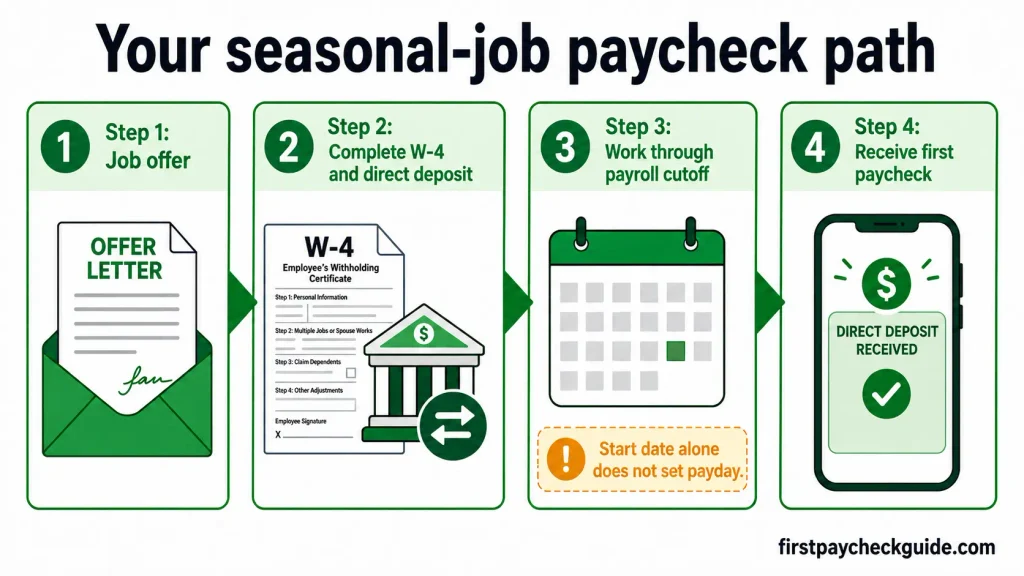
A seasonal employee normally completes the same basic payroll paperwork as another new employee. That includes a Form W-4, direct-deposit setup if offered, and tax withholding from wages.
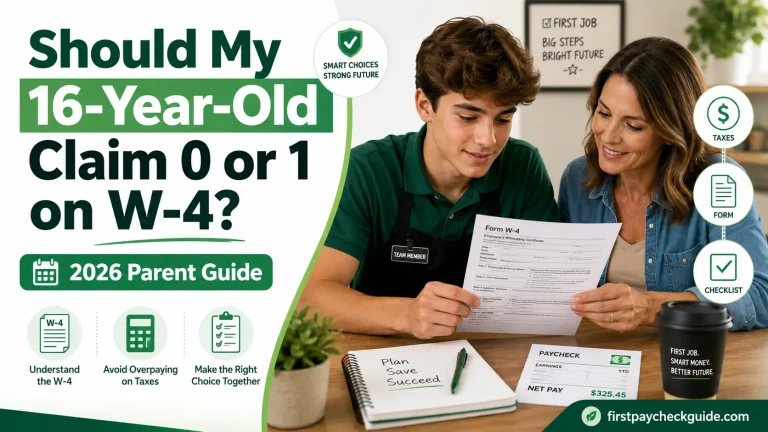
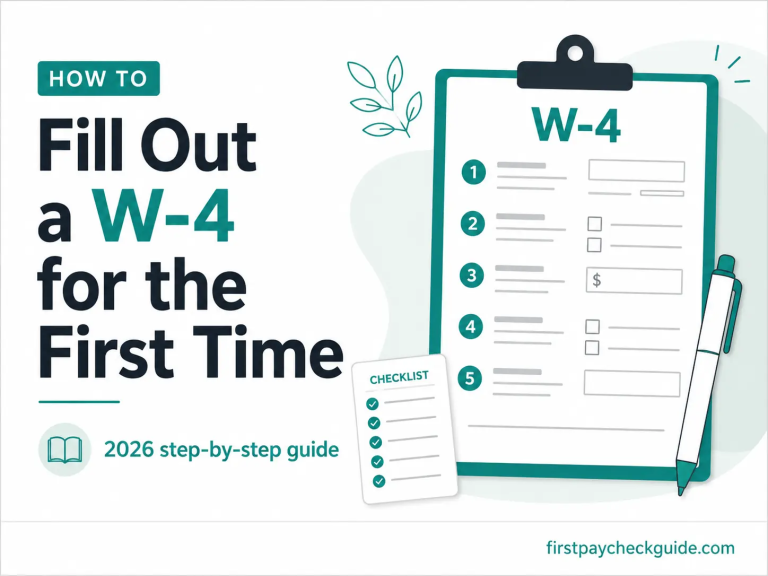
Read our first-job W-4 guide before submitting the form, especially if you have a second job. You can also use the W-4 Withholding Estimator to see how common withholding choices can affect your paycheck.
Your first paycheck depends on the employer’s pay period and payroll cutoff. If you start just after payroll closes, your first worked hours may be paid in the following cycle.
Ask three questions during onboarding: “Is pay weekly or biweekly?”, “What dates does this pay period cover?”, and “When should I expect my first payday?” Use our payroll cutoff date guide and First Paycheck Date Calculator to estimate the timing.
Working on Black Friday does not automatically mean time-and-a-half
Federal law does not generally require premium pay simply because a shift falls on a holiday or Black Friday. For many nonexempt employees, federal overtime is based on working more than 40 hours in one workweek. An employer may offer a holiday premium, but the written policy and your local employment terms control the answer.
Holiday pay is also not automatic for seasonal employees. Some employers offer extra pay, special incentives, or holiday premiums, while others do not.
Check the job offer, employee handbook, union agreement if applicable, or ask HR before relying on a higher rate. After you are paid, keep your pay stub and compare its hours with your schedule.
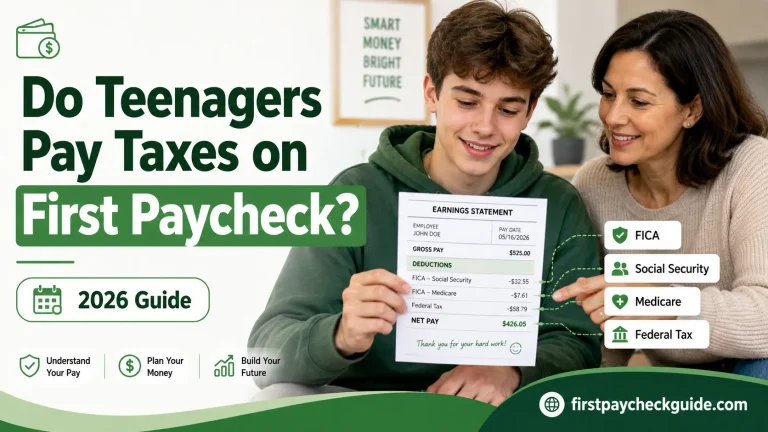
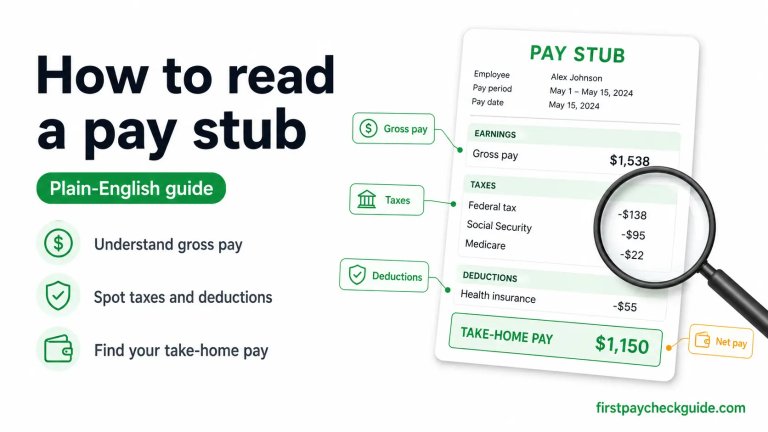
If the numbers look unfamiliar, use our guides on how to read your first pay stub, gross pay versus net pay, and what FICA means on a paycheck. You can also use the First Paycheck Take-Home Pay Calculator to estimate how taxes and deductions affect your deposit.
How to stand out when you have little or no work experience
For a first seasonal job, employers often care most about reliability, honest availability, communication, and willingness to learn. You do not need to invent experience to create a useful résumé.
Include school activities, volunteering, sports, customer-facing experience, family responsibilities, or projects that show you can show up and follow through. Be honest about your availability because missing peak shifts can affect whether an employer keeps you after the season.
If you are under 18, check your state’s youth-employment rules and the employer’s minimum-age requirement before applying. Some jobs and shifts may have additional restrictions for younger workers.
Frequently asked questions about holiday seasonal jobs
When do holiday seasonal jobs start?
Many holiday seasonal jobs begin appearing from August through October. September and early October are usually the strongest months to apply because employers are building their main teams before peak shopping and shipping dates.
How long do seasonal jobs last?
Holiday seasonal jobs often last from a few weeks to a few months. Many end in early January, but the exact dates, weekly hours, and possibility of extension vary by employer and location.
Are seasonal jobs full time?
They can be full time, part time, or variable-hour roles. “Seasonal” means the position is tied to a busy period, not that it guarantees a certain number of hours each week.
Can seasonal jobs become permanent?
They can, but it depends on whether the employer has a regular opening and wants to retain workers after the season. Strong attendance, good performance, and telling your manager that you want to stay can help, but there is no guarantee.
Do seasonal workers get holiday pay?
Not automatically. Holiday pay depends on employer policy, a union agreement where applicable, and state or local rules, while federal overtime is generally based on total workweek hours.
When will I get my first seasonal-job paycheck?
Your first paycheck depends on your employer’s payroll cutoff and pay frequency. Use our first paycheck guide for a clear explanation of why a first deposit can take longer than expected.
The bottom line
Holiday seasonal jobs are easiest to find when you begin early, apply through official career pages, and stay realistic about your availability. September and early October are the best application window for most workers. A seasonal role can give you income, job experience, references, and sometimes a path to a regular position, but you should understand the terms before accepting.
- Apply early: Search from August and prioritize September or early October.
- Verify locally: Check the exact role, shift, pay, and end date on the official careers page.
- Understand payroll: Ask about your pay period and first payday before your first shift.
Finding the job is only the first step. Before your first shift, make sure you know what the role pays, when the assignment may end, and when your first direct deposit should arrive.
What to read next
These guides can help you handle the paperwork and pay questions that often come with a first seasonal job.
- When Will I Get My First Paycheck?
- What Is a Pay Period?
- How to Fill Out a W-4 for the First Time
- Weekly or Biweekly Pay? 9 Major Employers Compared
Sources and methodology: The seasonal-employment pattern is supported by the U.S. Bureau of Labor Statistics. Holiday-hiring context comes from the National Retail Federation and Amazon’s 2025 holiday hiring announcement. Holiday-pay and overtime guidance comes from the U.S. Department of Labor’s holiday-pay guidance and its overtime guidance. Employer openings and local terms change frequently, so verify the live listing before applying. Reviewed August 2026.
Got a seasonal-job offer?
Find out when your first direct deposit is most likely to arrive.
Your estimated payday is a planning tool, not a guarantee. Your employer’s payroll calendar and employee portal remain the final source for the actual deposit date.

About the author
Ashief Mahmood is the founder and editor of First Paycheck Guide. He researches and explains first-paycheck topics for U.S. workers using government publications, employer documentation, payroll resources, and clearly labeled practical guidance.
Ashief is not a financial advisor, tax professional, payroll provider, lawyer, or employer representative. First Paycheck Guide is an independent educational website.
Disclaimer: This article is for general educational purposes and is not legal, payroll, tax, or individualized financial advice. Job availability, age requirements, wages, schedules, benefits, holiday pay, overtime eligibility, and employment terms vary by employer, location, role, contract, and applicable law. Confirm current details directly with the employer before applying or accepting work.