401k limits Explained for Your First Job in 2026
⚡ 2026 401(k) limits at a glance — what matters for your first paycheck
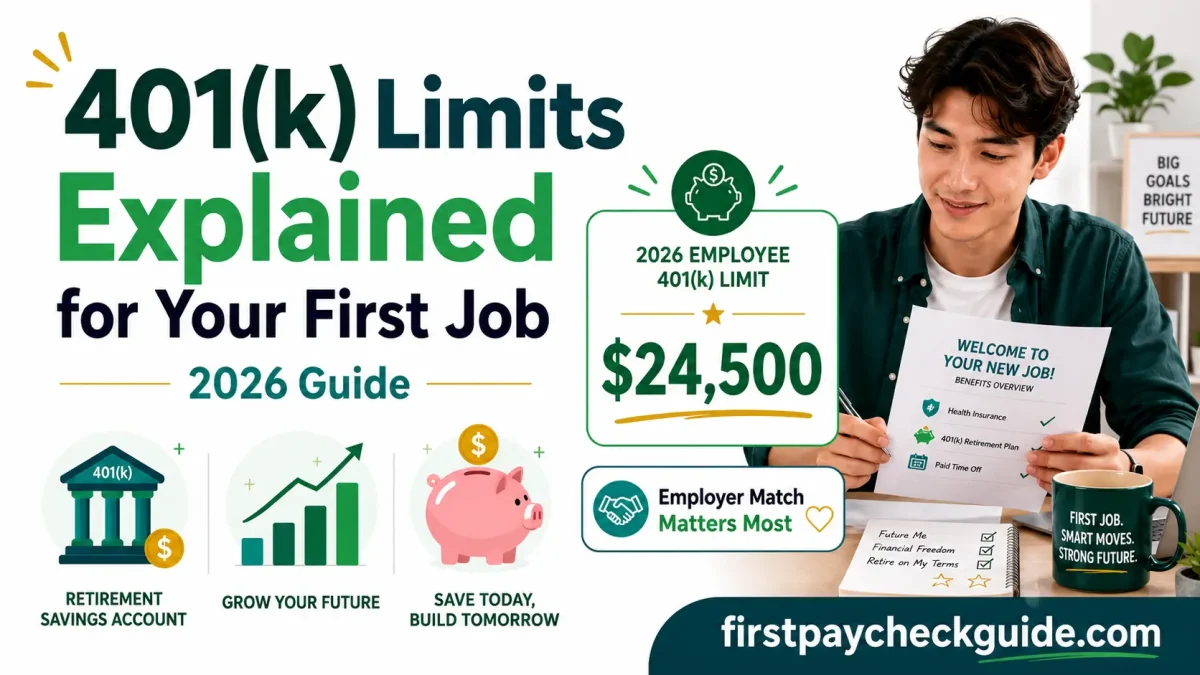
The 2026 employee 401(k) contribution limit is $24,500. The combined employee + employer limit is $72,000. But for most first-job workers, the real goal is not maxing out — it is contributing enough to get the full employer match.
- Employee limit — $24,500 per year, up from $23,500 in 2025. Most first-job workers will contribute far below this.
- Employer + employee total — $72,000 combined. Your employer’s match does not count against your personal $24,500 limit.
- Catch-up contributions — $8,000 extra if you are 50+, or $11,250 for ages 60–63 if your plan allows.
- First-job reality — 6% of a $40,000 salary is $2,400/year, only 9.8% of the $24,500 limit.
You saw the headline. Maybe it popped up in your news feed, or your dad texted you a link, or you overheard someone at work talking about it.
“401(k) limit rises to $24,500 in 2026.”
And if you are in your first job — making $35,000, $40,000, maybe $50,000 — you probably had one thought:
“Cool. I have no idea what that means for me.”
Here is what most headlines do not explain: the 2026 401k limits are designed for people trying to max out their retirement accounts. People making higher salaries. People later in their careers. People who already have their rent, emergency fund, and monthly bills figured out.
They are not the first number you need to worry about.
At 22, with your first real paycheck, you do not need to panic about hitting a $24,500 limit. You need to focus on something much smaller and much more important: getting your employer’s full 401(k) match.
That is usually 3% to 6% of your salary. At $40,000, that is $1,200 to $2,400 per year. A fraction of the IRS limit. But it is free money from your employer that many workers miss simply because the enrollment form feels confusing.
This post translates the 2026 401k limits into language that matters for someone who just learned what a W-4 is. We will cover the official numbers, why they probably do not limit you yet, and the one thing you should actually do this week.
If you are new to 401(k)s entirely, start with our complete first-job guide.
New to 401(k)s? Read: How Much of My Paycheck Should I Put in My 401(k)? →
Table of Contents
The 2026 401k limits — straight from the IRS
Every year, the IRS adjusts retirement contribution limits for inflation. For 2026, the main 401(k) and IRA limits increased.
| Limit type | 2025 | 2026 | Change |
|---|---|---|---|
| Employee 401(k) contribution limit | $23,500 | $24,500 | +$1,000 |
| Catch-up contribution, age 50+ | $7,500 | $8,000 | +$500 |
| Total employee limit with age 50+ catch-up | $31,000 | $32,500 | +$1,500 |
| Higher catch-up, ages 60–63 | $11,250 | $11,250 | No change |
| Employer + employee combined 401(k) limit | $70,000 | $72,000 | +$2,000 |
| IRA contribution limit, under 50 | $7,000 | $7,500 | +$500 |
| IRA catch-up, age 50+ | $1,000 | $1,100 | +$100 |
Source and timing
These limits come from IRS retirement plan cost-of-living adjustments for tax year 2026. The employee 401(k) limit increased from $23,500 in 2025 to $24,500 in 2026. The IRA limit increased from $7,000 to $7,500.
Sources: IRS IR-2025-111 — 401(k) and IRA Limits for 2026 and IRS Retirement Topics — 401(k) Contribution Limits
Most first-job workers never hit the 401k limit
The $24,500 employee limit is the maximum allowed — not the amount you are expected to contribute. For most first-job workers, a realistic starting point is 3–6% of salary, especially if that captures the full employer match. The 2026 401k limit is a ceiling, not your goal right now.
⚠️ Common misconception — employer match does NOT count against your $24,500
Many first-job workers assume their employer’s matching contributions eat into their personal $24,500 limit. They do not. If you contribute $2,400 and your employer matches $1,200, only your $2,400 counts against the employee limit. The employer’s $1,200 counts against the separate $72,000 combined limit. You are not penalized for receiving the match.
“But I make $40,000. Why do I care about a $24,500 limit?”
Short answer: you probably do not need to care about the cap yet.
Let us do the math. If you make $40,000 per year and contribute 6% of your salary to get your full employer match, here is what that looks like:
The math on a $40,000 salary
- Your contribution: 6% of $40,000 = $2,400 per year
- Your employer’s match, assuming 50% of your 6% contribution: $1,200 per year
- Total going into your account: $3,600 per year
- Percentage of the $24,500 employee limit you are using: 9.8%
You are not hitting the cap. You are not even close. And that is completely normal.
The $24,500 limit matters more for people trying to contribute very large amounts. Someone making $150,000 and contributing 15% of salary would put in $22,500 — close enough to the limit that they need to track it. Someone making $40,000 and contributing 6% is nowhere near that territory.
So what should you focus on instead? The match. Always start with the match.
The match is your real limit — and many people miss it
For a first-job worker, the employer match matters more than the IRS limit. The match is the amount your employer is willing to add to your retirement account if you contribute enough yourself. You do not need to be a financial expert to use it. You just need to know the formula.
- Find your employer’s match formula. It is usually something like “50% of your contributions, up to 6% of your salary.” Check your offer letter, benefits portal, or ask HR.
- Contribute enough to hit that percentage. If the match maxes out at 6%, contribute 6%. If it maxes out at 3%, contribute 3%.
- Done. You are now getting every dollar your employer offers. The IRS limit is a future problem. The match is this week’s decision.
Match vs. limit — the real comparison
At a $40,000 salary, contributing 6% to get the full match:
- You put in: $2,400/year — about $92 per biweekly paycheck
- Employer adds: $1,200/year — about $46 per paycheck
- Total: $3,600/year going toward your future
Trying to hit the full $24,500 employee limit on a $40,000 salary would require contributing 61.25% of your salary — about $942 per biweekly paycheck. That is not realistic for most first-job workers paying rent, groceries, transportation, and student loans.
The match is your achievable target. The 2026 IRS 401k limit is a ceiling you may care about later.
Two match details to check before you count the money
Before you count the employer match as yours, ask HR two things: when does the match start, and is there a vesting schedule? Your own contributions are always yours immediately. But some employer match money only becomes fully yours after you stay long enough.
Need the simple percentage answer? Read: How Much of My Paycheck Should I Put in My 401(k)? →
Roth 401(k) vs. traditional — the 2026 limit treats them together
One common confusion: people think the $24,500 limit applies separately to Roth and Traditional 401(k)s. Like you could put $24,500 in each. You cannot.
⚠️ The combined limit rule
The $24,500 employee contribution limit is combined across both account types. If you put $10,000 in Traditional and $14,500 in Roth, you have hit your $24,500 employee cap for the year. You cannot contribute another $24,500 to the other type.
At 22, with a first-job salary, this usually does not matter because you are not near the limit anyway. But the choice between Roth and Traditional can still matter for your taxes.
Traditional 401(k)
Contributions are pre-tax. You reduce your taxable income now, then pay taxes when you withdraw the money in retirement. This can help if you need the paycheck tax break today.
Roth 401(k)
Contributions are after-tax. You pay taxes now, then qualified withdrawals in retirement can be tax-free. This can be attractive if you are in a low tax bracket today.
The Roth option at a first job
At 22, making around $40,000, you may be in a relatively low federal tax bracket. That can make Roth attractive because you pay tax now and may withdraw qualified money tax-free later.
But Roth is not automatically best for everyone. If you need the paycheck tax break today, or if you expect lower taxable income in retirement, Traditional may still make sense. The most important first step is usually the same either way: contribute enough to get the employer match if one is offered.
New to 401(k)s? Read our complete first-job guide →
What if your employer does not offer a 401(k)?
Not every job comes with a 401(k). Small companies, startups, part-time roles, and some entry-level jobs may not offer retirement benefits. If that is you, the 401(k) limit is not the number to focus on. The IRA limit becomes more relevant.
2026 IRA limits
- Under age 50: $7,500 per year
- Age 50+: $8,600 per year, including the $1,100 catch-up contribution
At a $40,000 salary, contributing $7,500 to a Roth IRA would be 18.75% of your income. That is aggressive for many first-job workers, but smaller monthly amounts still help.
More realistically, start with what you can afford:
| Monthly contribution | Annual total | % of $40,000 salary | Feasibility |
|---|---|---|---|
| $100/month | $1,200/year | 3% | Very doable |
| $200/month | $2,400/year | 6% | Comfortable for some budgets |
| $300/month | $3,600/year | 9% | Aggressive but possible |
| $625/month | $7,500/year | 18.75% | Maxes IRA — tough at a first job |
Any of these beats zero. And unlike a 401(k), you can open a Roth IRA yourself through a brokerage. No employer plan is required.
Roth IRA income limits — most first-job workers are safe
The income limits for Roth IRA contributions in 2026:
- Single filers: phase-out starts at $153,000 and ends at $168,000
- Married filing jointly: phase-out starts at $242,000 and ends at $252,000
At a typical first-job salary, the main issue is affordability, not Roth IRA eligibility. For most first-job workers, full Roth IRA access is available.
No 401(k) at work? Read our guide on what to do instead →
The catch-up contribution section — why every 401(k) article mentions age 50+
Have you noticed something in most 401(k) articles? They all spend time explaining catch-up contributions for people over 50.
“If you are age 50 or older, you can contribute an additional $8,000…”
At 22, this may feel irrelevant. It is decades away. So why is it in every article?
Reason 1: Older workers have different rules
People age 50 and older get extra catch-up contribution room under IRS rules, so general 401(k) limit articles have to explain those numbers.
Reason 2: Most retirement content is not written for first-job workers
A lot of retirement content assumes the reader is already established, earning more, and trying to maximize savings. That is not where most first-job workers are starting.
That does not mean the catch-up rules are unimportant. They are just not your priority right now.
Our approach
Most 401(k) limit articles are written for people trying to max out their accounts. This guide is different: it puts the first-job decision first — how much to contribute, how to get the match, and when the 2026 401k limit actually matters for you.
For readers age 50+
The 2026 catch-up contribution is $8,000, up from $7,500 in 2025. That makes the age-50+ employee limit $32,500. Workers ages 60–63 may have a higher catch-up limit of $11,250 if their plan allows it.
For first-job workers in their 20s, this is useful to know for later — but it does not change what you should do this year.
When the 2026 401(k) limit actually matters for you
There are a few scenarios where the $24,500 limit may become relevant earlier in your career. Most first-job workers will not deal with these right away, but it helps to know what they are.
Scenario 1: You get a significant raise
Jump from $40,000 to $80,000 and contribute 15%. That is $12,000 per year — now you are using about half the limit. You are still not constrained, but you are starting to think about it.
Scenario 2: Multiple income streams
If you have W-2 income plus self-employment income, you may eventually explore a Solo 401(k). That is more advanced and usually not necessary for a simple first job.
Scenario 3: Mega backdoor Roth
Some large employer plans allow after-tax contributions beyond the $24,500 employee deferral limit, up to the $72,000 total plan limit, followed by a Roth conversion. This is a high-earner strategy and not a first-paycheck priority.
The first-job rule
For most first-job workers, the 401(k) limit will not matter until your salary rises significantly or you start saving a much higher percentage of your income. Until then, the employer match is the number worth tracking.
Should I try to hit the $24,500 401k limit?
Standard financial advice often says: “Max out your 401(k).”
Realistic advice for a 22-year-old making $40,000: get the match, build your safety net, then increase over time.
- Get the 401(k) match. This is employer money you only receive if you contribute enough. Time required: usually a few minutes in your benefits portal.
- Build a small emergency fund. Before locking away too much money for retirement, protect yourself from surprise expenses. Start with $1,000, then work toward 1–3 months of essential expenses.
- Pay down high-interest debt. Credit card debt at 20% APR is urgent. Paying it off is like getting a guaranteed return equal to the interest rate you avoid.
- Consider a Roth IRA. If your employer plan has no match or poor investment options, a Roth IRA may be a useful next step after capturing any available match.
- Increase 401(k) beyond the match. Once your budget is stable, increase your contribution by 1% after raises or every 6–12 months. You may approach the $24,500 401k limit later in your career — but you do not need to hit it on day one.
Maxing out is not the only definition of success
Do not let finance content make you feel behind because you are not hitting a $24,500 limit on a $40,000 salary. The 2026 401k limit is a ceiling, not a target. Your first target is the match. Your second target is consistency.
Will 401(k) limits go up again in 2027?
Probably, but nobody knows the final number until the IRS announces the annual cost-of-living adjustment.
In recent years, the employee 401(k) limit has often increased by $500–$1,000, depending on inflation. But for your first job, the exact 2027 limit matters less than building the habit now and getting your employer match.
Your better targets than watching IRS announcements
- This year: Get the full employer match if one is offered
- Next year: Keep the match and consider adding a small Roth IRA contribution if your budget allows
- Year 3: Increase your 401(k) contribution after your first raise
- Year 5: Revisit whether the annual 401k limit matters yet
The best financial plan is one you actually follow. A $24,500 limit you ignore because it feels impossible is less useful than a $2,400 contribution you actually make because it gets you the match.
Quick reference — 2026 401k limits at a glance
| Category | Under age 50 | Age 50+ |
|---|---|---|
| 401(k) employee limit | $24,500 | $24,500 + $8,000 = $32,500 |
| IRA limit | $7,500 | $7,500 + $1,100 = $8,600 |
| Combined 401(k) + IRA | $32,000 | $41,100 |
| Employer + employee 401(k) total | $72,000 | |
Note: Workers ages 60–63 may have a higher 401(k) catch-up limit of $11,250 in 2026 if their plan allows it.
IRA eligibility and deductibility rules can depend on income, filing status, and whether you are covered by a workplace retirement plan. At typical first-job income levels, Roth IRA access is usually not the issue — affordability is.
Roth IRA income phase-outs in 2026
- Single filers: $153,000–$168,000
- Married filing jointly: $242,000–$252,000
At a typical first-job salary, you are likely well under these limits. Always check current IRS rules if your income changes.
The bottom line on 2026 401(k) limits
The 2026 401(k) employee limit is $24,500. It is a big number that makes for good headlines.
But if you are in your first job, making an entry-level salary, that number may be about as relevant to your life as the price of a Ferrari. Nice to know. Not something you are buying this year.
What matters for your first paycheck:
- The match. Usually 3–6% of your salary. Employer money you can claim by contributing enough.
- The habit. Setting up automatic contributions now, even small ones, builds a muscle that pays off for decades.
- The knowledge. Understanding that 2026 401k limits exist, even if they do not constrain you yet, means you will make better decisions when your salary grows.
You do not need to max out your 401(k) at 22. You need to start. The limit will still be there when you are ready for it — and by then, you will know exactly what to do.
See How a 401(k) Affects Your Take-Home Pay
Enter your salary and a 401(k) contribution percentage to see exactly how much your take-home pay changes — and how much you save in federal taxes — using 2026 IRS figures.
Frequently asked questions about 2026 401(k) limits
What is the 401(k) contribution limit for 2026?
The employee contribution limit for 2026 is $24,500, up from $23,500 in 2025. If you are age 50 or older, you can contribute an additional $8,000 catch-up for a total of $32,500. Workers ages 60–63 may have a higher catch-up limit of $11,250 if their plan allows it. Most first-job workers never approach this limit; a typical 6% contribution on a $40,000 salary is only $2,400 per year, which is 9.8% of the cap.
Does the 2026 401(k) limit include employer matching?
No. The $24,500 limit is for employee contributions only. The combined employer plus employee limit is $72,000 for 2026. Your employer’s match does not count against your personal $24,500 limit. If you contribute $5,000 and your employer matches $2,500, your total 401(k) grows by $7,500; but only $5,000 counts against your personal annual limit.
Should I try to max out my 401(k) in my first job?
Probably not. Focus on getting your full employer match first, usually 3–6% of salary. Only consider increasing contributions after you have built a small emergency fund and handled high-interest debt. Most first-job workers do not max out their 401(k), and that is normal. The limit is a ceiling, not a target.
Do Roth and Traditional 401(k)s have separate limits?
No. The $24,500 limit applies to your combined Roth plus Traditional 401(k) contributions. You cannot put $24,500 in each. If you put $10,000 into Traditional and $14,500 into Roth, you have reached the full employee limit for the year.
What if my employer does not offer a 401(k)?
If your employer does not offer a 401(k), the limit does not affect you directly. Instead, consider opening a Roth IRA or traditional IRA. The 2026 IRA limit is $7,500 if you are under 50, or $8,600 if you are 50 or older. At many first-job income levels, the Roth IRA income limits are not the obstacle; the bigger question is how much you can afford to save.
Will 401(k) limits go up in 2027?
Probably, but the final number will not be known until the IRS announces the annual cost-of-living adjustment. In recent years, the employee 401(k) limit has often increased by $500–$1,000 depending on inflation. For a first-job worker, the exact 2027 limit matters less than building the habit now and getting the employer match.
Why do 401(k) articles always mention catch-up contributions for age 50+?
Because workers age 50 and older have different contribution rules. In 2026, they can contribute an extra $8,000, and workers ages 60–63 may have a higher catch-up limit of $11,250 if their plan allows it. Those rules matter later in your career. At your first job, the match and your starting contribution percentage matter more.
How much of the 2026 limit will I actually use at my first job?
On a $40,000 salary with a 6% contribution to get the full employer match, you will contribute $2,400 per year; only 9.8% of the $24,500 limit. On a $50,000 salary, 6% is $3,000, or 12.2% of the limit. You would need to earn about $408,333 for a 6% employee contribution to hit the $24,500 cap.
What is the 401(k) limit vs. the IRA limit in 2026?
The 2026 401(k) employee limit is $24,500. The IRA limit is $7,500 if you are under 50, or $8,600 if you are 50 or older. Combined, someone under 50 could theoretically contribute $32,000 across both account types. But for first-job workers, the practical question is not how to hit both limits; it is how to get the 401(k) match and maybe start a Roth IRA if the budget allows.
When should I start caring about the 401(k) limit?
Start caring when your salary rises and you are saving a much larger percentage of your income. Until then, the 2026 IRS 401k limit is mostly a ceiling that does not affect your day-to-day decisions. The employer match is your real first goal; and many workers do not even claim the full match.

About the Author
Ashief Mahmood is the Founder and Editor of First Paycheck Guide. He researches and explains first-paycheck topics for U.S. first-time workers using IRS publications, U.S. Department of Labor resources, official employer documentation, payroll sources, and carefully labeled estimates.
Ashief is not a financial advisor, tax professional, payroll provider, lawyer, or employer representative. First Paycheck Guide is an independent educational website.
The information in this article is for educational purposes only and does not constitute financial, tax, or investment advice. 401(k) contribution limits confirmed via IRS IR-2025-111 and IRS Retirement Topics — 401(k) Contribution Limits. Tax calculations are estimates based on 2026 IRS brackets and standard deductions. Employer match formulas, vesting schedules, investment options, and plan rules vary by employer. Consult a qualified financial advisor or tax professional for advice specific to your situation.