Do You Get Paid for Orientation? 2026 Training Pay Rules
Do you get paid for orientation and training? Quick answer
- Usually, yes. Required, job-related orientation and training are generally hours worked under U.S. Department of Labor guidance and must be paid.
- Unpaid training is a narrow exception. It generally must be outside normal work hours, genuinely voluntary, unrelated to your current job, and involve no productive work.
- Orientation pay usually appears on a regular paycheck. It is normally included in the pay period covering those hours rather than paid immediately at orientation.
- Orientation hours can count toward overtime. For non-exempt employees, paid orientation and training time generally counts toward the workweek’s total hours.
- State law can provide stronger protections. State minimum-wage, reporting-time, and youth-employment rules can add requirements beyond the federal baseline.
You accepted a new job, showed up for orientation, filled out onboarding paperwork, watched required training, and now you are wondering: do you get paid for orientation? For most ordinary new-hire situations, the answer is yes.
The federal rule is less about what the employer calls the session and more about whether you were required to attend and whether the activity relates to your job. This guide explains when orientation and training count as paid work time, when a genuine unpaid exception can apply, when those hours should appear on your paycheck, and what to do if they are missing.
Is job orientation legally required to be paid?
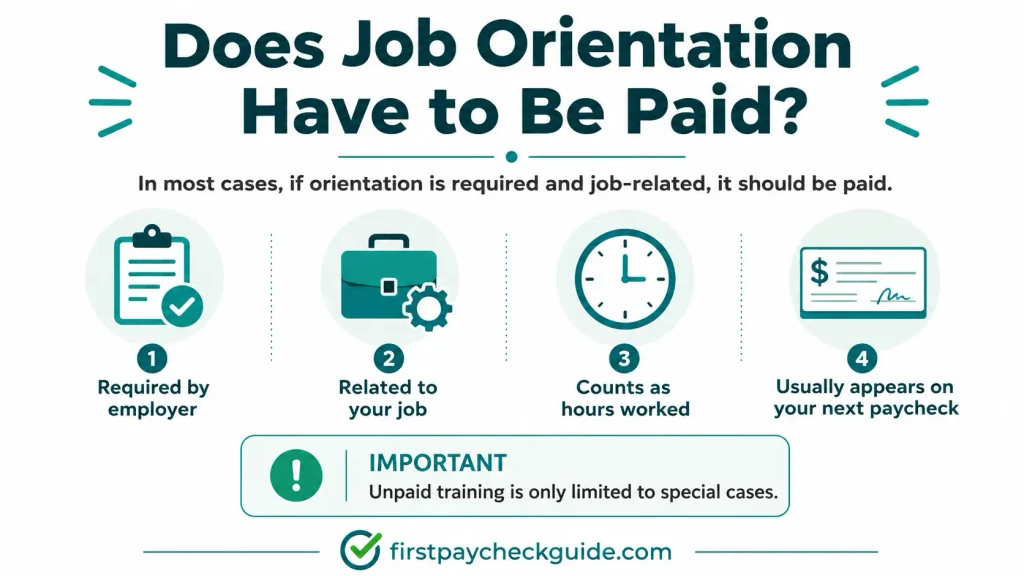
Generally, yes. The U.S. Department of Labor’s current Fact Sheet #22 on hours worked says lectures, meetings, training programs, and similar activities are working time unless a specific four-part exception is met.
That is why ordinary new-hire orientation is usually paid. If your employer requires you to attend onboarding, complete forms, watch required safety or policy training, learn a register or system, or perform other job-related onboarding tasks, the time generally counts as work even though you have not started your normal shift duties yet.
Paid orientation does not mean same-day payment
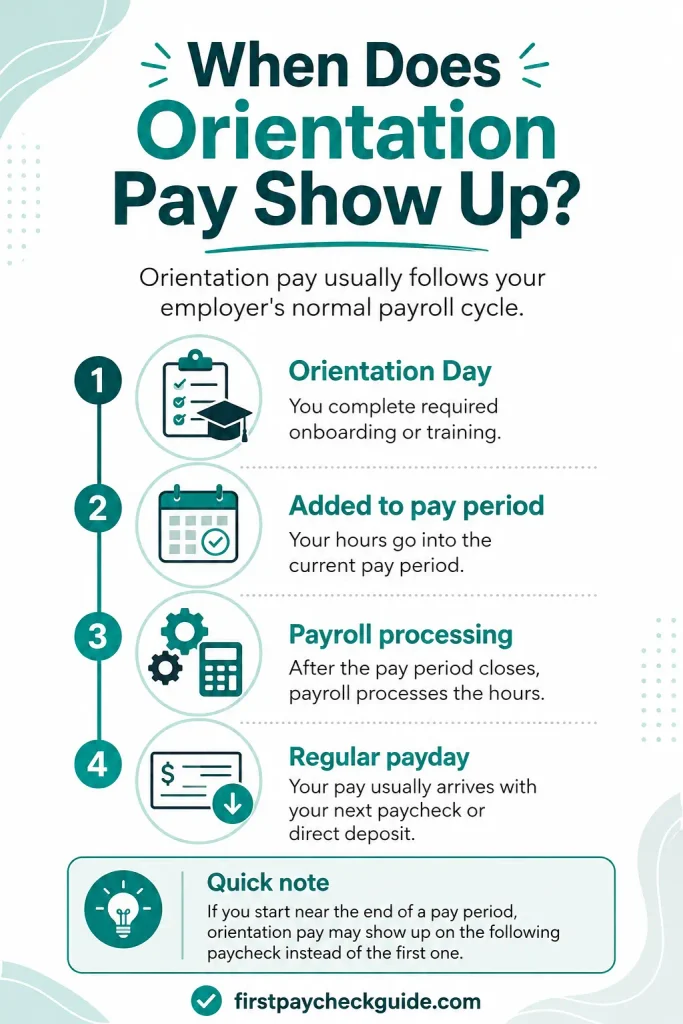
Your employer can owe you for orientation without paying you at the orientation itself. Those hours normally flow through the regular payroll cycle, so the key question is which pay period contains the orientation date and when that pay period is paid.
If the orientation hours were recorded but the paycheck itself has not arrived yet, the guide to why first paychecks can feel delayed explains the payroll timing separately.
What about training that happens after orientation?
The same rule applies to any required training that follows your first day, whether that is shadowing a coworker, completing an online training module, learning a point-of-sale system, or attending a multi-day certification course your employer requires for the role. If your employer mandates it, schedules it, and it relates to your job, it is compensable work time no differently than the hours you spend actually doing the job. This includes training that happens off-site, such as a regional training center or a corporate office, as long as your employer required you to attend.
Orientation and required training hours also generally count toward the 40-hour threshold used to calculate overtime for non-exempt employees. If those paid hours push the workweek over 40, the overtime rules apply just as they do to ordinary work hours.
Meal and rest breaks are a separate hours-worked issue. Our federal lunch break laws guide explains when short breaks are generally paid, when a meal period can be unpaid, and how working through lunch can affect your recorded hours.
When do you get paid for orientation?
Orientation is usually not paid immediately or on the same day. The hours are normally entered into the employer’s timekeeping or payroll system and paid on the regular paycheck that covers the pay period in which the orientation occurred.
That means a brand-new employee can complete paid orientation and still wait one or two weeks, or sometimes longer on a biweekly schedule, before seeing the money. Your start date, payroll cutoff, and the employer’s pay frequency determine when those hours actually reach your first check.
If those orientation wages reach you on a paper first check instead of direct deposit, the how to cash a paycheck guide covers cashing locations, ID requirements, fees, and mobile options.
How to find which paycheck should include orientation
Keep your onboarding email, schedule, sign-in record, or your own note of when you arrived and left.
Check your employer’s payroll calendar, your first payslip, or ask payroll which period contains the orientation date.
Paid orientation hours should normally appear on the paycheck for that pay period, unless a late time entry missed the payroll cutoff.
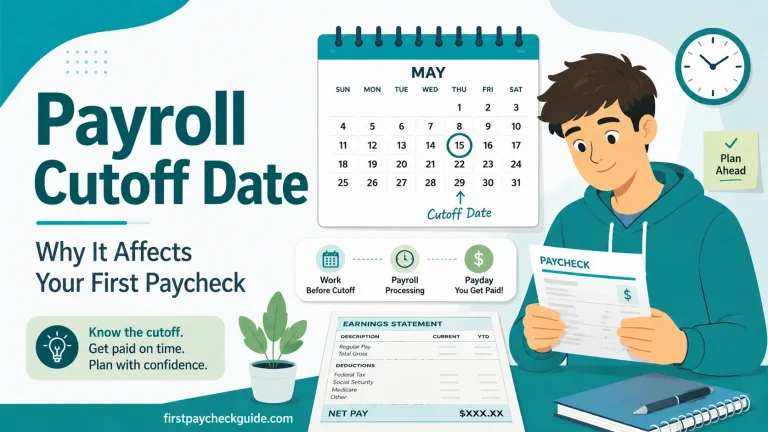
If you know your employer’s weekly or biweekly schedule, the First Paycheck Date Calculator can help estimate when that first payment should arrive. The payroll cutoff guide explains why a late-entered orientation shift can move to the following check.
Do Walmart, Target, Amazon, Home Depot, and other major employers pay for orientation?
The same federal hours-worked rule applies to covered employees at large employers too. If a new-hire orientation is required and job-related, it is generally paid time; what varies by employer is the length of orientation, the rate used where lawful, and which paycheck the hours appear on.
| Employer people commonly ask about | What a new hire should verify | Related first-paycheck guide |
|---|---|---|
| Walmart | Orientation hours, pay-period dates, and the first scheduled payday | Walmart first paycheck |
| Target | Whether orientation is entered on the first timecard and which biweekly period contains it | Target first paycheck |
| Amazon | Paid onboarding/training hours and the weekly paycheck that should contain them | Amazon first paycheck |
| Home Depot | Orientation hours on the payslip and the store’s local payroll cycle | Home Depot first paycheck |
| UPS | Orientation/training hours, weekly pay-period timing, and the first pay stub | UPS first paycheck |
| FedEx | Orientation hours and the payroll schedule used by the specific operating company or role | FedEx first paycheck |
| McDonald’s | Orientation/training hours and the payroll policy used by the specific restaurant or franchise | McDonald’s first paycheck |
| Chick-fil-A | Orientation hours and the local operator’s pay schedule | Chick-fil-A first paycheck |
Do not assume that two locations of the same brand use identical onboarding or payroll procedures. The safest check is your own orientation schedule, time record, payslip, and the payroll calendar used by the location that hired you.
The 4-part test for when training can be unpaid
Federal law does allow a narrow exception. Under the Department of Labor’s Hours Worked Advisor, a lecture, meeting, or training program generally does not have to be counted as working time only when all four of these conditions are met:
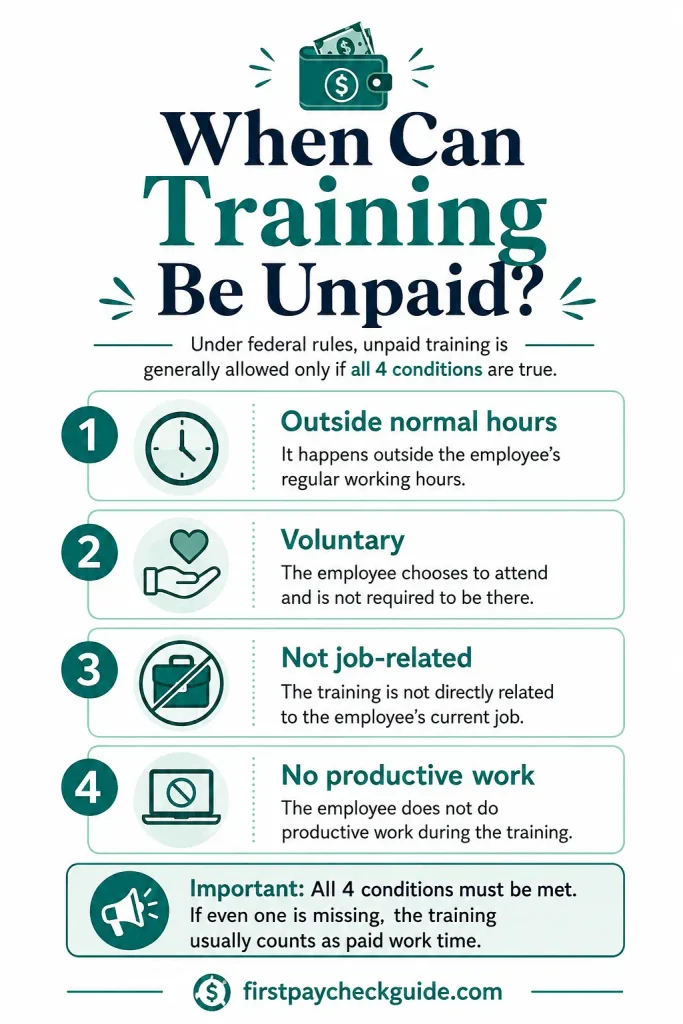
🔍 All four must be true for training to be unpaid
- It happens outside your normal working hours. Not during a shift you were already scheduled for.
- Attendance is genuinely voluntary. Nothing bad happens to your job, schedule, or standing if you skip it.
- It is not related to your current job. The content does not teach skills you need to do the work you were hired for.
- You do not perform any productive work during it. You are only observing or learning, not doing tasks that benefit the employer.
If even one of those four conditions is not met, the time is legally considered hours worked and must be paid. Standard new-hire orientation almost always fails at least two of these conditions on its own: it is mandatory, and it is directly related to the job you were hired for. That is why the exception rarely applies to orientation in practice, even though employers sometimes treat it as unpaid anyway.
Can they pay you a lower “training rate”?
Sometimes, but the rate still has to comply with the wage rules that apply to you. A required orientation cannot simply be treated as unpaid because the employer calls it “training.” If a different training rate is used, compare it with the applicable federal, state, and local minimum-wage rules and with any wage rate your employer promised in writing.
There is also a federal youth-minimum-wage rule that matters for some first-time workers. The U.S. Department of Labor says an employer may pay certain workers under age 20 as little as $4.25 per hour during the first 90 consecutive calendar days of employment, unless state or local law requires a higher rate or otherwise prevents it. That is a specific federal exception, not permission to pay every teenager a lower “orientation rate.”
Under 20? Check your state before assuming $4.25 applies
The federal youth wage is only a floor where it is legally available. A higher state or local minimum wage can still control. The Department of Labor explains the federal rule in Fact Sheet #32.
What if you’re still just an applicant, not an employee?
This is more fact-specific. A true pre-employment information session, interview, or evaluation can be different from orientation that happens after you have accepted a job and are being onboarded as an employee.
If you already accepted the offer and the employer requires you to report for onboarding, complete job-related training, or perform tasks for the business, that looks much more like compensable work time. If you have not actually been hired and are only attending an optional recruiting or evaluation event, the answer can depend on the circumstances. If a business asks you to perform productive work during a supposedly unpaid “tryout” or training session, get specific advice from the U.S. Department of Labor or your state labor agency rather than relying on the label the employer uses.
Does this change by state?
Yes. Federal law is the baseline, and state or local law can provide stronger protections, higher minimum wages, or additional pay requirements.
California is one example. Under the state’s reporting-time-pay rules for covered employees, someone who is required to report for work but is given less than half of the usual or scheduled day’s work can be owed additional reporting-time pay, generally subject to a two-hour minimum and four-hour maximum. Whether that rule applies to a particular orientation depends on the employee, industry, schedule, and applicable wage order, so do not assume every shortened California orientation automatically triggers the same payment.
Other states can also have their own minimum-wage, reporting-time, youth-employment, or wage-payment rules. If there is a real dispute, use your state labor department’s current guidance rather than relying only on the federal rule or on another employee’s experience in a different state.
What to do if you weren’t paid for orientation or training
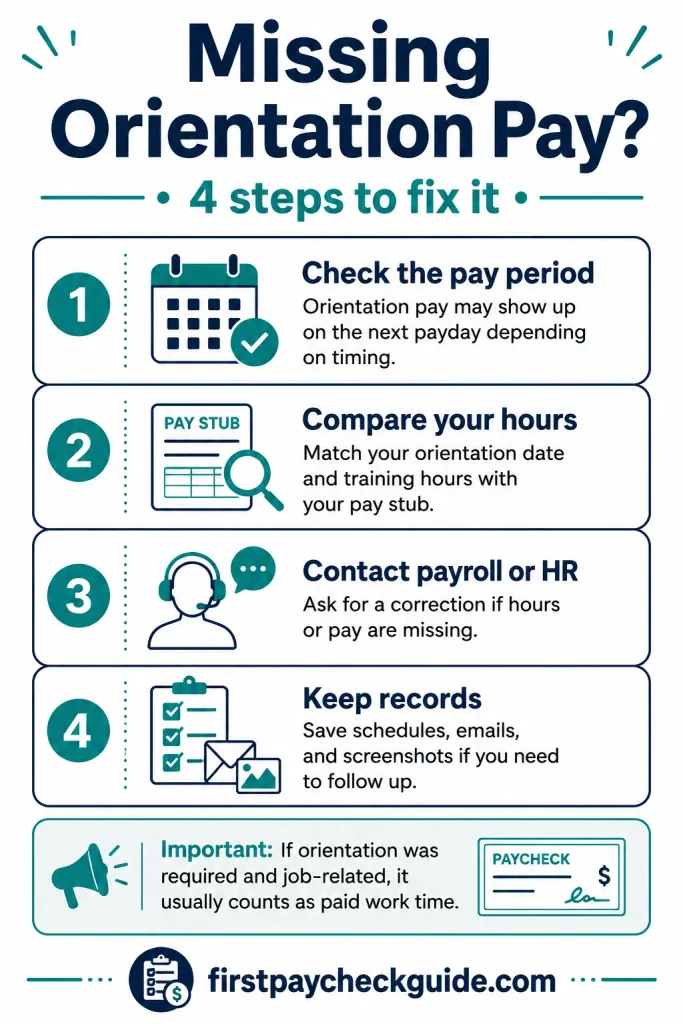
4 steps if orientation or training pay is missing
Make sure the orientation date belongs to the paycheck you are reviewing. A late time entry or payroll cutoff can move the hours to the following check.
Keep the orientation email, schedule, sign-in record, texts, or notes showing the date and how long you were required to attend.
Give the exact date and hours and ask which paycheck should contain them. A missing time entry is often easier to correct when you can identify the specific shift.
You can contact the U.S. Department of Labor’s Wage and Hour Division or your state labor agency. A local employment lawyer can also help when the facts or state rules are complicated.
When you review the check, the pay-stub guide can help you locate regular hours, overtime, gross pay, and any adjustment line that may contain the missing orientation time.
Frequently Asked Questions
Do you get paid for job orientation?
Usually. Under U.S. Department of Labor guidance, required job-related orientation is generally working time and must be paid, even when it happens before you begin your normal shift duties.
Is unpaid training legal?
Only in a narrow situation: training that is fully voluntary, happens outside your normal scheduled hours, is unrelated to your job, and involves no productive work. Standard new-hire orientation almost always fails this test, which means it should be paid.
Can my employer pay me less for orientation than my regular rate?
A different training rate can be lawful only if it complies with the wage rules that apply to you. Federal law also allows a limited youth minimum wage for some workers under 20 during their first 90 calendar days, but higher state or local rules can apply.
Does orientation count toward overtime?
Yes. For non-exempt employees, paid orientation and training hours count toward the 40-hour weekly threshold used to calculate overtime, the same as any other hours worked.
What if I was still just an applicant during the training?
A true pre-employment interview or evaluation can be different from required onboarding after you have accepted a job. Once you have been hired and are required to attend job-related orientation or training, that time is much more likely to be compensable.
Do Walmart, McDonald’s, and other large employers pay for orientation?
Major employers are subject to the same federal wage and hour laws as any other employer, and mandatory orientation is generally paid time. Specific onboarding steps and pay rates can vary by location and role, so confirm the details with your specific store or franchise during hiring.
What should I do if I wasn’t paid for orientation?
Compare your pay stub to your actual orientation hours, then raise the discrepancy with your manager or payroll first, since it may be a clerical error. If it is not corrected, you can file a complaint with the U.S. Department of Labor’s Wage and Hour Division or your state labor agency, or speak with an employment lawyer.
Does reporting time pay apply to orientation?
Possibly. Some states, including California, have reporting-time-pay rules that can require additional pay when covered employees report for scheduled work but receive substantially less work than expected. Whether the rule applies to a particular orientation depends on the state, industry, schedule, and other facts.
When do you get paid for orientation?
Orientation pay usually appears on the regular paycheck for the pay period that contains your orientation hours. It is normally not paid immediately on orientation day, so the exact date depends on the employer’s pay schedule and payroll cutoff.
Do you get paid for orientation at Walmart?
Required job-related orientation is generally paid working time under the same federal rule that applies to other covered employers. Walmart’s exact onboarding length and which paycheck contains those hours can vary, so verify the hours on your own time record and first payslip.
Do you get paid for job orientation?
Is unpaid training legal?
Can my employer pay me less for orientation than my regular rate?
Does orientation count toward overtime?
What if I was still just an applicant during the training?
Do Walmart, McDonald’s, and other large employers pay for orientation?
What should I do if I wasn’t paid for orientation?
Does reporting time pay apply to orientation?
When do you get paid for orientation?
Do you get paid for orientation at Walmart?
📚 What to read next
- Wondering why paid hours can still take time to reach you? Read Why Do Jobs Hold Your First Paycheck?
- Not sure which payday should contain your orientation hours? See When Will I Get My First Paycheck?
- Checking whether the hours actually appeared? Use How to Read a Pay Stub for the First Time
- Think the hours missed payroll processing? Read the Payroll Cutoff Date guide
Source note: The federal training-time guidance in this article comes from the U.S. Department of Labor’s Fact Sheet #22 and Hours Worked Advisor. The under-20 youth minimum-wage discussion comes from DOL Fact Sheet #32. The California reporting-time example is based on the California Department of Industrial Relations wage-order rules. State and local rules can provide greater protections and should be checked separately.
Bottom line
Required, job-related new-hire orientation is generally paid work time. The part that often causes confusion is not whether you earned the money, but when those hours enter payroll and which paycheck contains them. Keep the orientation date and hours, confirm the pay period, and check the first payslip before assuming the employer failed to pay you.
If your orientation was paid correctly but the money has not reached you yet, the next step is to identify the employer’s regular pay frequency and the pay period that contains those hours.
Estimate when those hours should be paid
Once you know whether your employer pays weekly or biweekly, use your start date to estimate the first scheduled paycheck.
When the first check arrives, compare the pay-period dates and total hours with your own orientation record. That is the quickest way to tell whether the pay is simply on a later cycle or genuinely missing.

About the Author
Ashief Mahmood is the Founder and Editor of First Paycheck Guide. He researches and explains first-paycheck topics for U.S. first-time workers using IRS publications, U.S. Department of Labor resources, official employer documentation, payroll sources, and carefully labeled estimates.
Ashief is not a financial advisor, tax professional, payroll provider, lawyer, or employer representative. First Paycheck Guide is an independent educational website.
Wage and hour laws, including rules on paid orientation, training, and reporting time pay, vary by state and can change at any time. The information here is a general educational overview based on publicly available U.S. Department of Labor guidance as of August 2026 and is not legal advice. If you believe you were not paid correctly for orientation or training, consult your state labor agency, the U.S. Department of Labor’s Wage and Hour Division, or an employment lawyer about your specific situation.