What Is a Pay Period? Meaning, Examples & 2026 Paychecks
⚡ What is a pay period — quick answer
A pay period is the fixed window of work time that one paycheck covers. For example, if your pay period is May 1–May 14 and payday is May 21, that paycheck pays you for work from May 1 through May 14. Your payday is when the money arrives — usually a few days after the pay period ends.
- Pay period — the days you worked that this paycheck pays you for. Example: May 1–May 14.
- Payday — the day the money hits your account. Example: May 21. Always separate from the pay period end date.
- The gap — 3–7 days between when the pay period ends and when you get paid. This is normal payroll processing time.
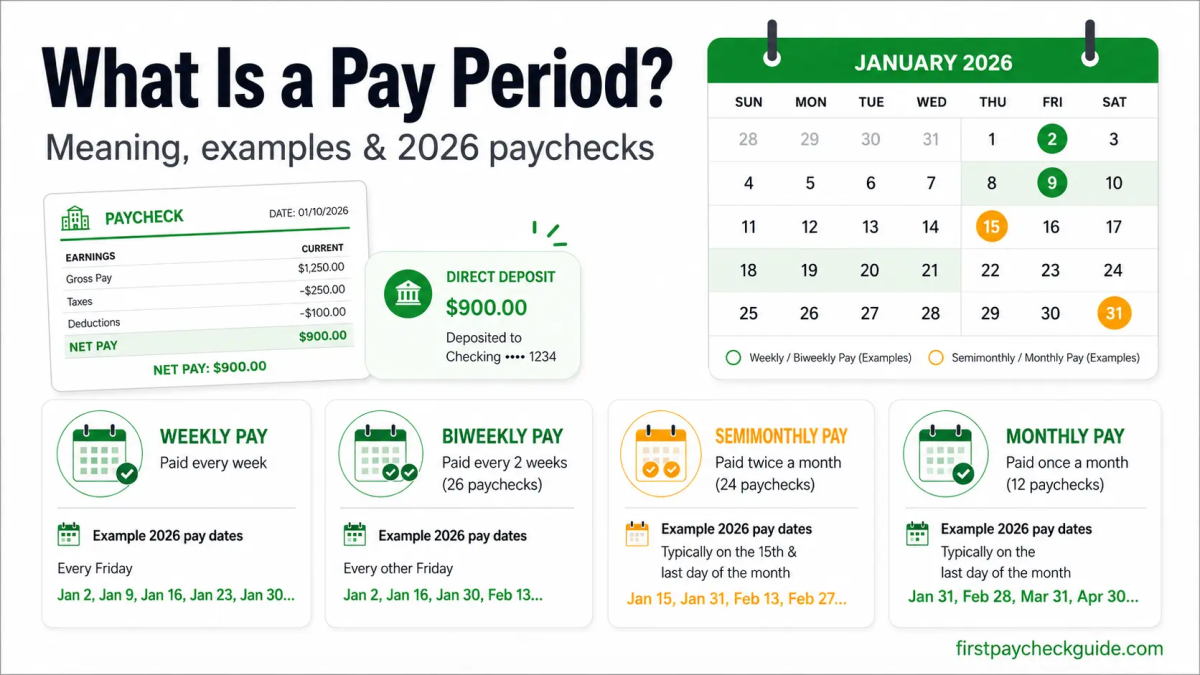
- Types — weekly (52/year), biweekly (26/year), semi-monthly (24/year), monthly (12/year).
- 2026 — some biweekly workers get 27 paychecks this year instead of 26, and two months will have 3 paydays.
If your first paycheck looks smaller than expected, the first thing to check is the pay period.
A pay period is the window of time your paycheck actually covers — the days you worked and earned money for that specific check. Understanding what is a pay period explains why your first check may only cover a few days, why money does not arrive the same day your pay period ends, and why some months your bank account gets an unexpected third deposit.
This guide explains pay period meaning and how many pay periods per year you can expect by schedule type — including the 2026 pay period calendar, which months biweekly workers get three paychecks, and whether this year gives you an extra paycheck.
Table of Contents
What is a pay period — the plain-English meaning
A pay period is a fixed window of time — set by your employer — that determines which days of work a specific paycheck covers. Your employer calculates how much you earned during that pay period and sends you that amount on your payday.
The pay period is the work you did. The paycheck is the payment for that work. Payday is when the payment arrives. These are three separate things — and mixing them up is the most common source of first-paycheck confusion.
The simplest pay period definition: it is the dates printed at the top of your pay stub that show which days you are being paid for.
Pay period vs payday — the difference in one table
| Term | What it means | Real example |
|---|---|---|
| Pay period | The days you worked that this paycheck covers | May 1 – May 14 |
| Pay period end date | The last day of work included in this paycheck | May 14 |
| When payroll finalizes your hours | When HR calculates everyone’s pay and sends to the bank | May 15–16 |
| Payday / pay date | The day the money actually arrives in your account | May 21 |
| Pay stub date | The date printed on your pay stub — usually the same as payday | May 21 |
Closely connected to the pay period is the payroll cutoff date — the deadline for submitting and approving hours within that period before payroll is processed.
Reading your job offer letter — two dates to look for
On a job offer letter or onboarding document, look for two separate dates. The “pay period” dates tell you which days you are being paid for. The “pay date” tells you when the money arrives. For example: pay period ends May 14, pay date is May 21. If your offer letter only lists one date, ask HR: “What is the pay period start and end date, and what is the actual pay date?” These are not the same thing — and knowing both before your first day prevents the most common first-paycheck confusion.
What if payday falls on a weekend or holiday?
If your scheduled payday is Saturday, Sunday, or a federal holiday, many employers pay on the business day before, while others move payment to the next business day. Banks do not process ACH direct deposits on weekends or federal holidays. Ask your employer: “Does payroll move early or late when a payday falls on a holiday?” The answer affects when you can count on the money.
What does “per pay period” mean?
“Per pay period” means the amount that applies to each individual paycheck — not per month, not per year. If your health insurance costs $75 per pay period and you are paid biweekly, you pay $75 every two weeks. That is $1,950 per year. If you are paid semi-monthly, that same $75 per pay period totals $1,800 per year. Always multiply by your number of pay periods per year to understand the annual cost.
Why did my paycheck arrive early?
Some banks — especially online-only banks like Chime, Cash App, SoFi, and Current — release direct deposits 1–2 days before your official payday. If your payday is Friday but the money shows up Wednesday night, that is normal. Your employer sent the payroll file ahead of time, and your bank made the funds available immediately instead of waiting. Your pay period dates did not change. Your coworker with a traditional bank may not see the money until Friday — same pay period, different bank timing.
Why your first paycheck may not cover every day you worked
This is the most important section for anyone starting their first job. The single most common reason a first paycheck looks smaller than expected is that you started working in the middle of a pay period — so your first check only covers the days from your start date to the end of that pay period.
⚠️ This is not a mistake — this is how pay periods work
If your pay period runs from the 1st to the 14th and you started on the 8th, your first paycheck only pays you for the 8th through the 14th. Your employer is not holding money from you. You simply did not work the first half of that pay period.
If your first paycheck looks wrong, compare three dates before panicking: your start date, the pay period end date, and the pay date. If all three make sense, the check is correct.
Scenario 1 — You started at the beginning of a pay period
Pay period: June 1–14. Start date: June 1. Your first paycheck covers all 14 days and arrives June 21. This is the clean scenario — your first check is a full check.
Scenario 2 — You started in the middle of a pay period
Pay period: June 1–14. Start date: June 8. You only worked June 8–14 — 5 working days out of 10. Payday: June 21. Your first check covers only those 5 days and will be roughly half a regular paycheck. Your next full check arrives July 5 covering June 15–28.
Scenario 3 — You started after payroll cutoff
Pay period: June 1–14. Start date: June 13. Payday: June 21. If payroll finalized before your June 13–14 hours were entered, those hours may appear on your next paycheck instead. This feels like a delay, but it is usually payroll cutoff timing — not your employer refusing to pay you. Ask payroll: “Were my hours from my first days included in this check?”
Copy and send this to HR on your first day
“Hi, I want to make sure I understand my first paycheck. Could you confirm: (1) the start and end dates of the current pay period, (2) the next payday, (3) whether my first check will be full or partial, and (4) how many days after the pay period ends I get paid? Thank you!”
✅ What to check if your first paycheck looks wrong
- Compare three dates before panicking: your start date, the pay period end date, and the pay date
- If all three make sense given the scenarios above — the check is correct
- If the dates do not add up — contact payroll before they process your next check
- “What are the start and end dates of the current pay period?”
- “Will my first paycheck be a full check or a partial check?”
- “How many days after the pay period ends do I get paid?”
Think your employer is holding your check? Read: Why Do Jobs Hold Your First Paycheck? →
How to find your pay period on your pay stub
Every pay stub shows your pay period — you just need to know where to look. It usually appears near the top of the stub labeled as one of these:
✅ What to look for on your pay stub
- Pay Period Start or Period Begin — the first day of work covered by this paycheck
- Pay Period End or Period End Date — the last day of work covered by this paycheck
- Pay Date or Check Date — the day the money actually arrives
- Pay Period Hours — the hours included in this paycheck. Full-time biweekly workers see 80.00 (40 hrs × 2 weeks). Part-time workers see their actual hours worked. Semi-monthly workers may see approximately 86.67 as the average used for salary math, though actual workdays differ month to month. If the number looks wrong, check your time records against what payroll shows before your next check.
- YTD (Year to Date) — the running total of everything paid to you since January 1 at this employer
What does “80 hours” on a biweekly pay stub mean?
If you are full-time and paid biweekly, your stub will show 80 pay period hours — that is 40 hours per week × 2 weeks. If you are part-time and worked 30 hours over two weeks, your stub shows 30. The number reflects your actual hours worked during that pay period, not a fixed standard. If your hours look wrong, check with payroll before they process your next check. If meal or rest breaks are part of the mismatch, see our federal lunch break laws guide to understand when break time should count toward paid hours.
Quick check: does your pay stub look right?
Look at the pay period start and end dates. Count the number of days. If you are biweekly, it should be 14 days. If you are semi-monthly, the period length may vary depending on the month and your employer’s schedule. If the dates do not match what HR told you — ask payroll before the next check runs. Errors are much easier to fix before payroll closes than after.
The four types of pay periods
Every employer uses one of four pay schedules. Here is what each one means for you as an employee:
| Pay schedule | How often you get paid | Paychecks per year | What it feels like | Most common for |
|---|---|---|---|---|
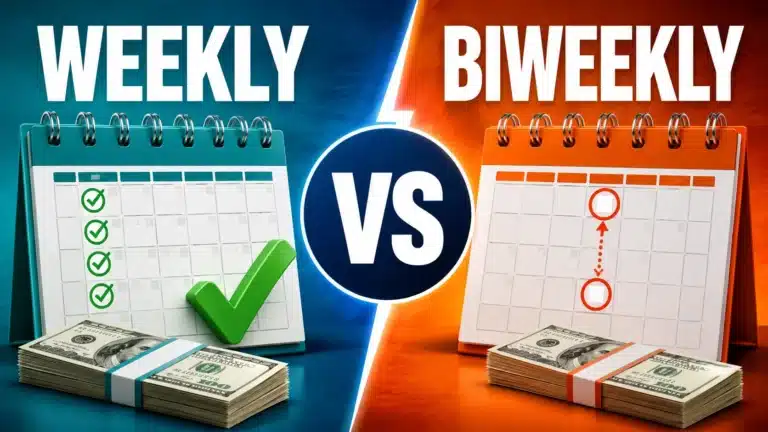
| Weekly | Every week — 7 days | 52 (sometimes 53) | Smaller checks but money comes in every week — easiest to budget for daily expenses | Construction, hospitality, hourly retail |
| Biweekly | Every two weeks — 14 days | 26 (sometimes 27) | Most common in the US — two months per year have 3 paydays | Most private employers |
| Semi-monthly | Twice per month — usually 1st and 15th, or 15th and last day | Always 24 | Same two dates every month — predictable for rent and monthly bills | Salaried corporate, finance, law |
| Monthly | Once per month | Always 12 | Biggest individual check — hardest to budget because gaps are long | Some professional salaried roles |
Is two weeks a pay period?
Yes — a biweekly pay period is exactly two weeks (14 days). It is the most common pay schedule in the United States. Most private sector employers use biweekly pay. If you are paid biweekly, you receive 26 paychecks per year in most years — and in 2026, some workers may receive 27. Not every major employer follows that pattern, though — the weekly or biweekly pay comparison of nine major employers shows which large employers, like Publix and UPS, still stick to weekly pay instead.
For a real employer example, Costco uses a reported biweekly Friday cycle. The Costco first paycheck guide shows how that pay period translates into first-check timing, ESS pay-stub access, and expected 2026 paydays.
Home Depot is another useful biweekly example. The Home Depot first paycheck guide shows how a reported two-week pay period, commonly reported Friday payday, and your start date can determine whether the first check is full or partial.
How many pay periods in a year?
The number of pay periods per year — also called how many pay periods per year — depends entirely on your pay schedule. Here is the breakdown:
| Pay schedule | Pay periods per year | Hours per pay period (full-time) | Gross pay per period on $40,000/year salary |
|---|---|---|---|
| Weekly | 52 (sometimes 53) | 40 hours | $769.23 |
| Biweekly | 26 (sometimes 27 — see 2026 section) | 80 hours | $1,538.46 |
| Semi-monthly | Always 24 | ~86.67 hours (annual average — actual days vary by month) | $1,666.67 |
| Monthly | Always 12 | ~173.33 hours | $3,333.33 |
💡 Same salary, different paycheck sizes
A $40,000 annual salary looks very different depending on your pay schedule. You are not earning more or less — the same yearly pay is just split differently. Biweekly workers receive $1,538.46 per check. Semi-monthly workers receive $1,666.67. The semi-monthly check is larger, but you receive fewer of them.
How many pay periods in a year if paid biweekly?
Usually 26. Because 52 weeks ÷ 2 = 26. However, because a year is 365 days — not exactly 364 — the calendar shifts slightly each year. In some years like 2026, some biweekly workers may receive 27 paychecks. This is explained in detail in the 2026 section below.
How many pay periods in a year if paid semi-monthly?
Always exactly 24. Semi-monthly means twice per calendar month — 2 × 12 months = 24. The pay dates are locked down to the exact same calendar dates every month. Unlike biweekly, semi-monthly never varies because it is tied to calendar months, not a rolling 14-day cycle. Semi-monthly workers never get a third paycheck in a month.
Biweekly vs semi-monthly pay — the confusing part
Biweekly and semi-monthly both sound like “twice a month” — but they are not the same and they result in different paycheck counts and different check sizes.
⚠️ Is biweekly and semi-monthly the same thing? No.
Biweekly = every 14 days = 26 paychecks per year. Semi-monthly = twice per calendar month = 24 paychecks per year. They produce different paycheck sizes even on the same annual salary. Here is why this matters for your monthly budget calculations: if you switch from biweekly to semi-monthly at the same salary, your individual checks get bigger but you get fewer of them.
| Feature | Biweekly | Semi-monthly |
|---|---|---|
| Meaning | Every 14 days | Twice per calendar month |
| Paychecks per year | 26 (sometimes 27) | Always 24 |
| Pay dates | Same day of the week every two weeks — shifts around the calendar | Fixed dates each month — usually 15th and last day |
| Three-paycheck months? | Yes — 2 months per year have 3 paydays | No — always exactly 2 per month |
| Gross check size ($36,000/year) | $1,384.62 | $1,500.00 |
| Gross check size ($40,000/year) | $1,538.46 | $1,666.67 |
| Annual total | $40,000 | $40,000 |
| Better for… | Workers who like getting paid on the same weekday — easier to track. Two months per year have a third payday timing effect. | Workers with rent/bills on fixed monthly dates — the 15th and last day are predictable every month. |
The real difference in plain English
At $36,000/year, biweekly pay gives you $1,384.62 per check — 26 times a year. Semi-monthly gives you $1,500.00 per check — 24 times a year. Same job, same annual pay, different check size and different frequency. If your rent and bills are monthly, semi-monthly may feel easier to budget because the dates are predictable. If you like getting paid on the same weekday, biweekly may feel more consistent.
2026 pay period calendar — will you get 26 or 27 paychecks?
This is the 2026 question that comes up most — and the answer depends on your exact payday schedule.
Is 2026 a 27-paycheck year?
For some biweekly workers — yes. Here is why:
A standard biweekly schedule produces 26 paychecks per year. But 52 weeks × 14 days = 364 days — one day short of a full year. This means the calendar shifts slightly each year. In 2026, workers whose biweekly payday falls on Friday, January 2, 2026 run through 26 regular paydays ending December 18, 2026. Their next scheduled payday would normally be Friday, January 1, 2027 — but January 1 is a federal holiday. Many employers pay that check early on Thursday, December 31, 2026, creating a 27th payday inside the 2026 calendar year.
Is this guaranteed? No — check with your employer
Not every employer pays early when a payday falls on a holiday. Some move the pay date to the next business day (Monday, January 4, 2027 in this case), which means no 27th check in 2026. Whether you see 27 checks depends entirely on your employer’s payroll policy. Ask HR or payroll: “Does our payroll move early when a payday falls on a holiday or weekend?”
Which months in 2026 have 3 biweekly paychecks?
For biweekly workers, two months every year have three paydays instead of the usual two. Which months depends on your company’s pay schedule:
| If your first 2026 biweekly paycheck is… | Your three-paycheck months in 2026 | Possible 27th paycheck? |
|---|---|---|
| Friday, January 2, 2026 | January and July | Maybe — if employer pays the Jan 1, 2027 check early on Dec 31, 2026 |
| Friday, January 9, 2026 | May and October | No — schedule ends cleanly at 26 checks |
Paid on Thursdays or another weekday?
The table above covers the two most common Friday biweekly schedules. Thursday paydays produce different three-paycheck months:
The easiest way to find your three-paycheck months: look at your first 2026 payday and count every 14 days through the year, or ask payroll for your official 2026 payroll calendar.
For reference: a Thursday January 8 start typically produces April and October as three-paycheck months. The Friday schedules in the table above are the two most common examples.
📅 Free Download — 2026 Biweekly Pay Period Calendar
Both Friday schedules in one printable PDF — every payday listed, three-paycheck months highlighted in amber, the possible 27th check explained. Download it, save it to your phone, or print it and keep it with your first pay stub.
⬇ Download: 2026 Pay Period Calendar PDF💡 The three-paycheck month is not a bonus
It is easy to feel like you are getting extra money in a three-paycheck month. You are not — it is the same annual salary delivered across more frequent deposits. What it is, though, is an opportunity. Most monthly bills (rent, subscriptions, utilities) come out twice a month or monthly. In a three-paycheck month, the third paycheck is not already spoken for by regular bills. Many financial planners suggest treating it as automatic savings, debt payoff, or emergency fund contribution, so it helps to know the exact three-paycheck months for 2026 ahead of time.
Do semi-monthly workers get three-paycheck months?
No. Semi-monthly means exactly twice per calendar month — always 24 paychecks per year, always two per month. The pay dates may occasionally shift one day earlier or later when a scheduled payday falls on a weekend or holiday, but the schedule still has 24 pay periods per year. Semi-monthly workers never experience three-paycheck months.
2026 tax note
New 2026 federal tax rules for certain tips and overtime may affect how some amounts are reported on your W-2, but they do not change what a pay period is, how many pay periods your employer uses, or when your employer pays you.
How pay periods affect your paycheck size and gross pay
Your pay period directly determines how much gross pay appears on each paycheck. Here is how the math works for common salary and hourly levels:
🧮 Salaried workers — gross pay per check
| Annual salary | Weekly gross | Biweekly gross | Semi-monthly gross | Monthly gross |
|---|---|---|---|---|
| $30,000 | $576.92 | $1,153.85 | $1,250.00 | $2,500.00 |
| $36,000 | $692.31 | $1,384.62 | $1,500.00 | $3,000.00 |
| $40,000 | $769.23 | $1,538.46 | $1,666.67 | $3,333.33 |
| $50,000 | $961.54 | $1,923.08 | $2,083.33 | $4,166.67 |
| $60,000 | $1,153.85 | $2,307.69 | $2,500.00 | $5,000.00 |
🧮 Hourly workers — biweekly gross pay by rate and hours
Hourly workers are paid for the actual hours worked in the pay period — not a fixed amount.
| Hourly rate | 20 hrs/week (40 hrs biweekly) |
30 hrs/week (60 hrs biweekly) |
40 hrs/week (80 hrs biweekly) |
|---|---|---|---|
| $10.00/hr | $400.00 | $600.00 | $800.00 |
| $12.00/hr | $480.00 | $720.00 | $960.00 |
| $15.00/hr | $600.00 | $900.00 | $1,200.00 |
| $17.00/hr | $680.00 | $1,020.00 | $1,360.00 |
| $18.00/hr | $720.00 | $1,080.00 | $1,440.00 |
These are gross pay numbers — the total you earned before taxes and deductions take their cut. Your actual take-home pay (the cash that hits your account) will be smaller after Social Security (6.2%), Medicare (1.45%), federal income tax, and state income tax.
Does your pay schedule change how much FICA you pay?
No. Social Security and Medicare tax rates are identical regardless of your pay schedule. A biweekly worker and a semi-monthly worker with the same annual salary owe the same total FICA taxes over the year — the same total tax is taken out across more or fewer checks. Your pay schedule changes the size of each check, not your annual FICA tax total — assuming the same annual wages.
What happens if you get a raise or change jobs mid-year?
Getting a raise mid-pay-period
If your raise takes effect on June 8 and your pay period runs June 1–14, your paycheck will include hours at your old rate (June 1–7) and hours at your new rate (June 8–14). The check will show a blended total — not fully at the new rate. Your first fully new-rate check comes in the next pay period.
Changing jobs mid-year
Your old employer’s final paycheck covers their last pay period. Your new employer starts a completely new payroll record. Your new pay stub’s YTD total will only show wages from the new job — not your total earnings for the year. At tax time, you will receive two separate W-2 forms — one from each employer.
Budget for the gap between jobs
If you start a new job mid-pay-period, your first check will likely be partial (as explained in Block 3 above). If you change jobs right at a pay period boundary, you may go 2–4 weeks between receiving money from the old job and receiving your first check from the new job. Plan for this gap — it is the most common financial surprise for first-time job changers.
Should you budget by pay period or by month?
For most first-time workers paid biweekly, budgeting by pay period is more practical than budgeting by month. Here is why:
Budget by pay period (recommended for biweekly)
Each paycheck covers 14 days. Assign every paycheck specific bills and expenses. Paycheck 1 covers rent and utilities. Paycheck 2 covers groceries, gas, and savings. The paycheck timing is consistent — same day of the week, every two weeks.
Budget by month (better for semi-monthly)
Semi-monthly workers receive checks on fixed dates (like the 15th and the 30th). Monthly bills align more naturally to these fixed dates. Track monthly income as two fixed checks totaling your monthly salary.
What to do with a three-paycheck month
In months with three biweekly paychecks, your regular monthly bills are already covered by the first two checks. The third check is not already spoken for. Common strategies: put it toward an emergency fund, pay down debt, or save for a specific goal. Treat it as automatic savings before it disappears into everyday spending.
New to budgeting on a pay period schedule?
Start simple. Write down your net pay per check. List every bill due in the next 14 days. Subtract bills from net pay. What remains is your money for food, gas, and anything else. Repeat every pay period. Once you see two or three full pay cycles, the pattern becomes predictable.
Ready to make a plan for your first full paycheck? Read: What to Do With Your First Paycheck →
💬 Share this with a friend starting their first job
Quick summary: A pay period is the days you worked that a check covers. Your payday comes 3–7 days later. In 2026, biweekly workers get 26 checks — some get 27. Two months will have 3 paydays. Ask HR for your exact schedule and whether your first check will be full or partial.
Frequently Asked Questions About Pay Periods
What is a pay period?
A pay period is the fixed window of work time that one paycheck covers — the days you worked and earned money for that specific check. For example, if your pay period runs May 1–May 14 and payday is May 21, the May 21 paycheck pays you for work done from May 1 through May 14. The pay period is different from your payday — the period is when you worked, the payday is when the money arrives.
What is biweekly pay?
Biweekly pay means you receive a paycheck every 14 days — typically every other Friday. You receive 26 paychecks per year on a biweekly schedule, and two months per year will have three paydays instead of the usual two. Biweekly is the most common pay schedule for private employers in the United States.
What does pay period mean on a job application?
On a job application, pay period refers to how often you would be paid — weekly, biweekly, semi-monthly, or monthly. If an application asks about your pay period at a previous job, it wants to know how often you were paid there. If it asks for your desired pay period, it is asking about your preferred payment frequency.
Is two weeks a pay period?
Yes — a biweekly pay period is exactly two weeks, or 14 days. It is the most common pay schedule in the US. Biweekly workers receive 26 paychecks per year in most years. A two-week pay period is different from a semi-monthly schedule — semi-monthly means twice per calendar month, not every 14 days.
What are the 4 types of pay periods?
Weekly (52 paychecks per year), biweekly (26 per year, sometimes 27), semi-monthly (always 24 per year), and monthly (always 12 per year). Weekly and biweekly are most common for hourly workers. Semi-monthly and monthly are more common for salaried professional roles. The pay schedule is set by your employer.
How many pay periods are in a year?
It depends on your pay schedule. Weekly: 52 (sometimes 53). Biweekly: 26 (sometimes 27). Semi-monthly: always 24. Monthly: always 12. The most common schedule in the US is biweekly, so most workers receive 26 paychecks per year.
How many biweekly pay periods are in 2026?
Most biweekly workers receive 26 paychecks in 2026. However, workers whose first 2026 biweekly payday was Friday, January 2 may receive a 27th paycheck if their employer pays the January 1, 2027 holiday check early on December 31, 2026. This depends on your employer’s payroll policy — check with HR to confirm your exact 2026 pay schedule.
Are there 26 or 27 pay periods in 2026?
For most biweekly workers, 26. But workers paid on Friday, January 2, 2026 may see a 27th paycheck if their employer pays the January 1, 2027 holiday check early on December 31, 2026. This is not automatic — it depends on your employer’s payroll calendar. Ask HR: “Does our payroll move early when a payday falls on a holiday?”
Is January 2026 a 3-paycheck month?
Yes — for biweekly workers whose first 2026 paycheck was Friday, January 2. That schedule produces three Friday paydays in January: January 2, January 16, and January 30. If your first 2026 biweekly paycheck was January 9, your three-paycheck months are May and October instead.
What months do I get 3 paychecks in 2026?
If your biweekly payday falls on Fridays starting January 2, 2026 — your three-paycheck months are January and July. If your payday starts January 9, 2026 — your three-paycheck months are May and October. If you are paid on Thursdays, your three-paycheck months are different — ask your payroll department for your 2026 payroll calendar. Semi-monthly schedules always produce exactly two paychecks per month — no three-paycheck months.
Is biweekly and semi-monthly the same?
No. Biweekly means every 14 days — 26 paychecks per year, with two months having 3 paydays. Semi-monthly means twice per calendar month — always 24 paychecks per year, always the same two dates each month. On the same annual salary, semi-monthly checks are larger because the same annual amount is divided by 24 instead of 26.
What is the difference between a pay period and payday?
The pay period is the window of time you worked that the paycheck covers. Payday is the specific date the money arrives in your account. They are always separate — typically 3–7 days apart. Example: pay period May 1–14, payday May 21. You worked May 1–14 but the money does not arrive until payroll finishes calculating and processing on May 21.
Does per pay period mean every paycheck?
Yes — “per pay period” means the amount that applies to each individual paycheck. If your health insurance premium is $75 per pay period and you are paid biweekly, $75 comes out of every check — 26 times per year for a total of $1,950 annually. If you are paid semi-monthly, $75 comes out 24 times per year for $1,800 annually.
How many days are in a biweekly pay period?
Always 14 calendar days — exactly two weeks. This typically covers 10 working days (Monday through Friday, both weeks) assuming no holidays. Your pay stub will show the start and end dates of the 14-day period your check covers. If either of those two weeks contains a holiday, you still get paid for your regular schedule — you just may get the check slightly earlier if the payday itself falls on the holiday.
What if payday falls on a weekend or holiday?
Most employers pay on the business day before the weekend or holiday — so if payday is Saturday, you typically get paid Friday. If payday falls on a federal holiday like Christmas or New Year’s Day, most employers process payroll on Thursday instead. Some employers move payment to the next business day instead, which means a one-day delay. Check your employee handbook or ask HR how your employer handles this.
Why did my direct deposit arrive early?
Some banks — especially online-only banks like Chime, Cash App, SoFi, and Current — release payroll deposits 1–2 days before the official payday when they receive the payroll file early. Your employer’s official pay date has not changed. Your coworker with a different bank may receive the same paycheck on a different day. This does not affect your pay period dates or your paycheck amount.
What happens if I get a raise in the middle of a pay period?
Your paycheck may include two different rates — hours worked before the raise date at your old rate, and hours after the raise date at your new rate. The check will show a blended total rather than fully reflecting your new rate. Your first completely new-rate check will come in the following pay period. If the math does not look right, ask payroll for a breakdown.
Know Your Pay Period — Now Find Out When You Get Paid
Understanding your pay period is step one. Step two is knowing exactly when your first paycheck will arrive — which depends on your start date, your pay schedule, and your employer’s payroll processing time. Use the free calculator to find your exact expected first pay date.
Read: When Will I Get My First Paycheck? (+ Free Date Calculator) →

About the Author
Ashief Mahmood is the Founder and Editor of First Paycheck Guide. He researches and explains first-paycheck topics for U.S. first-time workers using IRS publications, U.S. Department of Labor resources, official employer documentation, payroll sources, and carefully labeled estimates.
Ashief is not a financial advisor, tax professional, payroll provider, lawyer, or employer representative. First Paycheck Guide is an independent educational website.
The information in this article is for educational purposes only and does not constitute financial or legal advice. Pay period schedules, payroll processing times, and employer practices vary by employer and state. The 2026 three-paycheck month dates (January/July for January 2 start; May/October for January 9 start) are confirmed by Bankrate and Money.com. The 27th paycheck scenario for some 2026 workers is sourced from Fisher Phillips (January 16, 2026) and Littler Mendelson — whether your employer pays the January 1, 2027 check early on December 31, 2026 depends entirely on their individual payroll policy. Always verify your pay schedule directly with your HR or payroll department.