Three Paycheck Months 2026: Exact Dates by Payday
3 paycheck months 2026: quick answer
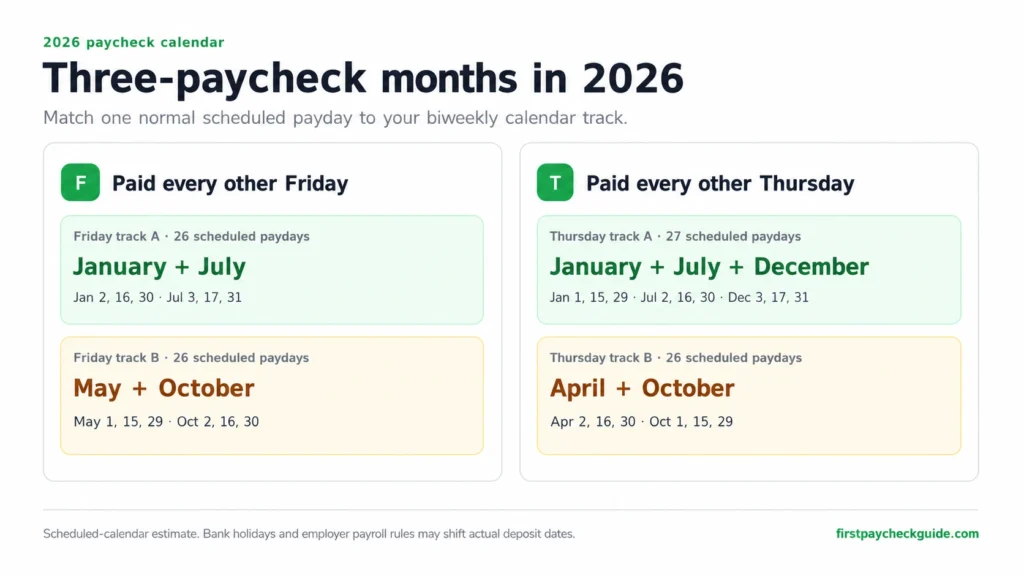
Wondering what months have 3 paychecks in 2026? If you are paid every other Friday, your three-paycheck months are usually January and July, or May and October, depending on your payroll cycle. If you are paid every other Thursday, one 2026 calendar track has three scheduled paydays in January, July, and December, while the other has them in April and October.
- Biweekly Friday, Track A: January and July.
- Biweekly Friday, Track B: May and October.
- Biweekly Thursday, Track A: January, July, and December on the 27-payday calendar track.
- Biweekly Thursday, Track B: April and October.
- Weekly Friday: January, May, July, and October have five scheduled paydays.
- Weekly Thursday: January, April, July, October, and December have five scheduled paydays.
- Semi-monthly or monthly: There are no recurring three-paycheck months because the number of scheduled payments is fixed.
Not sure which track applies to you? Enter any normal payday in the calculator below to find your exact 2026 pay schedule. Bank holidays or employer payroll rules can move an actual deposit earlier, so confirm the final date in your payroll portal.
Use the calculator to find your own 2026 months from any normal recurring payday. It works for weekly and biweekly schedules on any weekday, not only Thursday or Friday.
Why some months have three paychecks instead of two
Biweekly does not mean twice a month. It means once every 14 days, usually on the same weekday.
Most calendar years contain 26 biweekly paydays, but those paydays do not divide evenly into 12 months. As a result, two months commonly contain three scheduled paydays while the other months contain two. Some calendar alignments can produce a 27th scheduled payday, creating a third three-paycheck month.
Weekly schedules work similarly. A weekly employee generally receives 52 scheduled paydays, but some months contain five occurrences of the employee’s payday instead of four. Semi-monthly pay is different: it normally means 24 payments on two fixed calendar dates each month, so it does not create recurring three-paycheck months.
Biweekly is the most common pay-period length among U.S. private establishments in the Bureau of Labor Statistics’ February 2023 snapshot. The BLS estimated that 43.0% used biweekly pay periods, compared with 27.0% weekly, 19.8% semi-monthly, and 10.3% monthly. These figures describe establishments rather than individual employees and should be treated as a point-in-time snapshot. You can review the full BLS pay-period analysis or use our pay-period guide to identify the schedule on your pay stub.
Your employer’s payroll calendar controls the answer
Your regular payroll group – not simply your hire date – determines your recurring payday cycle. A first-ever paycheck can be partial, delayed, or processed off-cycle, so use a normal recent scheduled payday when using the calculator. State law can also affect how frequently employees must be paid; the U.S. Department of Labor lists state payday requirements.
Find your three- or five-paycheck months in 2026
Select your pay frequency and enter one normal recurring scheduled payday. The calculator will count backward and forward using the same 7- or 14-day cycle and show every scheduled payday in your extra-paycheck months.
Find my 2026 paycheck months
Use a normal scheduled payday, not a deposit moved because of a holiday, bonus, payroll correction, or new-hire delay.
Why the calculator says “scheduled”: A recurring payday can fall on a bank holiday or a day when your employer closes payroll early. The actual deposit may then arrive on a nearby business day. That shift can occasionally move a deposit into the previous month, so your employer’s published payroll calendar remains the final authority.
Three paycheck months in 2026 for biweekly Friday paydays
A recurring every-other-Friday calendar falls into one of two alternating tracks. Match any normal scheduled payday – not necessarily your first paycheck – to one of the date sequences below.
| Calendar track | January dates | Three-paycheck months | Scheduled dates in those months |
|---|---|---|---|
| Friday Track A | Jan 2, 16, 30 | January and July | Jan 2, 16, 30; Jul 3, 17, 31 |
| Friday Track B | Jan 9, 23 | May and October | May 1, 15, 29; Oct 2, 16, 30 |
Each Friday track contains 26 scheduled 2026 paydays before employer-specific holiday adjustments. For example, Friday, July 3, 2026 is the observed Independence Day holiday for federal purposes, so some employers may move that deposit earlier. A scheduled January 1, 2027 payday could also be processed on December 31, 2026 by some payroll systems. Confirm the actual deposit dates with your employer.
Three paycheck months in 2026 for biweekly Thursday paydays
Thursday paydays deserve their own table because 2026 begins and ends on a Thursday. That creates one Thursday calendar track with 27 scheduled paydays.
| Calendar track | January dates | Scheduled paydays | Three-paycheck months |
|---|---|---|---|
| Thursday Track A | Jan 1, 15, 29 | 27 | January: 1, 15, 29 July: 2, 16, 30 December: 3, 17, 31 |
| Thursday Track B | Jan 8, 22 | 26 | April: 2, 16, 30 October: 1, 15, 29 |
January 1 is a bank holiday, so a nominal January 1 payday may be deposited in December 2025 instead. The table and calculator show unadjusted scheduled dates; your payroll portal determines which calendar year contains the actual deposit.
How major employers commonly schedule pay
An employer’s name alone cannot guarantee your schedule. Pay frequency and payday can vary by payroll group, role, location, employing entity, franchise or Operator, union agreement, and holiday processing. Use this table as a starting point, then enter one of your own normal scheduled paydays in the calculator.
| Employer | Commonly reported pattern | What to verify |
|---|---|---|
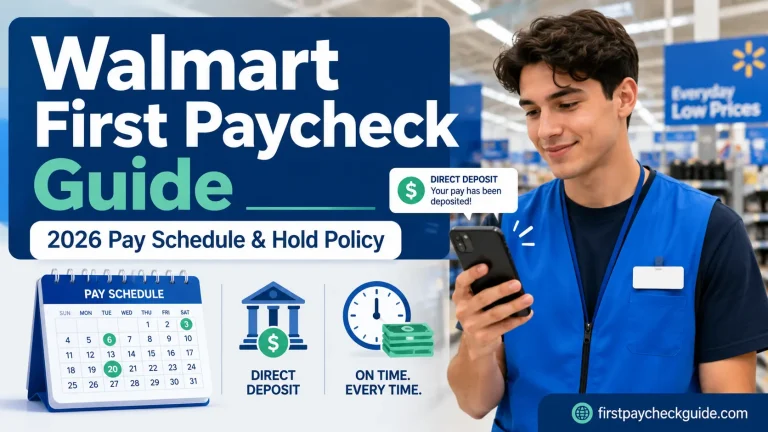
| Walmart | Biweekly, commonly Thursday for U.S. store associates | Check OneWalmart or your pay stub for your recurring date |
| Target | Biweekly, commonly Friday | Confirm your store and payroll group’s calendar |
| Costco | Biweekly, commonly Friday | Check ESS; the reported 2026 cycle aligns with Friday Track B |
| Home Depot | Biweekly at many U.S. locations; Friday commonly reported | Confirm one normal payday from your own payslip or Self Service before using the calculator |
| Publix | Weekly, commonly Thursday | Confirm the deposit date in your employee portal |
| UPS | Weekly for many hourly employees; payday may vary | Check your hub, role, and local agreement |
| Amazon | Weekly for many hourly associates; other schedules exist | Confirm your role, site, and employing entity |
| Starbucks | Weekly pay beginning in August 2026 for U.S. partners | Company-operated store status and actual recurring payday |
| McDonald’s | Weekly or biweekly; franchise-set | Ask your specific franchise Owner/Operator |
| Chick-fil-A | Weekly or biweekly; Operator-set | Ask your restaurant’s Operator or payroll contact |
| FedEx | Varies by role, employing company, and contractor status | Confirm your employer of record and payroll portal |
For a broader comparison, see our guide to which employers pay weekly or biweekly. Starbucks has also announced weekly pay for U.S. partners beginning in August 2026, with the changes rolling out through U.S. company-operated coffeehouses. You can read the Starbucks announcement.
Five-paycheck months in 2026 for weekly pay
Weekly employees do not have three-paycheck months because they normally receive four or five scheduled paydays every month. Their equivalent of an extra-paycheck month is a month containing five recurring paydays.
| Weekly payday | Five-paycheck months in 2026 |
|---|---|
| Sunday | March, May, August, November |
| Monday | March, June, August, November |
| Tuesday | March, June, September, December |
| Wednesday | April, July, September, December |
| Thursday | January, April, July, October, December |
| Friday | January, May, July, October |
| Saturday | January, May, August, October |
Thursday-paid weekly workers have five such months because 2026 contains 53 Thursdays. Workers paid on each other weekday have 52 scheduled paydays and four five-paycheck months. Again, an actual holiday-adjusted deposit can differ from the unadjusted calendar date.
Why semi-monthly and monthly schedules are different
Semi-monthly pay means two scheduled payments each month, often on dates such as the 15th and the last business day. That produces 24 scheduled payments a year. Monthly pay normally produces 12 scheduled payments. Because these schedules are tied to calendar dates rather than a rolling 7- or 14-day interval, they do not create recurring three- or five-paycheck months.
To distinguish biweekly from semi-monthly, compare several normal pay stubs. If the paydays remain exactly 14 days apart and land on the same weekday, the schedule is biweekly. If the dates are fixed or move around the calendar to preserve two payments each month, it is likely semi-monthly.
Is a three paycheck months actually extra money?
It is an additional paycheck within that calendar month, but it is not a bonus or an automatic increase in annual pay. For most salaried employees paid biweekly, each regular paycheck stays about the same; three of those normal paychecks simply land in one month. Hourly earnings, overtime, bonuses, taxes, and benefit deductions can still make individual deposits different.
The third check can nevertheless feel extra if your monthly budget is built around two biweekly paychecks and those two checks already cover the month’s regular bills. That creates an opportunity to assign the third deposit to a larger financial goal.
What to do with your three paycheck months
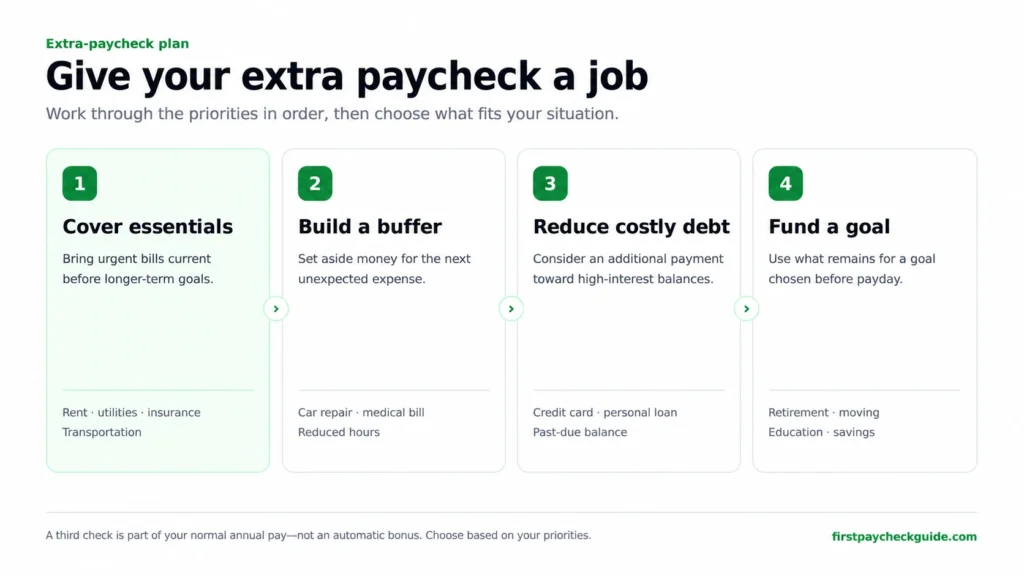
Decide what the third check will do before it arrives. A simple priority order can keep the money from disappearing into routine spending.
Four practical options
- Cover urgent essentials first. Catch up on rent, utilities, transportation, insurance, or another necessary expense that has fallen behind.
- Build an emergency buffer. Even one paycheck in a separate savings account can reduce the need to borrow when an unexpected bill appears.
- Pay down expensive debt. An additional payment toward high-interest debt can reduce future interest, provided there is no prepayment penalty.
- Fund a planned goal. Use part of the check for retirement, moving costs, education, a car repair fund, or another goal you have chosen in advance. Review your employer’s plan rules before changing a 401(k) contribution or trying to reach the annual limit early.
If you are building your first budget, our 50/30/20 rule guide for a first paycheck offers a simple starting framework. The Consumer Financial Protection Bureau also provides free consumer budgeting tools and resources.
Will the same months repeat in 2027?
Do not assume that your 2026 extra-paycheck months will repeat in 2027. The relationship between a rolling weekly or biweekly cycle and the calendar changes from year to year, and employer holiday processing can create additional differences. When your employer publishes its 2027 payroll calendar, calculate the year again using a normal recurring scheduled payday.
Frequently asked questions
What are the 3 paycheck months 2026?
For biweekly Friday paydays, they are usually January and July, or May and October, depending on your calendar track. For biweekly Thursday paydays, one scheduled track has three paydays in January, July, and December, while the other has them in April and October. Other weekdays produce different combinations, so enter one normal scheduled payday in the calculator for your result.
Can someone receive 27 biweekly paychecks in 2026?
Yes. A biweekly schedule containing scheduled paydays on Thursday, January 1 and Thursday, December 31 can fit 27 scheduled paydays into 2026. Holiday processing may move either deposit into a neighboring calendar year, so confirm the actual dates in your employer’s payroll calendar.
Is the third paycheck a bonus?
No. It is another normal paycheck landing within the same calendar month, not an automatic increase in annual pay. It can still provide additional room in that month’s budget if your regular expenses are already covered by two checks.
How many five-paycheck months are there in 2026?
A weekly Thursday schedule has five five-paycheck months in 2026 because the year contains 53 Thursdays. Weekly schedules on each other weekday have four five-paycheck months. Use the weekly table or calculator to see the exact months.
Do semi-monthly employees get three-paycheck months?
Not as part of the regular schedule. Semi-monthly pay normally provides two scheduled payments per month and 24 per year. Bonuses, corrections, reimbursements, or holiday adjustments are separate from the recurring schedule.
Why does my employer’s calendar differ from this one?
Employers can move deposits around bank holidays, process some workers through different payroll groups, or issue off-cycle and new-hire payments. The calculator provides an unadjusted recurring calendar estimate; your employer’s payroll portal is the final source for actual deposit dates.
Can I use my first-ever paycheck in the calculator?
Only if it landed on your normal recurring payday. A first paycheck may be partial, delayed, or processed separately from the regular cycle. A normal recent payday or the official payroll calendar is more reliable.
Does my employer’s name tell me my exact track?
Not reliably. Large employers may use different payroll groups, while franchises and independently operated locations can set their own schedules. Check your pay stub or employee portal and enter one of your recurring scheduled paydays in the calculator.
The bottom line
Your three-paycheck months depend on your recurring payday cycle, not simply your employer’s name. Use one normal scheduled payday to calculate the calendar, verify holiday adjustments in your payroll portal, and decide what the additional check within that month will do before it arrives.
- Calculate: Use a normal weekly or biweekly scheduled payday.
- Confirm: Check your employer’s holiday-adjusted calendar.
- Plan: Assign the extra check within the month to a specific priority.
What to read next
Sources and methodology: Pay-period frequency figures come from the U.S. Bureau of Labor Statistics’ February 2023 CES snapshot. State-frequency information is available through the U.S. Department of Labor. Budgeting resources are from the Consumer Financial Protection Bureau. The 2026 calendar results were calculated by advancing recurring scheduled paydays in 7- or 14-day intervals. Employer-specific patterns should be confirmed using each employer’s payroll documentation. Reviewed August 2026.
Know when your extra paycheck lands?
Give the money a job before payday arrives.

About the author
Ashief Mahmood is the founder and editor of First Paycheck Guide. He researches and explains first-paycheck topics for U.S. workers using government publications, employer documentation, payroll resources, and clearly labeled calendar estimates.
Ashief is not a financial advisor, tax professional, payroll provider, lawyer, or employer representative. First Paycheck Guide is an independent educational website.
Disclaimer: Calendar results in this article show recurring scheduled dates before employer-specific adjustments. Actual deposits can move because of bank holidays, payroll processing, off-cycle checks, early direct deposit, new-hire timing, or an employer’s specific calendar. Franchise and independently operated locations may follow locally determined schedules. Always confirm your pay dates with your payroll portal, manager, HR contact, or employer. This article is for general educational purposes and is not legal, payroll, tax, or individualized financial advice.