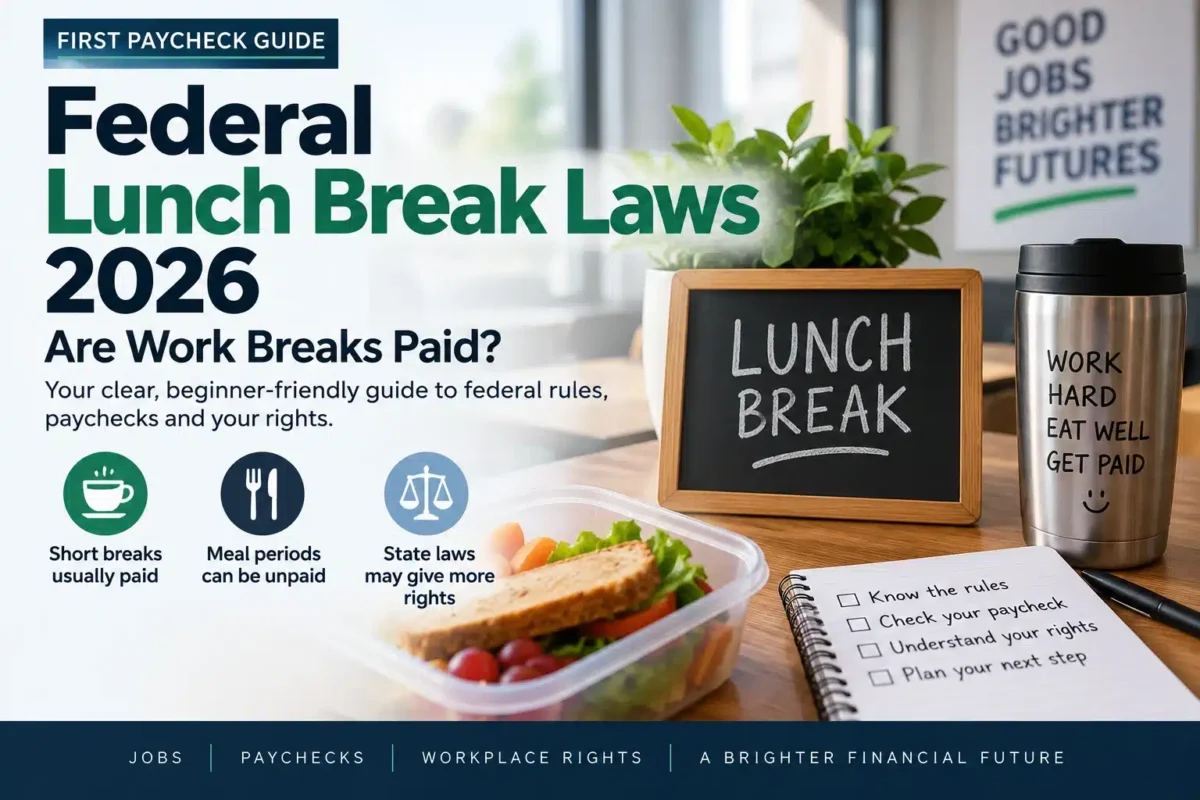
Federal Lunch Break Laws 2026: Are Lunch and Rest Breaks Paid?
Federal lunch break laws: quick answer
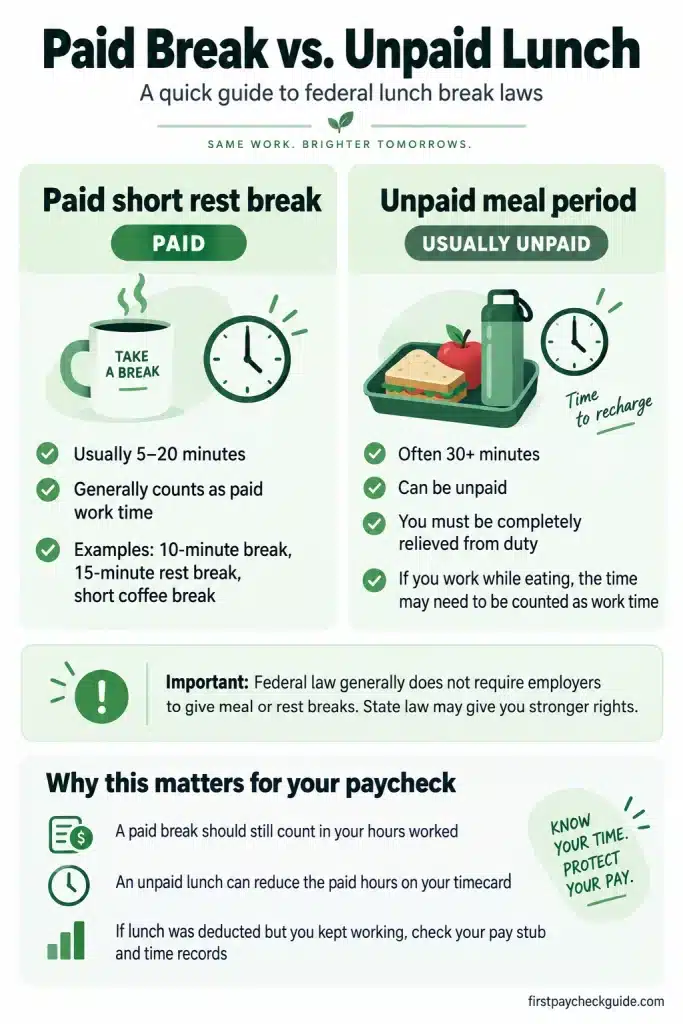
- Federal law generally does not require employers to provide a lunch break or rest break. State law, a union agreement, or company policy may require more.
- Short rest breaks of about 5 to 20 minutes generally count as paid work time when an employer allows them.
- A genuine meal period can usually be unpaid when you are completely relieved from duty and can use the time for your own meal.
- Thirty minutes is common, but it is not an absolute federal cutoff in every case. The U.S. Department of Labor says shorter meal periods can qualify in special circumstances.
- If your employer automatically deducts lunch but you actually work through it, that time may still be compensable. Keep records and report missed or interrupted lunches through your employer’s timekeeping process.
If you are starting your first job, break rules can make your first paycheck confusing. You may be at work for eight hours but see only 7.5 paid hours. Or you may be told that your 15-minute breaks are unpaid. The important question is not just whether you were “on break.” It is whether federal or state law treats that time as hours worked.
This guide explains the federal lunch break laws that apply to many U.S. workers, how paid rest breaks differ from unpaid meal periods, what happens when a lunch break is interrupted, how automatic meal deductions affect your paycheck, and when state law gives you stronger rights.
Rates and legal guidance checked September 11, 2026.
Quick Skim: Jump to What You Need
Do federal lunch break laws require your employer to give you a break?
Usually, no. The Fair Labor Standards Act does not generally require an employer to provide a meal period or ordinary rest break. That surprises many first-time workers because lunch breaks are so common that they feel like a universal legal right.
The federal rule is mainly about how break time must be counted and paid when a break is provided. State law can go further and require specific meal or rest periods. A collective bargaining agreement or employer policy can also give you break rights beyond the federal minimum.
The U.S. Department of Labor confirms this in its FLSA questions and answers and its breaks and meal periods guidance.
One important federal exception
Most nursing employees have a separate federal right to reasonable break time and a private space to pump breast milk at work for up to one year after a child’s birth. Those rights come from the FLSA as amended by the PUMP Act and are separate from ordinary lunch and rest-break rules.
Are 10-minute, 15-minute and 20-minute breaks paid?
For covered nonexempt workers, short rest breaks are generally paid. Many hourly first-job roles are nonexempt, although job title and hourly pay alone do not determine exempt status. Department of Labor guidance says breaks of short duration, usually about 5 to 20 minutes, must be counted as hours worked when the employer permits them.
That means a normal 10-minute coffee break or 15-minute rest break should not usually reduce your paid hours. If you work an eight-hour paid day and take two employer-authorized 15-minute rest breaks, those 30 minutes are still part of your paid work time.
| Break type | Typical federal treatment | Counts toward hours worked? |
|---|---|---|
| 10-minute rest break | Paid | Yes |
| 15-minute rest break | Paid | Yes |
| 20-minute rest break | Generally paid | Yes |
| Bona fide meal period | Can be unpaid | Usually no, if you are completely relieved from duty |
There is one caution: an employer can set a reasonable length for an authorized break. The Department of Labor says unauthorized extensions of an allowed break do not always have to be counted as work time when the employer clearly communicated the break limit, explained that extending it violates the rules, and treats the extension as a disciplinary issue.
If your pay stub appears to deduct ordinary short rest breaks, compare your recorded hours with our pay stub guide before contacting payroll.
Is a 30-minute lunch break paid or unpaid?
A bona fide meal period can generally be unpaid under federal law. The Department of Labor says these meal periods are typically 30 minutes or more and do not have to be counted as work time when the employee is completely relieved from duty for the purpose of eating a regular meal.
The key phrase is completely relieved from duty. If you are expected to answer phones, watch the register, respond to customers, monitor a work radio, prepare orders, supervise other workers, or perform other job duties while you eat, the time may not qualify as an unpaid meal period.
An unpaid lunch should actually be your time
Calling something a “lunch break” on the schedule does not automatically make it unpaid. What matters is what actually happened during that period and whether you were completely relieved from duty.
Is 30 minutes a strict federal lunch-break cutoff?
No. Thirty minutes is the normal benchmark, but current Department of Labor guidance makes clear that it is not a rigid rule in every situation.
On September 7, 2026, the Wage and Hour Division issued Opinion Letter FLSA2026-11. The question was whether a 60-minute unpaid lunch break remained a bona fide meal period when employees had to spend 6 to 14 minutes walking to and from a designated break area. The Department said yes: even after accounting for that travel, roughly 46 minutes remained for the meal period, which was still well above the 30 minutes ordinarily regarded as sufficient. This was a fact-specific opinion; it does not mean that all required walking time during a meal period is automatically unpaid.
Separately, the Department’s Field Operations Handbook says meal periods under 30 minutes require a case-by-case review. Relevant factors include whether interruptions are minimal, whether the worker has enough time to eat a regular meal, whether there is an agreement that the shorter period is sufficient, and whether state or local law requires a longer break.
Do not use “under 30 minutes = always paid” as a universal rule
Short rest breaks of 5 to 20 minutes are generally paid, but a shorter meal period can sometimes qualify as an unpaid bona fide meal period under special circumstances. The facts matter.
Why does an 8-hour shift sometimes show only 7.5 paid hours?
This is one of the most common first-paycheck surprises. The answer usually depends on whether your scheduled shift includes an unpaid meal period.
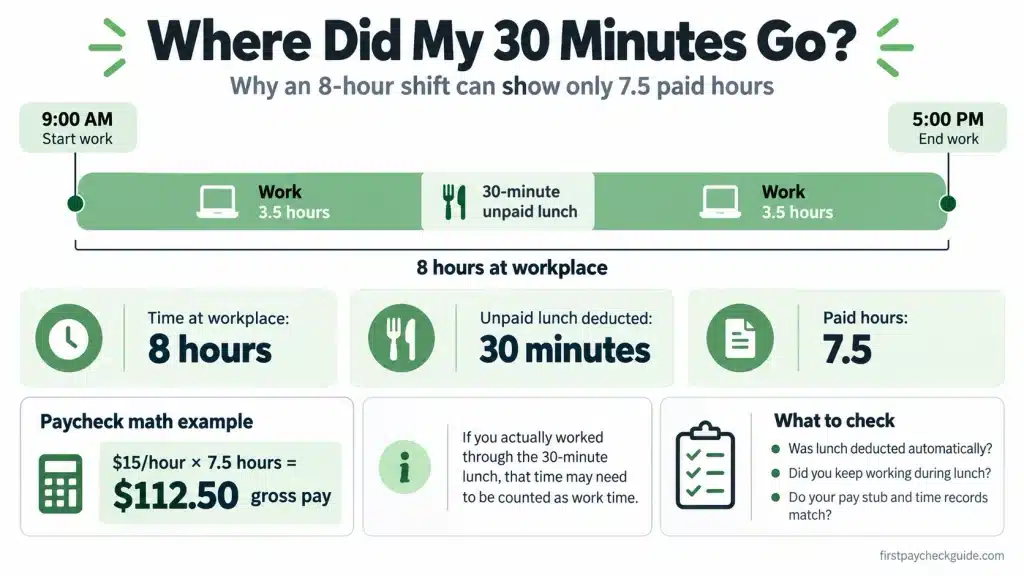
| Shift example | Time at workplace | Paid hours |
|---|---|---|
| 9:00 a.m. to 5:00 p.m. with 30-minute unpaid lunch | 8 hours | 7.5 hours |
| 8:00 a.m. to 4:30 p.m. with 30-minute unpaid lunch | 8.5 hours | 8 hours |
| 8 paid hours plus two 15-minute paid rest breaks | Depends on schedule | Rest breaks stay included |
Suppose you earn $15 per hour and are scheduled from 9:00 a.m. to 5:00 p.m. with a genuine 30-minute unpaid meal period. Your normal paid time is 7.5 hours, so your gross earnings for that shift are $112.50.
But if you actually worked through the entire 30-minute lunch, your work time could be 8 hours instead. At $15 per hour, that difference is $7.50 for the day. Over five similar shifts, the difference becomes $37.50 before considering whether overtime is triggered.
If your first check looks smaller than expected for several possible reasons, see why a first paycheck can be lower than expected.
Can your employer automatically deduct 30 minutes for lunch?
An automatic meal deduction is not automatically illegal. Many timekeeping systems subtract a standard meal period from each qualifying shift. The problem arises when the system deducts time that you actually spent working.
In Fact Sheet #53, the Department of Labor gives an example of an employer automatically deducting 30 minutes for meals. The Department says the practice can comply with the FLSA, but the employer remains responsible for ensuring employees actually receive the uninterrupted meal period.
Check these three things if lunch is automatically deducted
- Did you actually take the meal period? If not, document the work you performed.
- Was the lunch interrupted by work? Note who contacted you and what task you handled.
- Is there a correction process? Use the employer’s timecard, missed-meal, or payroll adjustment process as soon as possible.
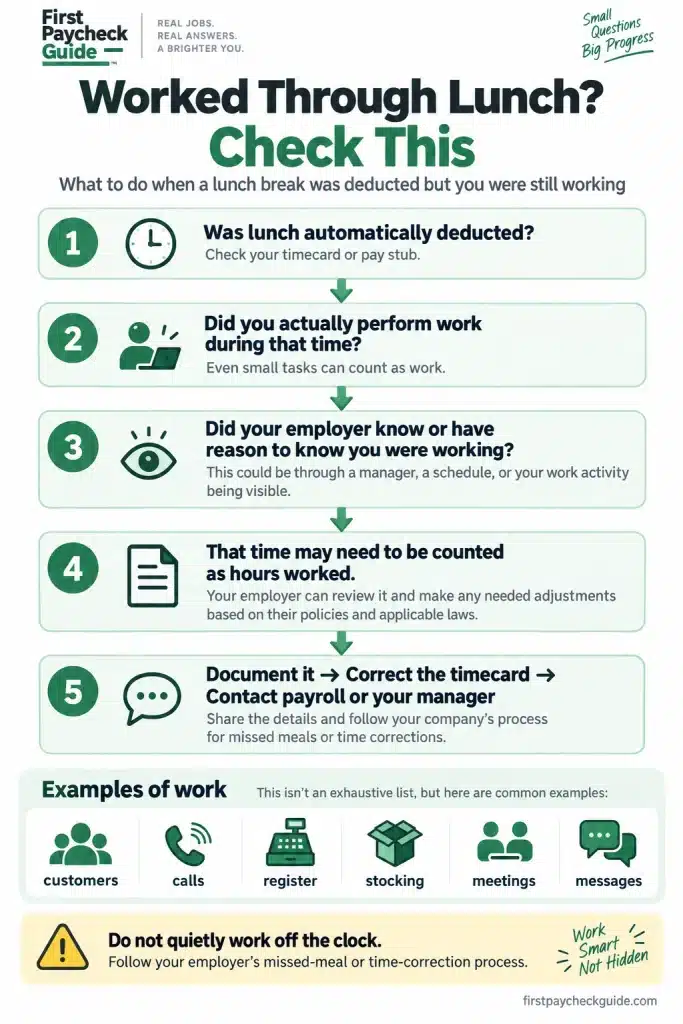
A payroll system cannot turn actual working time into unpaid time simply by labeling it “meal deduction.” Employers covered by the FLSA have recordkeeping and wage obligations based on hours actually worked.
What if you work through your unpaid lunch?
If your employer knows or has reason to know that you are working during an unpaid meal period, that work time generally needs to be counted. This can include obvious work such as serving customers, answering calls, stocking, entering data, cleaning, or attending a meeting.
Do not assume that working through lunch is automatically allowed, though. Your employer can usually require you to follow its meal-break policy, and state law may require that a meal period be provided. The safer approach is to follow the policy and report any missed lunch rather than quietly working off the clock.
Working “off the clock” is the bigger issue
If a manager tells you to clock out for lunch but continue working, save the schedule, time record, messages, and your own notes. The fact that you were clocked out does not erase work you were required or permitted to perform.
What if your manager interrupts your lunch break?
An occasional brief interruption does not automatically answer the legal question by itself. The issue is whether the meal period, viewed in context, still qualifies as a bona fide meal period.
Frequent, lengthy, or meaningful work interruptions are much more concerning. Department of Labor guidance says an employee must be completely relieved from duty for a meal period to be excluded from hours worked. The September 2026 opinion letter specifically addresses brief required walking time within a longer meal period, rather than creating a new general rule for interrupted lunches.
If your “unpaid lunch” regularly means eating beside the register while helping customers, remaining at a desk to answer calls, or repeatedly stopping your meal to perform tasks, keep a record of what is happening.
Can you skip lunch and leave 30 minutes early?
Federal law does not give workers a general right to skip a scheduled meal period and leave early. Employers can set work schedules and meal policies, and some states require meal periods under circumstances where waivers are limited or unavailable.
So if your schedule says 8:00 a.m. to 4:30 p.m. with a 30-minute lunch, do not assume you can work straight through and leave at 4:00 p.m. Ask your manager first. If a state law requires the break, the employer may need to make sure it is actually provided.
How many breaks do you get in an 8-hour shift?
There is no single federal answer. The FLSA generally does not require ordinary meal or rest breaks, so the number of required breaks in an eight-hour shift depends mainly on state law and employer policy.
A common workplace schedule might include two paid 10- or 15-minute rest breaks plus one unpaid 30-minute meal period, but that is not a universal federal rule. In one state, that pattern may be legally required. In another, it may simply be the employer’s policy. Your pay period determines how those daily hours are grouped for your paycheck.
State lunch and rest break laws can be more protective
Federal law is only the starting point. States can require meal periods, paid rest breaks, or both. This is why two workers doing the same job for the same national company may have different break rights in different states.
| Example | What the current state guidance says | Why it matters |
|---|---|---|
| California | Most covered workers receive paid 10-minute rest periods based on hours worked and a 30-minute meal period when working more than five hours, subject to detailed rules and exceptions. | California goes well beyond the federal baseline. |
| Illinois | Covered employees generally receive at least a 20-minute meal period for a 7.5-hour shift, beginning no later than five hours after the shift starts, plus additional requirements for longer shifts. | A meal period can be legally required even though federal law does not require one. |
| Texas | Texas generally does not require ordinary meal or rest breaks for adult workers, so federal pay rules and employer policy are especially important. | No state break mandate does not mean short employer-provided breaks can be unpaid. |
These are examples, not a 50-state legal chart. Break rules include industry exceptions, collective bargaining provisions, youth rules, and local requirements. Before relying on a summary, check your state labor agency’s current guidance.
For current examples, see the California Labor Commissioner’s rest-period guidance, the Illinois Department of Labor’s ODRISA guidance, and the Texas Workforce Commission’s break guidance.
Are break laws different for workers under 18?
They can be. Federal child-labor rules regulate issues such as minimum age, hours for younger workers, and hazardous occupations, but the Department of Labor specifically says the federal youth-employment provisions do not generally require breaks or meal periods.
State law is often where additional youth break protections appear. A state may require a meal break for a 14- or 15-year-old even when it does not require the same break for an adult employee. When federal and state youth standards differ, the more protective applicable rule generally controls.
If this is your first teen job, also see our teen first-paycheck tax guide for the paycheck side of starting work.
Are bathroom breaks different from ordinary rest breaks?
Yes. Do not assume that “federal law does not require breaks” means an employer can block reasonable restroom access. OSHA’s sanitation rules require employers to make toilet facilities available and allow prompt access when workers need to use them. Employers can use reasonable procedures, but restrictions cannot cause unreasonable or extended delays.
OSHA explains this in its restrooms and sanitation guidance.
Can unpaid break time affect overtime?
Yes. For a covered nonexempt employee, overtime under the FLSA is generally based on hours worked over 40 in a workweek. Paid short breaks count as hours worked. A genuine unpaid meal period generally does not.
If an employer improperly excludes time that should have counted as work, correcting those hours can sometimes push the weekly total over 40. In that situation, the issue is not just missing straight-time wages; overtime may also need to be recalculated.
Simple example
You have 40 recorded work hours for the week, but you also performed 30 minutes of work during an unpaid lunch on three days. If those 1.5 hours should count as work, your total could become 41.5 hours. That can change the overtime calculation for a covered nonexempt worker.
What should you do if break deductions make your paycheck look wrong?
Start with the records. Do not rely only on memory after several pay periods have passed.
- Compare your schedule, clock-in and clock-out records, and pay stub for the same workweek.
- List every automatic lunch deduction and note whether you actually received an uninterrupted meal period.
- Document work performed during unpaid time, including messages, customer tasks, calls, meetings, or manager instructions.
- Use your employer’s payroll or missed-meal correction process and keep a copy of what you submitted.
- If the issue is not fixed, check your state labor agency and the U.S. Department of Labor Wage and Hour Division for the rules and complaint options that apply to your situation.
If your missing time came from orientation, training, or onboarding rather than a meal break, our paid orientation and training guide covers that separate issue.
Frequently Asked Questions
Are lunch breaks required by federal law?
Generally, no. The Fair Labor Standards Act does not usually require employers to provide ordinary meal or rest breaks. State law, a collective bargaining agreement, or employer policy may require them.
Are 15-minute breaks paid?
Generally yes for covered nonexempt employees when the employer permits the break. Department of Labor guidance treats short rest breaks of about 5 to 20 minutes as compensable hours worked.
Is a 30-minute lunch break paid?
A bona fide meal period can generally be unpaid when the worker is completely relieved from duty for the purpose of eating a regular meal. If the employee performs work during the period, that time may need to be counted as hours worked.
Can my employer automatically deduct lunch?
An automatic meal deduction is not automatically illegal, but the employer remains responsible for paying for time actually worked. If you work through or lose the meal period, follow the employer’s correction process and keep records.
Can I work through lunch and leave early?
Federal law does not give employees a general right to skip a scheduled meal period and leave early. Employer policy and state meal-break rules can control whether that is allowed.
How many breaks are required in an 8-hour shift?
There is no single federal number because the FLSA generally does not require ordinary meal or rest breaks. The number of required breaks depends mainly on state law and employer policy.
What if my manager makes me work during unpaid lunch?
Work performed during an unpaid meal period may need to be counted as compensable time. Document the work, report the missed meal through payroll or timekeeping procedures, and keep copies of your records.
Are breaks different for workers under 18?
They can be. Federal youth-employment rules do not generally require meal or rest breaks, but many states impose additional break requirements for minors. Check your state youth labor rules.
Does walking time to a break room count against my lunch break?
In one fact-specific September 2026 opinion letter, the U.S. Department of Labor said a 60-minute lunch period remained bona fide even when employees spent 6 to 14 minutes walking to and from a designated break area, because substantial meal time still remained. That does not mean all required walking time during a meal period is automatically unpaid.
What to read next
Break rules tell you which minutes should count as paid work. Your payroll schedule determines when those earned wages actually reach your account.
Trying to understand your first paycheck?
Estimate when it should arrive based on your start date and pay schedule.
This guide is educational and was reviewed against current federal and state agency guidance before publication.

About the Author
Ashief Mahmood is the Founder and Editor of First Paycheck Guide. He researches and explains first-paycheck topics for U.S. first-time workers using IRS publications, U.S. Department of Labor resources, official employer documentation, payroll sources, and carefully labeled estimates.
Ashief is not a financial advisor, tax professional, payroll provider, lawyer, or employer representative. First Paycheck Guide is an independent educational website.
Sources: This guide was checked against the U.S. Department of Labor’s Fact Sheet #22, FLSA FAQ, Field Operations Handbook Chapter 31, Opinion Letter FLSA2026-11, Fact Sheet #53, Fact Sheet #43, and Fact Sheet #73; OSHA’s restroom-access guidance; and current guidance from the California Labor Commissioner, Illinois Department of Labor, and Texas Workforce Commission.
Meal and rest break requirements vary by state, industry, age, union agreement, and job classification and can change. This article is a general educational overview based on guidance reviewed September 11, 2026 and is not legal advice. Confirm the current rule for your workplace with the U.S. Department of Labor and your state labor agency before relying on it.