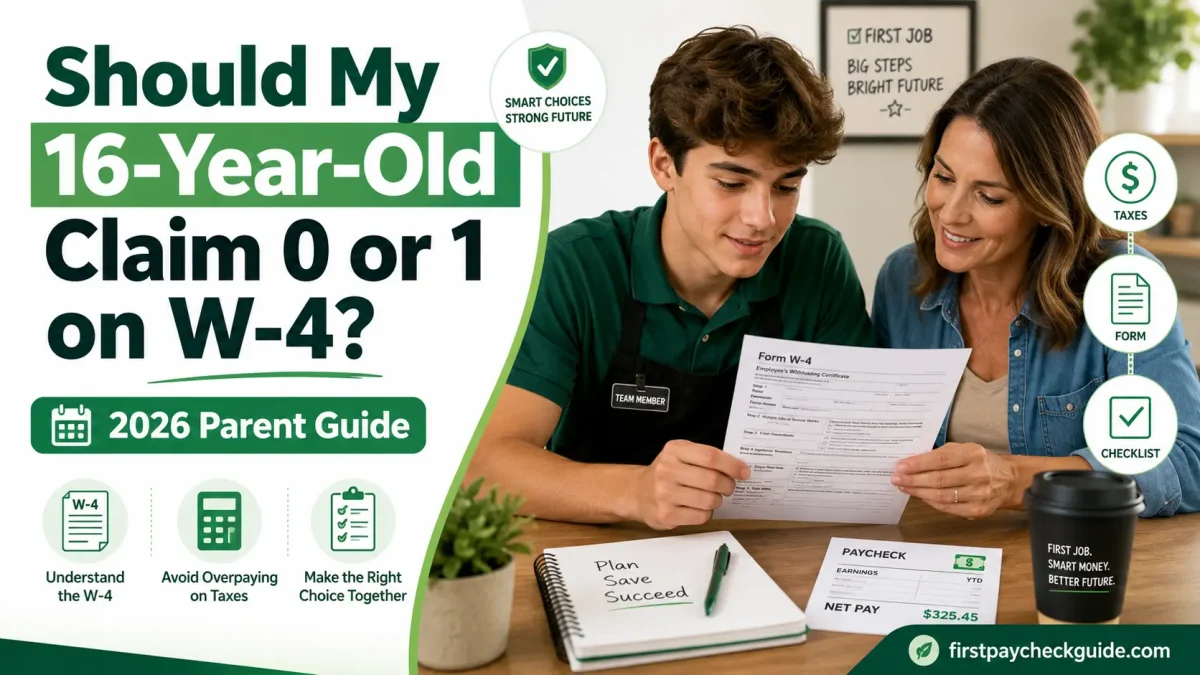
Should My 16 Year Old Claim 0 or 1 on W-4? 2026 Parent Guide
⚡ Should my 16 year old claim 0 or 1 on W-4? — quick answer
Neither. The current 2026 W-4 does not have a “0 or 1” option. The IRS removed the allowances system in 2020. Your 16-year-old should check Single filing status, leave Steps 2–4 blank, and only check the Exempt from withholding box if they qualify, meaning they had no federal tax liability last year and expect none this year. For a teen with only W-2 job wages, that usually means expected 2026 earnings are below about $16,100.
- Claiming 0 or 1 — not applicable. The 2026 W-4 has no allowances. Anyone giving this advice is using a pre-2020 form.
- Step 1 — name, address, SSN, and check Single (or Married Filing Separately if applicable).
- Steps 2–4 — leave blank for most teenagers with one job and no other income.
- Exempt option — only check the Exempt from withholding box if your teen had no federal income tax liability in 2025 and expects none in 2026.
Your teenager just got their first job. The employer handed them a W-4. And now you are searching “should my 16 year old claim 0 or 1 on W-4”. That is what you were always told to do.
that advice is from the old W-4. The IRS completely redesigned the form in 2020, and the current 2026 version has no “0 or 1” option anywhere on it.
There are no allowances. There is no box where your teenager chooses 0 or 1. If a website or person is still telling you to “claim 0 or 1,” they are describing a form that no longer exists.
This guide covers what your 16-year-old should put on their 2026 W-4, when they can claim exempt, and what happens if they get it wrong.
Table of Contents
Why “claim 0 or 1” no longer applies to the 2026 W-4
Before 2020, the W-4 used a system of “allowances.” More allowances meant less tax withheld. Claiming 0 meant maximum withholding. Claiming 1 meant slightly less.
The IRS eliminated the entire allowances system when it redesigned the W-4 in 2020. The 2026 W-4 looks different and works differently.
⚠️ Outdated advice is everywhere: how to spot it
If anyone tells your teenager to “claim 0 or 1,” they are describing the old pre-2020 form. The current W-4 has five steps; none ask you to choose a number of allowances. That advice does not apply to the form your teenager is holding today.
What the current 2026 W-4 looks like instead
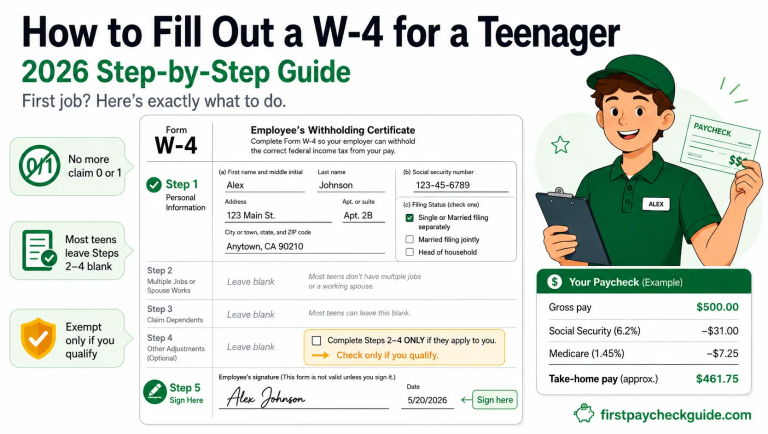
The 2026 W-4 has five steps:
- Step 1 — Personal information: name, address, SSN, and filing status
- Step 2 — Multiple jobs or spouse works (most teens leave this blank)
- Step 3 — Claim dependents (most teens leave this blank)
- Step 4 — Other adjustments, plus the separate Exempt from withholding box/section if they qualify
- Step 5 — Signature
For most 16-year-olds with a single part-time job, only Step 1 and Step 5 need to be filled in. Everything else stays blank.
What should a 16-year-old actually put on their 2026 W-4?
For most 16-year-olds with a single part-time or summer job, the W-4 is simple. Here is what to write in each section:
- Fill in completely. Legal name exactly as it appears on their Social Security card, home address, Social Security number, and check Single or Married filing separately. Most teenagers check Single.
- Leave blank for most teens. This step is for employees with multiple jobs or a working spouse. A 16-year-old with one job leaves this entire step blank.
- Leave blank. This step is for claiming child tax credits and dependents. Your teenager is the dependent; they do not have their own dependents to claim.
- Leave blank, or check the Exempt from withholding box if they qualify. This is the only decision that matters for most teens. See the exempt section below to determine whether your teenager qualifies.
- Your teenager signs and dates. The employee signs the W-4, not the parent. You can help fill it out, but your teenager needs to put their signature on line 5.
✅ Before your teen hands in the W-4
- Legal name — matches exactly what is on their Social Security card
- Social Security number — double-checked for accuracy
- Filing status — Single is checked in Step 1
- Steps 2–4 — left blank unless they have two jobs or qualify for exempt
- Exempt box — only checked if they had no federal tax liability in 2025 and expect none in 2026
- Signature — your teenager signed Step 5, not you
- Date — today’s date is on the form
- Copy saved — photo or copy kept for your records before handing in
The safest default if you are not sure
If you are unsure whether your teenager qualifies for exempt status, leave Step 4 blank entirely. This means federal income tax may be withheld based on their Single filing status. They may get a refund when they file their tax return in April. For a teen with only one W-2 job, this is usually safer than claiming exempt incorrectly.
Should my 16-year-old claim exempt on their W-4?
The real question behind “should my teen claim 0 or 1.” In the old system, claiming 0 meant maximum withholding and claiming exempt meant no withholding. The current W-4 only has the exempt option. There is no “0 or 1” anymore.
Your teenager can check the Exempt from withholding box only if they meet both of these IRS conditions:
Both conditions must be true to claim exempt:
- Condition 1: They had no federal income tax liability in 2025, meaning they either did not earn enough to owe tax, or they got back everything that was withheld
- Condition 2: They expect to have no federal income tax liability in 2026, meaning they expect to earn under the standard deduction amount for their filing status
💡 The 2026 income threshold for teen exempt status
For 2026, the regular standard deduction for a single filer is $16,100. A dependent teenager with only W-2 job wages will usually owe no federal income tax if their earned income stays below about $16,100.
But the official W-4 exempt test is not just one income number. Your teen can claim exempt only if they had no federal income tax liability in 2025 and expect no federal income tax liability in 2026.
Important: this is the threshold for federal income tax only. FICA taxes — Social Security and Medicare — still come out of every paycheck regardless of exempt status. Claiming exempt does not stop FICA.
Should my teen claim exempt? Quick check
Answer 5 questions to see whether exempt status may make sense for your teenager.
This quiz is for general education only and does not replace IRS guidance or professional tax advice. Individual circumstances vary. State income tax rules may be different.
| Teen’s expected 2026 earnings | Likely exempt status | Recommendation |
|---|---|---|
| Under $5,000 (summer job only) | Almost certainly qualifies | Claim exempt; no federal tax owed |
| $5,000–$10,000 (part-time year round) | Very likely qualifies | Claim exempt; earnings under threshold |
| $10,000–$16,100 (substantial part-time) | Likely qualifies | Claim exempt; verify with a tax calculator |
| Over $16,100 | Does not qualify | Do not claim exempt; leave Step 4 blank |
⚠️ Exempt status expires every year
Exempt status on a W-4 is not permanent. For 2026 exempt status specifically, your teenager must submit a new 2027 Form W-4 by February 16, 2027. If they do not renew it, their employer will default to Single with no additional withholding and federal income tax will begin being withheld from their checks.
What claiming exempt actually means for your teen’s paycheck
Here is what a typical 16-year-old’s paycheck looks like with and without exempt status:
Paycheck example: $12/hour, 20 hours per week, biweekly pay
Gross pay per check: $12 × 20 hours × 2 weeks = $480
| Deduction | With exempt (Step 4 = Exempt) | Without exempt (Step 4 blank) |
|---|---|---|
| Gross pay | $480.00 | $480.00 |
| Social Security (6.2%) | $29.76 | $29.76 |
| Medicare (1.45%) | $6.96 | $6.96 |
| Federal income tax | $0.00 | Usually $0–small amount depending on payroll setup |
| Take-home pay | $443.28 | About $443.28, or slightly less if federal tax is withheld |
At $12/hour working 20 hours per week, annual wages are about $12,480, below the 2026 single standard deduction of $16,100. This means payroll software may already withhold little or no federal income tax even without claiming exempt. The bigger practical point is that Social Security and Medicare come out either way. If your teen qualifies for exempt, claiming it ensures no federal income tax is withheld, but the difference in take-home pay may be small or zero depending on how their employer’s payroll is configured.
Key point: FICA still comes out regardless
Notice that Social Security ($29.76) and Medicare ($6.96) come out of both scenarios. Claiming exempt on the W-4 only affects federal income tax withholding. FICA is mandatory for almost all employees, including 16-year-olds, and cannot be reduced by anything on the W-4. For a complete breakdown of every tax that comes out of a teenager’s paycheck, see our guide on what taxes teenagers pay on their first paycheck.
What happens if my teenager claims exempt incorrectly?
If your teenager claims exempt but does not actually qualify — for example, because they earn more than the standard deduction threshold — no federal income tax will be withheld from their paychecks during the year. When they file their tax return in April, they will owe the federal income tax that should have been withheld. They will get a tax bill instead of a refund.
If they claimed exempt incorrectly
No federal tax withheld all year. File tax return in April. Owe the difference. May also owe a small underpayment penalty. Stressful surprise for a teenager who spent all their income.
If they did not claim exempt when they could have
Federal tax withheld all year. File tax return in April. Get a refund of the amount over-withheld. No penalty. Just a delayed return of money they were owed anyway.
When in doubt: do not claim exempt
If you are not certain whether your teenager qualifies, leave Step 4 blank or use the IRS Tax Withholding Estimator. The worst outcome of skipping exempt is a small over-withholding and a small refund in April. The worst outcome of incorrectly claiming exempt is an unexpected tax bill. The conservative choice is always to skip exempt when unsure.
Can a parent sign the W-4 for their 16-year-old?
The W-4 must be signed by the employee. Your teenager. The employer needs the employee’s signature on the form, not a parent’s signature.
You can help fill out each section. You can explain each step and make decisions together. But when it comes to Step 5, your teenager needs to sign their own name.
Does filling out a W-4 affect your ability to claim your teen as a dependent?
No. The W-4 your teenager fills out has no effect on whether you can claim them as a dependent on your tax return. Dependency is determined by IRS rules; primarily whether you provided more than half of their financial support and whether they meet the qualifying child criteria. Your teenager completing their own W-4 and even filing their own tax return does not prevent you from claiming them. The two tax situations are completely separate.
What if my 16-year-old has two jobs or earns tips?
Two jobs
If your teenager works two jobs at the same time — for example, a weekend job at a grocery store and a weekday job at a café — they should account for both jobs before deciding whether to claim exempt. If the two jobs have similar pay, Step 2(c) may be the simplest option. If one job pays much more than the other, the IRS Tax Withholding Estimator is safer.
Two-job option for teens
The simplest approach for a teenager with two jobs: on the W-4 for the higher-paying job, check the box in Step 2(c) that says both jobs have similar pay. This adjusts withholding without requiring complex calculations. For two jobs, use the IRS Tax Withholding Estimator or follow the W-4 multiple-jobs instructions. Do not claim exempt on either job unless your teen truly expects no federal income tax liability for the year across both jobs combined.
Tips
If your teenager works in a restaurant, café, or any tipped position, their tips are taxable income. FICA taxes — Social Security and Medicare — apply to reported tips as well as hourly wages. If they earn significant tips and claim exempt on their W-4, they may end up owing taxes at filing time if their total income including tips exceeds the standard deduction threshold.
⚠️ Tipped teens should be cautious about claiming exempt
A teenager who earns $8/hour but also receives $200–$400 per month in tips may have total annual income that exceeds the exempt threshold even if their hourly wages alone do not. Calculate total expected income — wages plus estimated tips — before deciding on exempt status.
Frequently Asked Questions: 16-Year-Old W-4 and Claiming 0 or 1
Should my 16-year-old claim 0 or 1 on their W-4?
Neither. The 2026 W-4 does not have a 0 or 1 allowances option. The IRS removed the allowances system in 2020. If someone is telling you to “claim 0 or 1,” they are referring to the old pre-2020 W-4 form. On the current form, your teenager should complete Step 1 with their personal information and Single filing status, leave Steps 2–4 blank (unless they qualify for exempt), and sign Step 5.
Should my teenager claim exempt on their W-4?
Only if they meet both IRS conditions: they had no federal income tax liability in 2025, and they expect no federal income tax liability in 2026. For most 16-year-olds working part-time and earning under $16,100 in 2026, this means they likely qualify for exempt status. If they are uncertain or expect to earn close to or above that threshold, the safer choice is to leave Step 4 blank and let normal withholding apply.
Are minors exempt from federal income taxes?
Not automatically. Minors follow the same federal income tax rules as adults; if their income exceeds the standard deduction, they owe federal income tax. However, most teenagers working part-time earn well below the standard deduction threshold, which means they often owe no federal income tax and may qualify for exempt withholding on their W-4. Exempt status must be claimed on the W-4; it is not applied automatically.
Do minors pay Social Security and Medicare taxes?
Yes. FICA taxes — Social Security at 6.2% and Medicare at 1.45% — apply to almost all employees regardless of age. A 16-year-old at their first job pays the same 7.65% FICA rate as a 40-year-old. Claiming exempt on the W-4 only affects federal income tax withholding; it has no effect on Social Security and Medicare. Both will still come out of every paycheck.
Can a parent fill out a W-4 for a minor?
A parent can help fill out the form. But the employee (your teenager) must sign the W-4. The employer needs the employee’s signature, not a parent’s. You can sit together and complete the form, but your teenager needs to sign their own name on Step 5.
What if my teen has two jobs?
If your teenager works two jobs at the same time — for example, a weekend job and a weekday job — they should account for both jobs before deciding whether to claim exempt. If the two jobs have similar pay, Step 2(c) may be the simplest option. If one pays significantly more, the IRS Tax Withholding Estimator is more accurate. Do not claim exempt on either job unless their combined annual income is expected to stay below the threshold and they had no federal income tax liability last year.
What if my teen earns tips?
Tips are taxable income subject to both federal income tax and FICA. If your teenager works in a restaurant or any tipped position, they should add their estimated annual tips to their estimated hourly wages before deciding on exempt status. If combined wages and tips exceed roughly $16,100, they should not claim exempt. FICA applies to reported tips the same as regular wages; it comes out of every paycheck regardless of exempt status.
Does my teen filing their own W-4 affect my ability to claim them as a dependent?
No. Your teenager completing a W-4 and even filing their own tax return does not affect your ability to claim them as a dependent. Dependency is determined by IRS rules, primarily whether you provided more than half of their financial support and whether they meet the qualifying child criteria for age, residency, and relationship. The W-4 is a withholding instruction form that has no effect on dependency status.
What is the 2026 standard deduction for a teenager?
For 2026, the regular standard deduction for a single filer is $16,100. A dependent teenager with only W-2 job wages will usually owe no federal income tax if their earned income stays below about $16,100. However, dependents with investment income, self-employment income, taxable scholarships, tips, or multiple jobs may need a closer calculation. In practice, this means most teenagers with earned income under $16,100 will owe no federal income tax in 2026. State income tax rules vary by state and are separate from this calculation.
When does exempt status expire on a W-4?
For 2026 exempt status, your teenager must submit a new 2027 Form W-4 by February 16, 2027. If they miss the deadline, the employer will default to Single with no additional withholding and federal income tax will begin being withheld from their paychecks. Mark the calendar; this is an easy deadline to miss.
The bottom line for parents
The 2026 W-4 does not have a “0 or 1” option. That question belongs to a form from before 2020.
Here is what your teenager actually needs to do:
- Step 1: Fill in name, address, SSN, check Single
- Steps 2–4: Leave blank unless they have two jobs or qualify for exempt
- Exempt: Check the Exempt from withholding box only if they had no federal income tax liability in 2025 and expect no federal income tax liability in 2026
- Step 5: Teen signs, not the parent
If you are not sure about exempt, skip it. For a teen with one W-2 job, normal withholding is usually safer than claiming exempt incorrectly.
See Exactly What Comes Out of Your Teen’s First Paycheck
Enter your teenager’s hourly rate, hours, and pay schedule to see the exact Social Security, Medicare, and federal income tax breakdown using 2026 IRS figures.
Confused about the difference between a W-4 and a W-2? Read: W-4 vs W-2: What Is the Difference? →

About the Author
Ashief Mahmood is the Founder and Editor of First Paycheck Guide. He researches and explains first-paycheck topics for U.S. first-time workers using IRS publications, U.S. Department of Labor resources, official employer documentation, payroll sources, and carefully labeled estimates.
Ashief is not a financial advisor, tax professional, payroll provider, lawyer, or employer representative. First Paycheck Guide is an independent educational website.
The information in this article is for educational purposes only and does not constitute tax or legal advice. W-4 withholding rules confirmed via IRS Form W-4 guidance. Standard deduction figures for 2026 confirmed via IRS Tax Topic 551. Exempt withholding conditions confirmed via IRS Publication 505. Tax rules for dependents vary by situation; consult a tax professional for advice specific to your family’s circumstances.