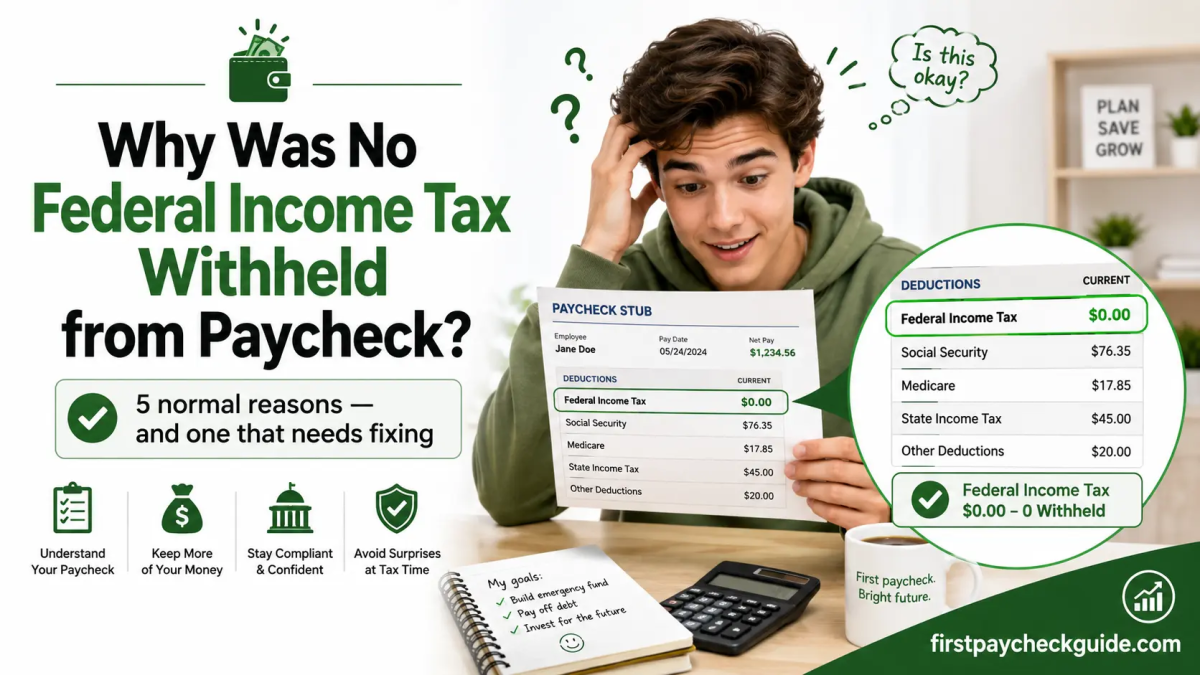
Why Was No Federal Income Tax Withheld from Paycheck? (2026)
⚡ Why was no federal income tax withheld from paycheck? — quick answer
There are 5 reasons no federal income tax is withheld from a paycheck — and most of them are completely normal. The most common reason for first-job workers: your income is too low for federal withholding to kick in. FICA taxes (Social Security and Medicare) still come out regardless.
- Income too low — your annualized wages fall below the withholding threshold for your filing status. Very common for part-time and hourly workers.
- Claimed exempt on W-4 — you checked the exempt box, so no federal income tax is withheld by design.
- W-4 filled out incorrectly — certain W-4 settings can reduce withholding to zero even when tax will be owed.
- Tips or overtime on 2026 W-4 — if you accounted for qualified tips or overtime on your updated W-4, your federal withholding may be lower.
- Employer payroll error — rare, but it happens. Needs to be fixed quickly.
You opened your pay stub expecting to see a line for federal income tax. Instead, that line either shows $0.00 or is missing entirely.
Your first reaction: something is wrong. Your second reaction: am I going to owe a huge tax bill in April?
Probably not. For most first-job workers, no federal income tax withheld from a paycheck is completely normal. But the reason why matters — because there are five different causes, and one of them does need to be fixed.
This guide covers every reason federal income tax withholding can be zero and what to do about each one.
One thing to check first: look at your pay stub for Social Security and Medicare deductions. Those are FICA taxes, and they should be coming out of every paycheck regardless of federal income tax. If FICA is also missing, that is a separate problem — read this guide first, then check our FICA explainer.
Table of Contents
No federal income tax withheld from paycheck — is this normal?
For most first-job workers, yes — it is completely normal. The most common reason is that your income is too low for federal withholding to apply. But there are five different causes, and knowing which one applies to you determines whether you need to take action.
5 reasons no federal income tax is withheld from your paycheck
Each cause has a different fix. Start with Reason 1 — it applies to most first-job workers.
Reason 1: Your income is too low for federal withholding to apply
This is the most common cause for teenagers, part-time workers, and hourly employees. Federal income tax withholding is not automatic — it only kicks in when your annualized wages exceed a certain threshold based on your filing status.
How payroll software calculates your withholding
Your employer’s payroll system takes your per-check wages and multiplies them by your pay periods to estimate your annual income. Then it applies your standard deduction and tax brackets. If your estimated annual income from one W-2 job falls below the standard deduction — $16,100 for single filers in 2026 — federal income tax withholding is often $0. No error. No problem. Just math.
| Hourly wage | Hours/week | Annual income | Federal withholding likely? |
|---|---|---|---|
| $12/hour | 20 hours | $12,480 | No — below $16,100 standard deduction |
| $15/hour | 20 hours | $15,600 | No — just under the threshold |
| $15/hour | 25 hours | $19,500 | Yes — above threshold, small amount withheld |
| $15/hour | 40 hours | $31,200 | Yes — clear withholding expected |
| $12/hour | 40 hours | $24,960 | Yes — above threshold |
For a complete tax breakdown by hourly wage including FICA, federal income tax, and take-home pay, see our guide on how much minors get taxed on their paycheck.
Does this mean I owe no federal income tax?
Yes — if your total annual income stays below $16,100 in 2026 and you only have W-2 wages, you will generally owe no federal income tax. Zero withholding during the year may be correct. You may still need to file a return depending on your situation, especially if federal tax was withheld earlier, but with only W-2 wages below the standard deduction, you generally will not owe federal income tax.
Reason 2: You claimed exempt on your W-4
When you filled out your W-4, there is an Exempt from withholding checkbox. If you checked it — or if someone helped you fill out the form and checked it on your behalf — your employer will withhold zero federal income tax from every paycheck for the entire year.
Claiming exempt is legitimate if you meet both IRS conditions:
Both must be true to legally claim exempt:
- You had no federal income tax liability last year
- You expect no federal income tax liability this year
⚠️ Claimed exempt but should not have?
If you checked exempt but your total 2026 income will exceed $16,100, you will owe federal income tax in April with no withholding to cover it. Fix this now by submitting a new W-4 to your employer with the exempt box unchecked. Your employer should apply the updated W-4 according to IRS payroll timing rules, usually within the next one or two payroll cycles.
How to check if you claimed exempt
Pull up your W-4 — you should have kept a photo of it when you submitted it. Look below Step 4(c) for the Exempt from withholding declaration. If it is checked, that is why no federal tax is coming out. If you no longer have a copy, ask your HR or payroll department for your W-4 on file.
Note: older W-4 guidance told people to write “Exempt” below Step 4(c). The 2026 W-4 uses a checkbox instead — do not write the word, check the box.
Reason 3: Your W-4 settings reduced withholding to zero
Even without checking the exempt box, certain W-4 settings can legally reduce federal income tax withholding to $0 for low-income workers. This is not an error — it is the W-4 system working as designed.
How this happens
The 2026 W-4 calculates withholding based on your filing status, any additional income entered in Step 4(a), and any extra deductions in Step 4(b). For a single filer earning under the standard deduction threshold, the withholding calculation legitimately produces $0 even without claiming exempt.
When to worry
If you entered extra deductions in Step 4(b) or listed additional income in Step 4(a) incorrectly, your withholding could be set too low. Use the IRS Tax Withholding Estimator to verify your settings are correct for your actual income situation.
The safest W-4 setting for most first-job workers
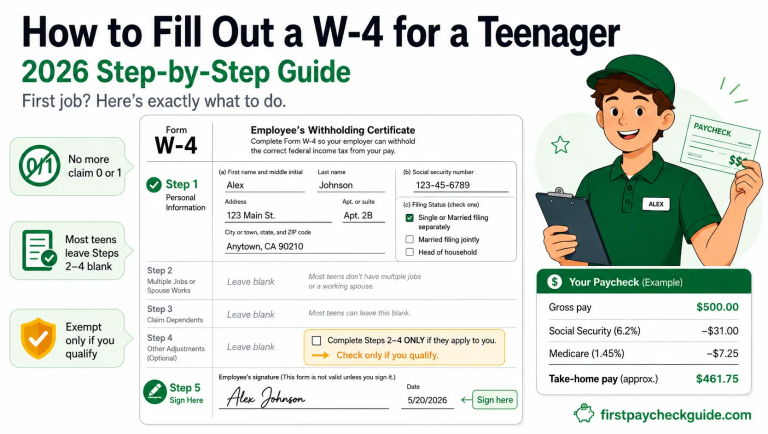
Complete Step 1 (name, SSN, Single filing status). Leave Steps 2, 3, and 4 blank. Do not check the Exempt box. Sign and date the form where indicated below Step 4(c). This produces the most accurate withholding for a single person with one job and no unusual income. If your income is below the standard deduction, withholding will automatically be $0 — no exempt box needed.
Want to verify your W-4 is set up correctly? Read: How to Fill Out a W-4 for the First Time →
Reason 4: You accounted for qualified tips or overtime on your 2026 W-4
Starting with the 2026 Form W-4, there is a new reason. Under the One, Big, Beautiful Bill Act, some workers may be able to deduct qualified tips and qualified overtime compensation on their federal tax return. The 2026 W-4 and IRS withholding procedures were updated so employees can account for those expected deductions during the year — instead of waiting until tax filing time to see the benefit.
What this means for withholding in 2026
If you work a tipped job or expect qualified overtime, and you submitted an updated 2026 W-4 that accounts for those expected deductions, your federal income tax withholding may be lower than expected — possibly even $0 if your overall taxable income is low enough after those deductions.
Tips and overtime are not tax-free. Social Security and Medicare still apply to tips and overtime wages regardless. And the withholding reduction happens because you updated your W-4 to reflect the expected deduction — not because payroll software automatically adjusted it.
The qualified tips deduction is up to $25,000 annually and phases out above $150,000 MAGI ($300,000 for joint filers). Qualified overtime generally refers to the overtime premium portion required under federal overtime rules.
⚠️ Do not assume all tips or overtime are automatically tax-free
The 2026 rules have limits and definitions. If you work a tipped job and see no federal income tax withheld, check whether your W-4 accounts for expected qualified tips or overtime. Use the IRS Tax Withholding Estimator or ask your payroll department before assuming your withholding is set correctly.
Reason 5: Employer payroll error — the one that needs fixing
In a small number of cases, federal income tax is not withheld because of a payroll error. The least common reason — but the most urgent to fix.
| Signs it might be a payroll error | What to do |
|---|---|
| You earn above $16,100 annually but $0 federal tax is withheld | Check your W-4 on file with HR, then ask payroll to verify the setup |
| Federal tax was withheld previously but stopped suddenly | Contact HR immediately — your W-4 may have been changed or a system update caused an error |
| Your pay stub shows no deductions at all, including FICA | Urgent — contact HR the same day. Missing FICA is a serious payroll problem. |
| You were reclassified as a contractor (1099) without notice | Contractors do not have taxes withheld — but the reclassification itself may be incorrect. Ask HR. |
How to report a payroll error quickly
Send a written message to HR or payroll — email is best so you have a record. Say: “I noticed federal income tax is not being withheld from my paychecks. Can you verify my W-4 setup and confirm whether this is correct for my income level?” Payroll errors are easiest to fix within the same or following pay period.
How to tell which reason applies to you — no federal income tax withheld
Work through these in order:
Quick check: should I worry about no federal income tax withheld?
- Annual W-2 income under $16,100 and FICA still coming out — probably normal, no action needed
- Checked Exempt on W-4 and you qualify for exempt — normal, remember to renew by February 16, 2027
- Income above $16,100 and did not claim exempt — check your W-4 or contact payroll
- Social Security and Medicare also missing from pay stub — contact payroll immediately
- Tips, overtime, multiple jobs, freelance, or investment income — use the IRS Tax Withholding Estimator
- Calculate your estimated annual income. Multiply your per-check gross pay by your number of pay periods per year (52 weekly, 26 biweekly, 24 semimonthly, 12 monthly). If the result is under $16,100, you are a single filer, and you only have W-2 wages, Reason 1 likely applies. Usually no action is needed.
- Look at your W-4. Is the Exempt from withholding box checked? If yes, Reason 2 applies. Decide whether you actually qualify for exempt based on both IRS conditions. If you do not qualify, submit a corrected W-4.
- Check Steps 2–4 of your W-4. Did you enter any amounts in Step 4(a) or Step 4(b)? If you entered deductions in Step 4(b) that are too high, your withholding may be set too low. Use the IRS Tax Withholding Estimator to verify.
- Do you earn tips or significant overtime? If yes, check whether you submitted a 2026 W-4 that accounts for expected qualified tips or overtime. If you did, Reason 4 may apply. Use the IRS Tax Withholding Estimator to verify your total annual withholding looks correct.
- None of the above apply? Your income is above the threshold, you did not claim exempt, your W-4 is set up correctly, and you do not earn tips or overtime — contact HR. This is likely a payroll error.
Will I owe federal income tax if nothing was withheld?
This depends entirely on your total annual income:
If your annual income is under $16,100 (single filer)
No federal income tax owed. Zero withholding during the year is correct. You may or may not need to file a return depending on your exact situation, but with only W-2 wages below the standard deduction, you generally will not owe federal income tax. FICA taxes (Social Security and Medicare) are still owed and already came out of each paycheck.
If your annual income is over $16,100 (single filer)
Federal income tax is owed on the amount above $16,100. If nothing was withheld during the year, you will owe the full amount when you file in April. Fixing an incorrect W-4 early matters — the longer it goes uncorrected, the larger the April bill.
The key distinction: withholding vs. owing
Withholding is the money your employer sends to the IRS on your behalf throughout the year. Owing is what you actually owe based on your full annual income and deductions. They get reconciled when you file your tax return. If withholding is too low and you owe more than $1,000, the IRS may also charge a small underpayment penalty. Fixing a low-withholding W-4 early avoids this.
FICA still comes out even when federal income tax does not
This is the most important thing to understand. Federal income tax and FICA are two completely separate deductions. When federal income tax withholding is $0 for any of the reasons above, FICA — Social Security and Medicare — still comes out of the paycheck for almost all ordinary W-2 jobs.
| Deduction | Comes out even when federal income tax is $0? | Rate |
|---|---|---|
| Federal income tax | No — can be $0 for valid reasons | Varies |
| Social Security (FICA) | Yes — withheld for almost all ordinary W-2 jobs | 6.2% |
| Medicare (FICA) | Yes — withheld for almost all ordinary W-2 jobs | 1.45% |
| State income tax | Depends on state — some states have no income tax | Varies |
⚠️ If FICA is also missing from your paycheck
Missing federal income tax withholding is often normal for low-income workers. Missing FICA is not. If Social Security and Medicare are also not being withheld, contact your HR or payroll department immediately. The most common cause is being incorrectly classified as an independent contractor (1099) instead of an employee (W-2). FICA is mandatory for almost all W-2 employees regardless of income level or age.
Why does FICA come out even when federal income tax does not? Read: What Is FICA? →
What to do next based on your situation
- Part-time worker earning under $16,100 for the year. Zero federal income tax withholding is likely correct. FICA is coming out. No action needed.
- You claimed exempt and you qualify. Nothing to do. Remember to renew by submitting a new W-4 by February 16, 2027 to keep exempt status for 2027.
- You claimed exempt but should not have, or your W-4 is set incorrectly. Submit a corrected W-4 to your employer today. The sooner you fix it, the smaller any April tax bill will be. Ask HR for a blank W-4, fill out Step 1 with Single status, leave Steps 2–4 blank, do not check the Exempt box, and sign below Step 4(c).
- Tipped or overtime worker using the new 2026 W-4 rules. Ask payroll whether your current W-4 accounts for expected qualified tips or overtime. Then use the IRS Tax Withholding Estimator to check whether your total annual withholding looks right for your full income situation.
- Possible payroll error. Contact HR in writing today. Provide your employee ID and the pay period dates where federal tax was missing. Request confirmation of your W-4 settings and ask when the correction will take effect.
Frequently asked questions — no federal income tax withheld
Why was no federal income tax taken out of my paycheck?
There are five reasons this can happen. The most common for first-job workers: your annualized income is below the standard deduction threshold ($16,100 for single filers in 2026), so payroll software correctly withholds $0 in federal income tax. Other reasons include claiming exempt on your W-4, W-4 settings that reduce withholding to zero, new 2026 tips and overtime deductions, or a payroll error. FICA taxes — Social Security and Medicare — still come out regardless of federal income tax withholding status.
Is it normal to have no federal income tax withheld?
Yes, for many workers. Part-time workers, teenagers, and anyone earning under approximately $16,100 annually as a single filer will typically see $0 in federal income tax withholding. The withholding system is correctly calculating that no tax is owed at that income level. Social Security and Medicare still come out of every paycheck.
Will I owe money at tax time if no federal income tax was withheld?
It depends on your total annual income. If your total 2026 earnings from all sources stay below $16,100 as a single filer with only W-2 wages, you owe no federal income tax and there is nothing to worry about. If your income exceeds $16,100, you will owe federal income tax on the amount above that figure, and without withholding during the year, the full amount will be due when you file in April. Fix an incorrect W-4 as soon as possible to avoid a large April bill.
Why is FICA still coming out if federal income tax is not?
FICA — Social Security and Medicare — is a separate payroll tax from federal income tax. It applies to almost all ordinary W-2 employees regardless of their income level, filing status, or W-4 settings. Federal income tax can legitimately be $0 for low-income workers or those who claimed exempt. FICA cannot be reduced to $0 through any W-4 setting for most ordinary jobs. The two deductions are completely independent of each other.
What happens if my employer never withheld federal income tax by mistake?
If you owed federal income tax but nothing was withheld due to a payroll error, you are still personally responsible for the tax owed when you file your return. The IRS does not waive the tax because your employer made an error — but you can work with your employer to recover the under-withheld amounts through payroll adjustments. Contact HR immediately, submit a corrected W-4, and use the IRS Tax Withholding Estimator to figure out how much you may owe. If the amount is significant, consider making estimated tax payments for the rest of the year.
Can I get a refund if no federal income tax was withheld?
Only if federal income tax was withheld and you overpaid. If no federal tax was withheld all year because your income was too low or you correctly claimed exempt, there is nothing to refund — because nothing was taken. A tax refund is the return of over-withheld money, not free money from the government. You still need to file a return if your income exceeds the filing threshold, even if you owe nothing.
Why did federal income tax stop being withheld from my paycheck?
If federal tax was previously withheld and suddenly stopped, the most likely causes are: your W-4 was updated (either by you or by a payroll system change), your hours or pay were reduced below the withholding threshold, you were reclassified as a contractor, or a payroll system error occurred. Contact HR and ask for your current W-4 on file and a review of your payroll setup. Bring records of your pay stubs showing when the withholding stopped.
Does no federal income tax withheld mean I am being paid under the table?
No. Being paid under the table means receiving cash with no payroll record and no taxes withheld at all — including no FICA. If you are receiving a regular paycheck with Social Security and Medicare deducted, you are not being paid under the table. Zero federal income tax withholding is a normal outcome for low-income workers. The clearest sign of legitimate payroll is the presence of FICA deductions on your pay stub.
How do I fix no federal income tax being withheld?
If it needs to be fixed — meaning you earn above the standard deduction and are not exempt — submit a new W-4 to your employer. Complete Step 1 with your name, SSN, and Single filing status. Leave Steps 2, 3, and 4 blank. Make sure the Exempt from withholding box is not checked. Sign and date below Step 4(c) and submit to HR or payroll. Your employer should apply the updated W-4 within the next one or two payroll cycles. If you are not sure how much to have withheld, use the IRS Tax Withholding Estimator at irs.gov/W4App before submitting.
What if I earn tips and no federal income tax is withheld?
Under the new rules, up to $25,000 in qualified tips may be deductible on your federal tax return if the tips qualify under the One, Big, Beautiful Bill Act. Starting with the 2026 W-4, employees can account for expected qualified tips when setting their withholding. If you work a tipped job and see no federal income tax withheld, check your W-4 and ask payroll whether that expected deduction was included in your withholding setup. FICA taxes still apply to reported tips regardless of the income tax deduction.
The bottom line — no federal income tax withheld from your paycheck
For most first-job workers, no federal income tax withheld is not a problem. It is the withholding system correctly recognizing that your income is too low to owe federal income tax.
The checklist is simple:
- Is FICA coming out? Social Security and Medicare should be on every pay stub. If they are, your payroll is working.
- Is your annual W-2 income under $16,100? Zero federal withholding is usually correct and expected.
- Did you claim exempt? Check your W-4. If you qualify, no action needed. If you do not qualify, submit a corrected W-4 today.
- Income above $16,100 with no withholding and no exempt? Contact HR. This needs to be fixed.
The worst thing you can do is ignore it. A missing federal withholding that goes uncorrected all year becomes an April tax bill. Catching it early costs nothing.
See Exactly What Should Come Out of Your Paycheck
Enter your hourly rate or salary to see your estimated federal tax, FICA, and take-home pay — and verify whether zero federal withholding is correct for your income level.
Want to verify your withholding is set correctly? Use the W-4 Withholding Estimator →
Need to fix or update your W-4? Read: How to Fill Out a W-4 for a Teenager (2026) →

About the Author
Ashief Mahmood is the Founder and Editor of First Paycheck Guide. He researches and explains first-paycheck topics for U.S. first-time workers using IRS publications, U.S. Department of Labor resources, official employer documentation, payroll sources, and carefully labeled estimates.
Ashief is not a financial advisor, tax professional, payroll provider, lawyer, or employer representative. First Paycheck Guide is an independent educational website.
The information in this article is for educational purposes only and does not constitute tax or legal advice. Federal withholding rules sourced from IRS Publication 15-T (2026). Standard deduction figures confirmed via IRS Revenue Procedure 2025-32. Tips and overtime deduction rules sourced from the One, Big, Beautiful Bill Act (2025). Always verify current withholding rules at irs.gov/W4App. Consult a tax professional for advice specific to your situation.