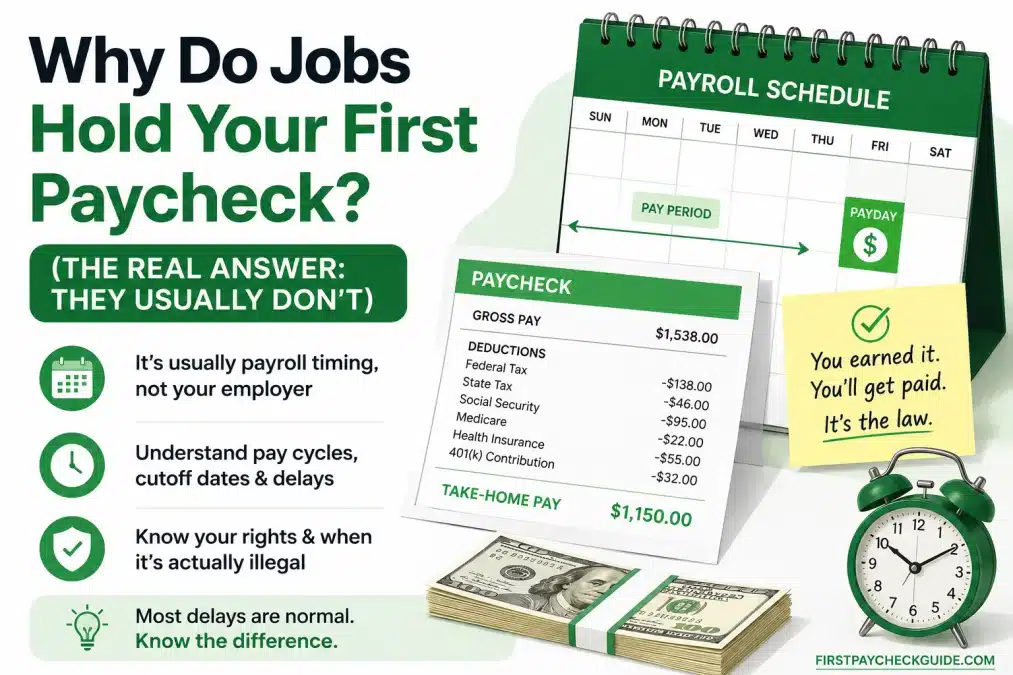
Why Do Jobs Hold Your First Paycheck? (The Real Answer: They Usually Don’t)
⚡ Why do jobs hold your first paycheck? — quick answer
In most cases, jobs do not hold your first paycheck. Your pay is usually delayed because employers pay in arrears, payroll has cutoff dates, or your first check is being issued by paper check instead of direct deposit. This is normal payroll timing — not wage theft.
It may be illegal if your employer:
- Misses the official payday for the pay period you worked with no explanation
- Says your first check is held until you quit or finish a probationary period
- Deducts training, uniform, or onboarding fees in a way that violates wage laws
- Pays less than your agreed rate or refuses to explain missing wages
- Tells you training or orientation days are unpaid — this is generally illegal
If you just started a new job and nobody has paid you yet, your first instinct might be to panic. Your second might be to Google “why do jobs hold your first paycheck.” Your third might be to quietly wonder if your employer is stealing from you.
You are not wrong to be worried — getting no paycheck after starting a job feels scary. But in almost every case, your employer is not stealing from you. The real explanation is something almost no one teaches you before your first job.
Here is the short version: jobs do not hold your first paycheck. What feels like holding is a timing gap built into how payroll works. This guide explains exactly why that gap exists, how long it should last, and — critically — how to tell if something genuinely illegal is happening.
Table of Contents
Why do jobs hold your first paycheck? Start here
💡 Should you panic?
If you started less than 2–3 weeks ago — probably not. Most new employees wait 2–3 weeks for their first deposit due to normal payroll timing. If the official payday for your first pay period has already passed and HR cannot explain where your money is — then it is time to document everything and act. The checklist below tells you exactly which situation you are in.
📊 The honest answer most sites won’t give you
The phrase “holding your first paycheck” is a myth that spread through word of mouth and Reddit. In reality, employers cannot legally hold your first paycheck. Under the FLSA, covered employers must pay required wages on the regular payday for the pay period covered. State wage payment laws may add stricter rules. What new employees experience as “holding” is almost always one of three completely normal payroll mechanics — explained below.
Do companies hold your first paycheck — or is it just delayed?
Answer these three questions right now. Your answers will tell you whether what you are experiencing is normal payroll timing or a genuine problem worth escalating.
🔍 The 2-minute test
- Did you start in the middle of a pay period? → Almost certainly delayed — not held
- Has it been fewer than 3 weeks since you started? → Normal payroll timing — wait for the next scheduled pay date
- Has the official payday passed and you still have not been paid? → This could be a genuine problem — keep reading
What “paying in arrears” means — and why it explains almost everything
Most US employers pay in arrears — meaning your paycheck covers work you already completed in a previous pay period, not work you are doing right now. If you think you are being paid “this week for this week’s work” — you are not. You are being paid this week for last pay period’s work. This single fact explains why almost every new employee waits 2–3 weeks before their first deposit.
Why your first paycheck feels held — 3 normal reasons
Reason 1: Payroll processes on a fixed cutoff schedule
Every employer has a payroll cutoff date — the last day of the pay period when your employer stops counting hours and starts processing payments. If you start after the cutoff, your first days of work are processed in the next payroll cycle, not the current one.
Payroll cutoff example — why you waited 3 weeks
Pay period: May 1–14 | Payroll cutoff: May 14 | Payday: May 21
Your start date: May 13
Result: Your 2 days (May 13–14) just made the cutoff. But payroll had already started processing. Your employer moves those 2 days to the next cycle.
Next pay period: May 15–28 | Payday: June 4
Your first deposit: June 4 — covering May 13 through May 28.
You started May 13. Your first deposit arrived June 4. That is 22 days. Nothing was held — you just started right before a cutoff.
Every employer has a payroll cutoff date — a deadline for submitting and approving hours before payroll runs. If your start date falls after that deadline, your first check may be delayed or cover fewer days than expected.
Visual payroll timeline — biweekly pay in arrears
Week 1 (May 5–11): You start work. You are working but payroll has not processed yet.
Week 2 (May 12–18): Pay period ends. Payroll department processes. This takes 3–5 business days.
Week 3 (May 19–21): 💰 Your first paycheck arrives — covering Weeks 1 and 2.
Week 4 onward: Regular biweekly deposits on schedule.
A 2–3 week wait for your first deposit is completely normal. Every week after that you are paid on the regular schedule.
Reason 2: You started in the middle of a pay cycle
If the pay period runs May 1–14 and you started May 8, your first paycheck only covers 7 days — not because the other days were held, but because they had not happened yet when payroll ran. Your second paycheck will be a full biweekly amount. There is no such thing as a probationary period that allows an employer to delay your pay. If you worked, you get paid on the regular payday — period.
Reason 3: Direct deposit setup delay or paper check
Some employers issue a paper check for the first pay period while your bank account details are being verified in their payroll system. A paper check takes 3–5 additional business days to arrive and clear — which can feel like your pay is being held when it is actually in the mail.
If that paper check has already arrived and you do not have a bank account, see how to cash a paycheck for retailer, bank, mobile, ID, and fee options.
Pay cards — what retail and fast food workers need to know
Some employers, especially in retail and fast food, issue pay cards instead of direct deposit or paper checks for new hires. Pay cards can carry fees for withdrawals or balance checks. You usually have the right to switch to direct deposit after your first pay cycle — ask HR: “Can I switch to direct deposit, and what do I need to submit?”
What to ask HR about your first payment method
“Was my first paycheck issued by direct deposit or paper check? If paper, what date was it mailed and what address was used?” — If your direct deposit went to the wrong account due to a data entry error, payroll can trace and reverse it. Contact HR immediately rather than waiting.
First paycheck arrived but looks too small? Read: Why Is My First Paycheck So Low? →
If you specifically just started at Target, the Target first paycheck guide covers the full 2026 Friday pay schedule, how DailyPay earned wage access works, and what to do if your hours are missing from myTime.
When IS it illegal for a job to hold your paycheck?
While the vast majority of “held paycheck” situations are just normal payroll timing, there are genuine illegal scenarios. Here is exactly when withholding pay crosses the legal line:
🚨 Red Flag 1: No payment after a full pay cycle with no explanation
Under the FLSA and state wage payment laws, covered employers must pay required wages on the regular payday for the pay period covered. If the regular payday has passed and you have received nothing — no direct deposit, no paper check, no explanation — that is a potential violation. Contact HR first. If unresolved within 2 business days, contact your state Department of Labor or the federal WHD.
🚨 Red Flag 2: “We hold your first check until you quit or finish probation”
Employers generally cannot hold earned wages as a security deposit or make payment conditional on continued employment or completing probation. Earned wages must be paid on the regular payday under federal wage rules, and state wage payment laws impose additional deadlines. If an employer tells you this, treat it as a serious red flag and document everything.
🚨 Red Flag 3: Unauthorized or illegal deductions
Employers may deduct from your paycheck what is legally permitted: taxes, court-ordered garnishments, and deductions you explicitly authorized in writing. Deductions for training fees, uniform costs, equipment, cash register shortages, or broken items may be illegal if they reduce your pay below minimum wage, cut into required overtime pay, violate state deduction rules, or were not properly authorized. If unfamiliar deductions appear on your stub, ask HR for a written explanation before assuming they are correct.
🚨 Red Flag 4: Paid less than your agreed rate
If your pay stub shows a lower rate than your offer letter — even on day one — that is a violation. Your agreed pay rate must appear correctly from your very first paycheck.
🚨 Red Flag 5: Unpaid training or orientation days
If your employer tells you your first 2 days are “training” and therefore unpaid, that can be a serious wage issue. Required, job-related orientation and training generally count as work time unless the federal training-time exception applies. Our guide to whether job orientation and training must be paid explains the four-part federal test and when those hours should appear on your paycheck.
✅ Is it delayed (normal) or held (potentially illegal)?
- You started mid pay cycle and your first check covers partial days → ✅ Normal and legal
- Fewer than one full pay cycle has passed → ✅ Normal payroll timing — wait
- First check is a paper check arriving by mail → ✅ Normal — allow 5 business days
- Direct deposit went to wrong account due to data entry error → ✅ Fixable error — contact HR today
- Full pay cycle has passed with zero payment and no explanation → 🚨 Potentially illegal — act now
- Employer says check is held until you quit or complete probation → 🚨 Serious red flag — document and escalate
- Unauthorized or unexplained deductions appear on stub → 🚨 Request written explanation from HR
- Employer claims training days are unpaid → 🚨 Generally illegal — contact DOL
- Pay rate on stub differs from offer letter → 🚨 Violation — raise with HR immediately
What if I quit before getting my first paycheck?
This is one of the most searched questions in this topic — and the answer is clear: you are legally entitled to be paid for every day you worked, even if you quit before your first scheduled payday.
💡 Your rights if you quit before your first check
Quitting before your first scheduled payday does not forfeit your earned wages. Your employer is legally required to pay you for all hours worked on the next scheduled payday — or sooner, depending on your state. Employers generally cannot deduct training costs, onboarding fees, or equipment charges from this payment unless the deduction is legally permitted, properly authorized where required, and does not reduce your pay below minimum wage.
If your employer refuses to pay for days worked after you quit, file a wage claim with your state’s Department of Labor. You can also contact the federal WHD at dol.gov/agencies/whd/contact/complaints or call 1-866-487-9243.
| Situation | Are you owed pay? | When should you receive it? |
|---|---|---|
| Quit after 1 day of work | ✅ Yes — for that 1 day | Next scheduled payday in most states |
| Quit after 1 week before first payday | ✅ Yes — for all days worked | Next scheduled payday or sooner by state |
| Fired before first payday | ✅ Yes — for all days worked | Immediately in some states (CA), next payday in others |
| Did not complete probation period | ✅ Yes — probation does not affect wage rights | Next scheduled payday |
What to do if your paycheck is actually late — step by step
If the checklist above indicates something may genuinely be wrong, here is your action plan in order:
🗓️ Paycheck Problem Action Plan
- Check your bank account — direct deposit may have processed without a notification
- Verify the pay date in your offer letter or employee handbook matches what you expected
- Confirm your bank routing and account numbers on file with HR are correct
- Check if a paper check or pay card was issued — allow 5 business days from pay date
- Email HR using the copy-paste script below — professional and non-accusatory
- Request written confirmation of your pay date, pay method, and any processing notes
- Give HR 1 business day to respond before escalating — document everything
- File a wage claim with your state’s Department of Labor — search “[your state] wage claim”
- File a federal complaint with the DOL Wage and Hour Division at dol.gov/agencies/whd/contact/complaints
- Call the WHD helpline: 1-866-487-9243 (free, available in multiple languages)
- Save all emails, pay stubs, offer letters, and texts as evidence before contacting anyone
Copy-paste message to HR about a late or missing paycheck
Hi [HR/Payroll Team], I wanted to follow up on my first paycheck. Based on our pay schedule, I expected to receive payment on [expected pay date] but have not yet received a deposit or paper check. Could you please confirm the status of my payment, the pay method being used, and when I can expect to receive it? I also want to make sure my bank account information on file is correct. Thank you.
Send by email — not text — so you have a written record. Professional, non-accusatory, and documents your inquiry.
How long can an employer legally hold your paycheck? (Key states)
📊 tl;dr on state laws
California has the strongest worker protections — fired employees get paid immediately on the spot. Texas gives employers 6 calendar days if they fire you. Most other states say “next scheduled payday” for both quitting and being fired. Every state is faster than “whenever they feel like it.” This table covers final paycheck laws — what happens when you leave a job. These are not first paycheck timing laws.
| State | If you quit | If you are fired | Key notes |
|---|---|---|---|
| California | Within 72 hrs (immediately if 72+ hrs notice given) | Immediately at time of termination | Strongest worker protections in the US — CA Labor Code §201–202 |
| Texas | Next regularly scheduled payday | Within 6 calendar days | 6-day rule is for discharge only — TX Payday Law via TWC |
| Florida | Next regular payday | Next regular payday | Florida has limited specific final-paycheck statutes — FLSA regular payday rules apply |
| New York | Next regular payday | Next regular payday | Final wages must be mailed if requested — NY DOL |
| Illinois | Next scheduled payday | Next scheduled payday | Illinois Wage Payment and Collection Act |
| Washington | Next regular payday | Next regular payday | RCW 49.48.010 — no state income tax but strong wage laws |
| Georgia | Next scheduled payday | Next scheduled payday | Fewer specific protections than most states |
| Pennsylvania | Next scheduled payday | Next scheduled payday | PA Wage Payment and Collection Law |
| Ohio | First day of next pay period | First day of next pay period | Ohio Revised Code Section 4113.15 |
| Michigan | Next scheduled payday | Next business day | Michigan Payment of Wages Act |
| North Carolina | Next scheduled payday | Next scheduled payday | NC Wage and Hour Act |
| Arizona | Next scheduled payday | Within 7 business days or next payday | AZ Wage Payment Act |
Your rights regardless of state
Under the FLSA, all covered employers must pay required wages on the established regular payday. State laws may add stronger protections. You are always entitled to whichever law — state or federal — gives you the stronger protection. If your state is not listed above, search “[your state] final paycheck law” or “[your state] wage claim Department of Labor.” State agencies often resolve wage issues faster than federal courts.
Does my employer hold your first paycheck? (Major US employers)
Some of the most searched questions in this topic are employer-specific. Here is what we know about pay schedules at major US employers — always confirm with your HR or manager since schedules can vary by role, location, and franchise owner:
| Employer | Do they hold the first check? | Typical pay schedule | When to expect first payment |
|---|---|---|---|
| Amazon | No | Varies by role and location — confirm in A to Z app or with HR | After first completed payroll cycle — typically 2–3 weeks |
| McDonald’s | No | Weekly or biweekly — franchise owner controls schedule | 1–2 weeks after start date for weekly; 2–3 weeks for biweekly |
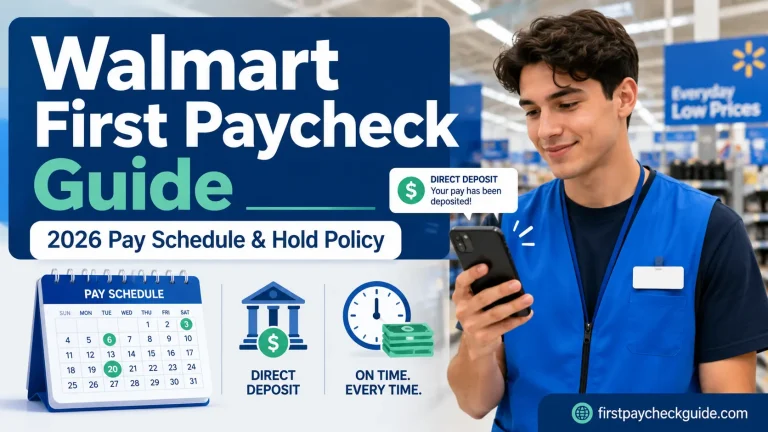
| Walmart | No | Generally biweekly — confirm with your People Lead | Typically 2–3 weeks after start date |
| Target | No | Generally biweekly for many store roles — DailyPay may be available | Typically 2–3 weeks after start date |
| Costco | No | Biweekly, commonly Friday | Depends on start date within the pay period; confirm dates and pay stubs in ESS |
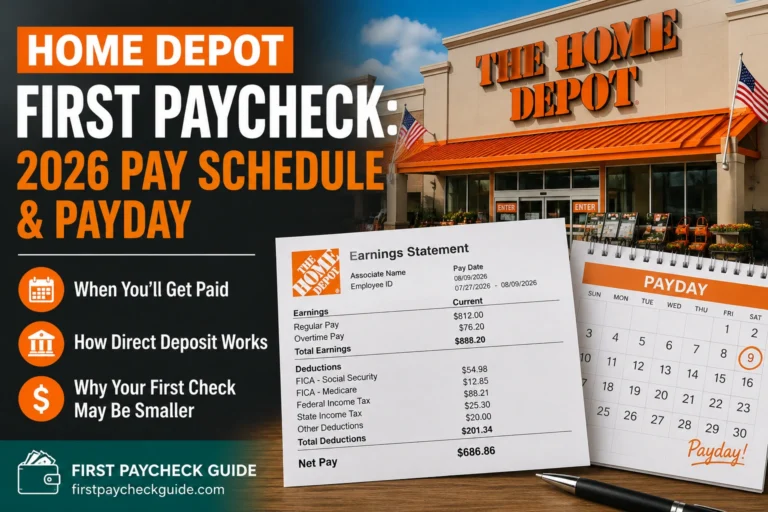
| Home Depot | No special first-paycheck hold is apparent | Biweekly at many U.S. locations; Friday commonly reported | Depends on where your start date falls in the pay period; verify your own store and payslip |
| Starbucks | No | Typically biweekly — confirm in partner portal | After first completed payroll cycle |
| Dollar General | No | Biweekly — confirm with store manager | Typically 2–3 weeks after start date |
| UPS (warehouse/package handler) | No | Weekly for many hourly warehouse roles | After first completed workweek and payroll processing |
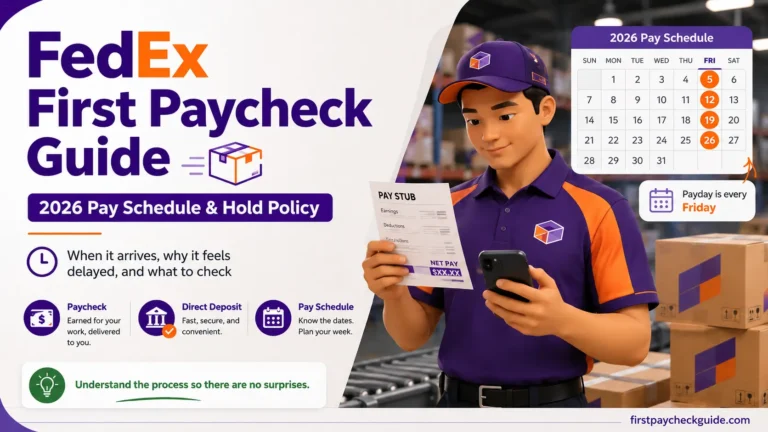
| FedEx Ground (package handler) | No | Weekly (Friday after workweek for many roles) | After first completed workweek and payroll processing |
For Walmart specifically, the bi-weekly cycle and OneWalmart GTA portal play a bigger role in first-paycheck timing than most new associates expect. The Walmart first paycheck guide covers the full 2026 pay schedule, what to check in OneWalmart if your hours aren’t showing up, and what the OnePay early wage access option looks like.
Amazon adds a layer of complexity here because the pay schedule varies by facility – most Fulfillment Centers run weekly while some Sortation Centers and Delivery Stations run bi-weekly, which means the “week in the hole” timing plays out differently depending on where you work.
FedEx is a good example of why first-paycheck delays can feel like a “hold” even when the real issue is payroll timing. A new worker may be waiting because of the pay period cutoff, direct deposit setup, or a contractor payroll process. The FedEx first paycheck guide shows how this works in a real employer situation.
Costco follows the same basic principle: what feels like a held first check is usually the gap between its reported biweekly pay period and Friday payday. The Costco first paycheck guide explains the reported cycle, expected 2026 dates, and ESS pay-stub access.
Home Depot is similar: a new hire can interpret the normal gap between a reported biweekly pay period and payday as a “hold.” The Home Depot first paycheck guide explains first-paycheck timing, Self Service payslips, direct deposit, and what to check if the first payment seems late.
At franchised fast food restaurants like McDonald’s, the wait can vary even more because each Owner/Operator sets their own pay schedule, meaning two McDonald’s locations in the same town might have different paydays and cycle lengths.
Starbucks is an interesting case here because the lag plays out differently depending on your state and when you started — partners in seven states are already on weekly pay while most others are bi-weekly until August 2026, which means two Starbucks partners who started the same week could have completely different first paycheck timelines.
UPS adds an extra layer to the standard payroll lag because direct deposit can take one to two full pay cycles to activate through UPSers.com, meaning most new Package Handlers wait longer than new hires at other employers even when everything is working correctly.
Publix is one of the clearest examples of payroll timing confusion because it pays on Thursdays instead of the Friday that most first-job workers expect, and the Sunday-through-Saturday pay period means the calendar looks different from every other employer covered here.
Chick-fil-A adds an extra layer of complexity here because most locations are independently operated by a local Operator who sets their own payroll calendar, and because pay periods run Monday through Saturday rather than the standard Sunday-to-Saturday cycle most other employers use.
Franchise employers — ask your specific location
McDonald’s, Subway, Domino’s, and other franchise chains set their own pay schedules. The franchise owner — not corporate — decides weekly vs. biweekly. The corporate website will not give you the right answer. Ask your specific store manager on your first day: “When is our payroll cutoff and when will I see my first deposit?”
Why the wait feels longer at big employers
Large employers like Amazon and Walmart process payroll for hundreds of thousands of employees with strict cutoff dates. If you start one day after the cutoff, your first days move to the next cycle — meaning some new hires wait 3 full weeks before their first deposit. This is standard for large organizations and not a sign anything is wrong.
Frequently Asked Questions
Why do jobs hold your first paycheck?
In almost every case, they do not hold it — it is delayed by normal payroll timing. Most employers pay in arrears, meaning your paycheck covers work you already completed in a previous pay period. If you started mid-cycle, your first check covers partial days. A 2–3 week wait for your first deposit is completely normal — not wage theft.
Is it legal for an employer to hold your first paycheck?
No — under the FLSA, covered employers must pay required wages on the regular payday for the pay period covered. If a full pay cycle has passed and you have not been paid, that is a potential violation. Contact HR first, then your state Department of Labor, or the federal Wage and Hour Division at dol.gov/agencies/whd/contact/complaints.
Does every job hold your first paycheck?
No job legally holds your first paycheck. What varies between jobs is how quickly you receive your first payment based on their pay schedule and when in the pay cycle you started. Weekly-pay jobs may pay you within a week. Biweekly-pay jobs often have a 2–3 week wait for the first deposit due to payroll processing timelines and arrears payments.
How long can an employer legally hold your first paycheck?
An employer cannot intentionally hold your paycheck. They must pay you on the established regular payday. For final paychecks (when you leave a job), California requires immediate payment upon termination, Texas requires payment within 6 calendar days for fired employees, and most other states require payment by the next scheduled payday. If you are just starting a job, the wait is due to payroll processing timing — not a legal hold.
Can an employer hold your last paycheck if you quit?
No — employers must pay all earned wages regardless of whether you quit, were fired, or left during a probationary period. In most states, your final paycheck must be issued on the next scheduled payday. California requires payment within 72 hours of quitting (immediately if you gave 72+ hours notice). If your employer refuses to pay your final wages, file a wage claim with your state’s Department of Labor.
What do I do if my first paycheck is late?
First verify that a full pay cycle has actually passed and check whether a paper check was mailed. Then contact HR using the copy-paste message in this guide. If HR does not resolve it within 2 business days, file a wage claim with your state’s Department of Labor or contact the federal WHD at dol.gov/agencies/whd/contact/complaints or 1-866-487-9243.
Can an employer hold your paycheck until you return equipment?
No — employers cannot withhold earned wages as leverage to return equipment, keys, or uniforms. Deductions for unreturned items may only be made if they are legally permitted, do not reduce pay below minimum wage, and were properly authorized where required by law. If your employer refuses to pay you until you return something, contact your state Department of Labor.
Does Amazon hold your first paycheck?
No — Amazon does not hold first paychecks. Pay schedules vary by role and location. Ask HR or check the A to Z app on your first day for your specific payroll cutoff date and first expected deposit date. Most Amazon employees wait 2–3 weeks for their first deposit due to normal payroll processing timelines.
Now You Know When You Are Getting Paid — Here Is What to Do With It
Your first paycheck is not being held — it is on its way. The 2–3 week wait is normal payroll timing, not wage theft. Now that you know when to expect it, the next step is knowing exactly what to do the moment it arrives so you do not run out of money before the next one hits.

About the Author
Ashief Mahmood is the Founder and Editor of First Paycheck Guide. He researches and explains first-paycheck topics for U.S. first-time workers using IRS publications, U.S. Department of Labor resources, official employer documentation, payroll sources, and carefully labeled estimates.
Ashief is not a financial advisor, tax professional, payroll provider, lawyer, or employer representative. First Paycheck Guide is an independent educational website.
The information in this article is for general educational purposes only and does not constitute legal advice. Wage payment laws vary by state and change over time. California final paycheck rules sourced from California DIR (dir.ca.gov). Texas final paycheck rules sourced from Texas Workforce Commission (twc.texas.gov). Federal FLSA information sourced from the U.S. Department of Labor (dol.gov). For specific legal guidance, consult your state’s Department of Labor or a qualified employment attorney.