
What Is a Tip Credit? How It Affects Your Paycheck (2026)
What is a tip credit? Quick answer
- A tip credit is not a deduction taken from your tips. It is a wage rule that allows an employer, where permitted, to count some of the tips you actually receive toward its minimum-wage obligation.
- Under federal law, the maximum tip credit is $5.12 per hour. An employer using the full federal tip credit must still pay at least $2.13 per hour in direct cash wages toward the $7.25 federal minimum wage.
- Your employer must make up any minimum-wage shortfall. If your direct cash wages plus allowable tips do not reach the required federal minimum for the workweek, the employer must pay the difference.
- Your state may require you to receive much more in direct wages. Some states require a higher tipped cash wage, while several states do not allow employers to use a tip credit at all.
- Your employer must tell you about the federal tip credit before using it. Federal rules require specific notice about the cash wage, the amount of credit claimed, your right to retain tips, and related requirements.
If this is your first server, bartender, hospitality, or other tipped job, this guide explains what a tip-credit line means on your paycheck, why a tipped paycheck can look surprisingly small, how the federal math works, and what to check if the numbers do not look right.
⚡ Quick Skim: Jump to What You Need
What is a tip credit and how does it work?
A tip credit is a legal way for an employer to count some of the tips you actually receive toward the employer’s obligation to pay minimum wage. Under federal law, it applies only when the FLSA’s tipped-employee rules are satisfied. It does not mean your employer can simply choose a lower hourly rate because customers tip you.
For each workweek, the employer must be able to show that the direct cash wage it paid plus the allowable tip credit is enough to meet the federal minimum-wage requirement. Only tips actually received by the employee can support the credit. If the numbers do not reach the required minimum, the employer has to make up the shortfall.
State law can be more protective. Some states require a higher tipped cash wage than the federal floor, while others do not allow a tip credit at all. When state and federal rules differ, the more protective standard generally controls.
If you work as a server in Florida, the state-specific numbers are much higher than the federal floor. Our Florida server minimum wage guide for 2026 explains the $10.98 direct wage through September 29, the $11.98 rate starting September 30, the $3.02 tip credit, and Florida overtime examples.
What does tip credit mean on your paycheck or pay stub?
If you see “tip credit,” “tip credit wage,” “tip makeup,” or a similar line on your pay stub, do not assume that amount was taken away from your tips. A tip credit is usually an accounting line showing how tips are being counted toward the employer’s wage obligation. Payroll systems label these items differently, so the exact wording on your stub can vary.
Tip credit is not the same as a deduction
A federal tip credit can reduce the amount of minimum wage the employer must pay directly in cash, but it does not give the employer ownership of your tips. Employers, managers, and supervisors generally may not keep employees’ tips, subject to the specific federal rules for valid tip pools and tips a manager receives directly for service they personally and solely provide.
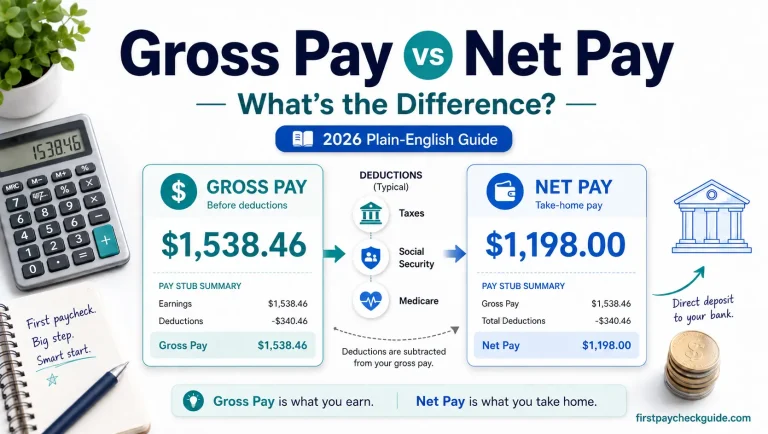
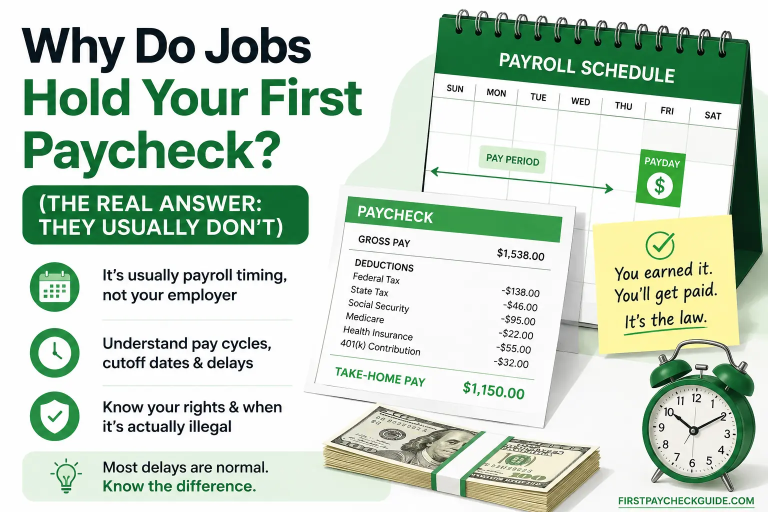
To understand the rest of the paycheck around that line—gross pay, taxes, reported tips, net pay, and deductions—use our plain-English pay stub guide.
Why can a tipped paycheck look tiny—or even close to $0?
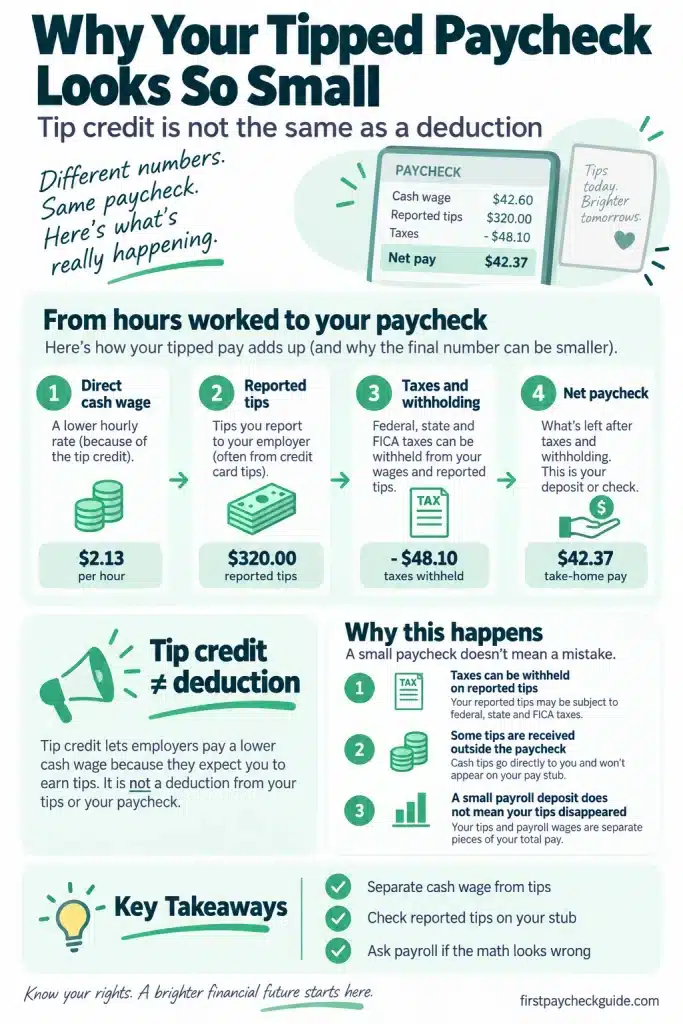
A very small net paycheck does not necessarily mean the tip credit itself was deducted from your pay. If you receive some tips separately—such as cash tips or card tips paid outside the regular paycheck—your employer still has to calculate withholding based on wages and reported tip income. Social Security, Medicare, and income taxes on those reported tips may be collected from the regular wages available on the paycheck.
The IRS explains in Topic No. 761 on tip withholding and reporting that when regular wages are not enough to cover all withholding on reported tips, federal rules apply a priority order: taxes on regular wages come first, then Social Security and Medicare taxes on reported tips, and then income tax on those tips. Some amounts may be collected from later payrolls or reported on Form W-2 for the employee to address at tax filing, depending on the tax involved. That is why a tipped worker can earn meaningful tips during the week but still see a surprisingly small payroll deposit.
Separate the three numbers
Cash wage is what the employer pays directly. Tips are amounts received from customers or through an eligible tip-sharing arrangement. Net paycheck is what remains in the payroll payment after withholding and other lawful deductions. They are related, but they are not the same number.
What are the federal cash wage and tip credit amounts?
As of 2026, the federal minimum wage is $7.25 per hour. Under the FLSA, an employer taking the maximum federal tip credit must pay a tipped employee at least $2.13 per hour in direct cash wages and may claim a maximum tip credit of $5.12 per hour. The basic federal equation is:
The $2.13 figure is only the federal floor. Many states require a much higher direct cash wage for tipped employees, and some require the full state minimum wage before tips. Always check the current rule where you actually work rather than assuming the federal numbers apply to your paycheck.
Tip credit example: what the math looks like on a real workweek
Suppose a tipped employee is covered only by the federal minimum and works 20 hours in one workweek.
| Calculation | Amount |
|---|---|
| Federal minimum-wage obligation | $7.25 × 20 = $145.00 |
| Direct cash wage at federal tipped minimum | $2.13 × 20 = $42.60 |
| Maximum possible federal tip credit | $5.12 × 20 = $102.40 |
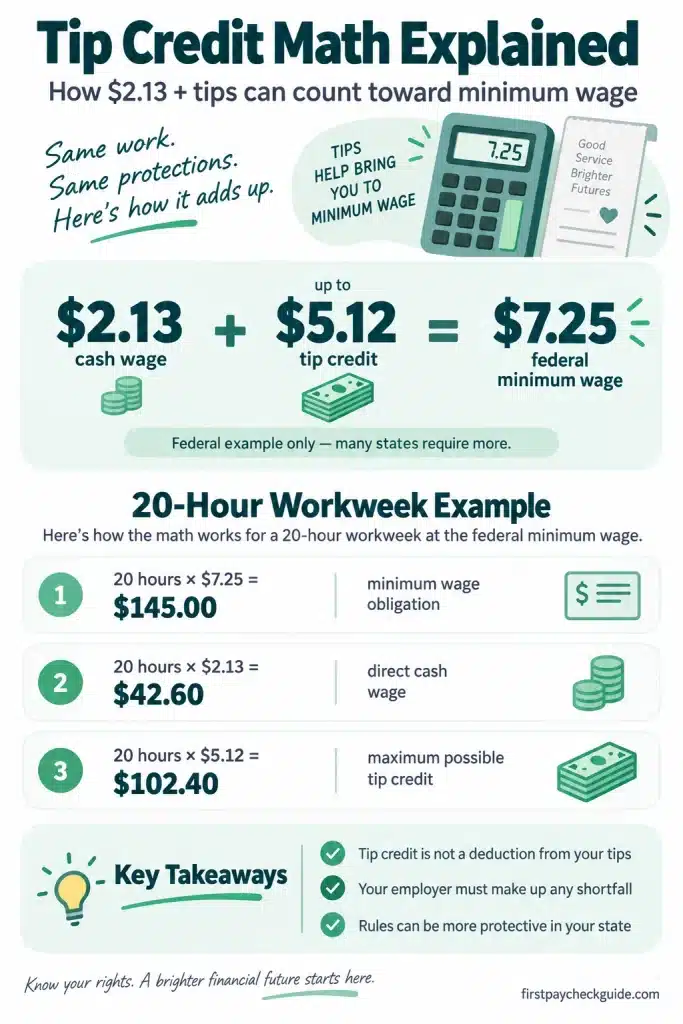
If the employee actually receives at least $102.40 in qualifying tips for that workweek, the federal minimum-wage requirement can be met with the $42.60 cash wage plus the allowable tip credit. If the employee receives only $60 in tips, the combined amount would be $102.60, which is $42.40 below the $145 federal minimum-wage obligation. The employer would have to make up that difference.
This example is intentionally federal-only. A higher state or local minimum wage can change every number in the calculation.
What if your tips don’t add up to minimum wage?
Under the federal rule, an employer claiming a tip credit has to be able to show for each workweek that the employee received enough direct cash wages plus allowable tips to satisfy the federal minimum-wage requirement. If the total falls short, the employer must make up the difference.
That means one unusually slow shift does not necessarily create a separate federal shortfall if stronger tip earnings elsewhere in the same workweek bring the total up to the required level. But the employer cannot carry an actual workweek shortfall forward and simply hope a later week fixes it.
Watch for a tip-makeup adjustment
Payroll systems use different labels, but a slow workweek may show an added wage adjustment, tip makeup, or similar line. If your tips plus direct cash wages are below the applicable minimum and there is no correction, save your time records and pay stub and ask payroll how the shortfall was handled.
Which states don’t allow a tip credit?
State tipped-wage rules vary widely. The U.S. Department of Labor’s tipped-minimum-wage table, updated July 1, 2026, identifies the following states as requiring employers to pay tipped employees the full applicable state minimum wage before tips rather than using a tip credit:
🚫 States requiring full state minimum wage before tips
- Alaska
- California
- Minnesota
- Montana
- Nevada
- Oregon
- Washington
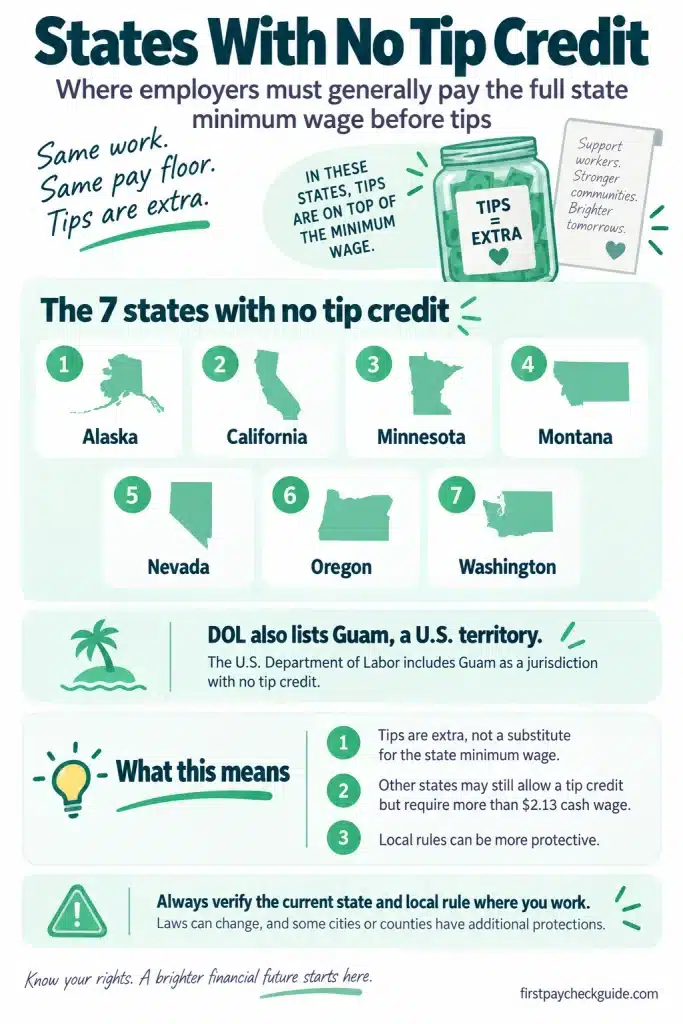
Territory note: The DOL table also lists Guam, a U.S. territory, among jurisdictions where employers must pay the applicable minimum wage in cash before tips. Montana also has a separate lower state minimum-wage rule for certain small businesses not covered by the FLSA, so workers there should check the current state and DOL tables rather than relying on one statewide number.
Other states may allow a tip credit but require a direct cash wage higher than the federal $2.13 floor. Local city or county rules can also be more protective. Use the current U.S. Department of Labor tipped-wage table as a starting point, then confirm your state and local rules.
What must your employer tell you before using a federal tip credit?
An employer cannot simply pay the lower tipped cash wage without telling you how the federal tip credit is being used. Before taking a federal tip credit, the employer must inform the tipped employee of key information required by the FLSA.
📋 Federal tip-credit notice should cover:
- The direct cash wage the employer will pay you.
- The additional amount the employer will claim as a tip credit.
- That the credit cannot exceed the tips you actually receive.
- That you retain your tips except for a valid tip-pooling arrangement.
- That the federal tip credit does not apply unless you have been informed of these provisions.
The Department of Labor says this notice may be oral or written. If the employer fails to provide the required information, it cannot take the federal FLSA tip credit for that employee.
What counts as a “tipped employee”?
Under the federal FLSA, a tipped employee is someone engaged in an occupation in which they customarily and regularly receive more than $30 a month in tips. Common examples include servers, bartenders, bussers, bellhops, and some other service employees, depending on the actual occupation and how tips are received.
Don’t confuse this $30 FLSA threshold with the IRS tip-reporting rule. If you receive $20 or more in cash tips during a calendar month while working for one employer, the IRS generally requires you to report those tips to that employer by the 10th day of the following month. The $20 and $30 figures answer two different questions.
Receiving an occasional tip does not automatically make every part of a job a tipped occupation. The job you are actually performing matters, especially when one employee works in both tipped and non-tipped roles.
What if you do side work or have two different jobs?
Current federal guidance distinguishes a true dual job from duties that are part of a tipped occupation. For example, someone who works part of the week as a hotel maintenance worker and part as a server is in two occupations; a tip credit cannot be taken for the maintenance hours. By contrast, a server may perform related duties such as cleaning and setting tables, making coffee, or occasionally washing glasses without automatically becoming a separate non-tipped occupation.
Important 2026 update: the old federal 80/20 and 30-minute test was vacated
The Fifth Circuit first issued an opinion on August 23, 2024. On October 29, 2024, it granted panel rehearing, withdrew that earlier opinion, and issued a superseding decision vacating the 2021 dual-jobs revision. The Department of Labor then restored the earlier dual-jobs regulatory text in December 2024. The DOL explains the change in its current Tip Regulations under the FLSA.
DOL’s 2026 regulatory agenda also lists RIN 1235-AA54, Tip Regulations Under the FLSA, at the proposed-rule stage. The agenda says the Department is considering a notice of proposed rulemaking; that agenda item does not itself change the current federal rule. Check DOL’s latest guidance for future updates rather than relying on older summaries of the 80/20 or 30-minute test.
What about tip pooling and tip sharing?
Federal tip-pool rules depend partly on whether the employer is taking a tip credit. If the employer takes a federal tip credit, a mandatory “traditional” tip pool generally may include employees who customarily and regularly receive tips, such as servers, bussers, bellhops, and service bartenders. The employer may take a tip credit only for tips the employee ultimately receives after the valid pool is distributed.
If the employer pays everyone in the pool at least the full federal minimum wage in direct cash wages and takes no tip credit, federal law can allow a broader “nontraditional” tip pool that includes workers such as cooks or dishwashers. State law may impose tighter rules.
If your employer collects tips to administer a mandatory tip pool, federal rules generally require those collected tips to be distributed by the regular payday for the relevant workweek or pay period. If payroll cannot determine the amount in time, the tips must be distributed as soon as practicable afterward.
Can a manager or owner take part of the tip pool?
Under the FLSA, employers, managers, and supervisors may not keep employees’ tips or receive distributions from an employee tip pool. A manager or supervisor may keep a tip only when a customer gives it directly for service the manager or supervisor directly and solely provided.
How does tip credit work with overtime?
Overtime is one of the easiest places for tipped-pay calculations to go wrong. If an employer takes a federal tip credit, it cannot calculate overtime using only the reduced cash wage, such as $2.13 per hour. The overtime calculation must start from the employee’s full regular rate, subject to the FLSA rules.
For a simple federal-minimum example, 1.5 times $7.25 is $10.875 per overtime hour. The employer generally cannot increase the ordinary $5.12 tip credit just because the hour is overtime. That means the direct cash portion for that simplified example would be at least about $5.76 for the overtime hour. Actual overtime can be higher when the regular rate includes other compensation or when state law requires more.
Tip credit vs. FICA Tip Credit: they are not the same thing
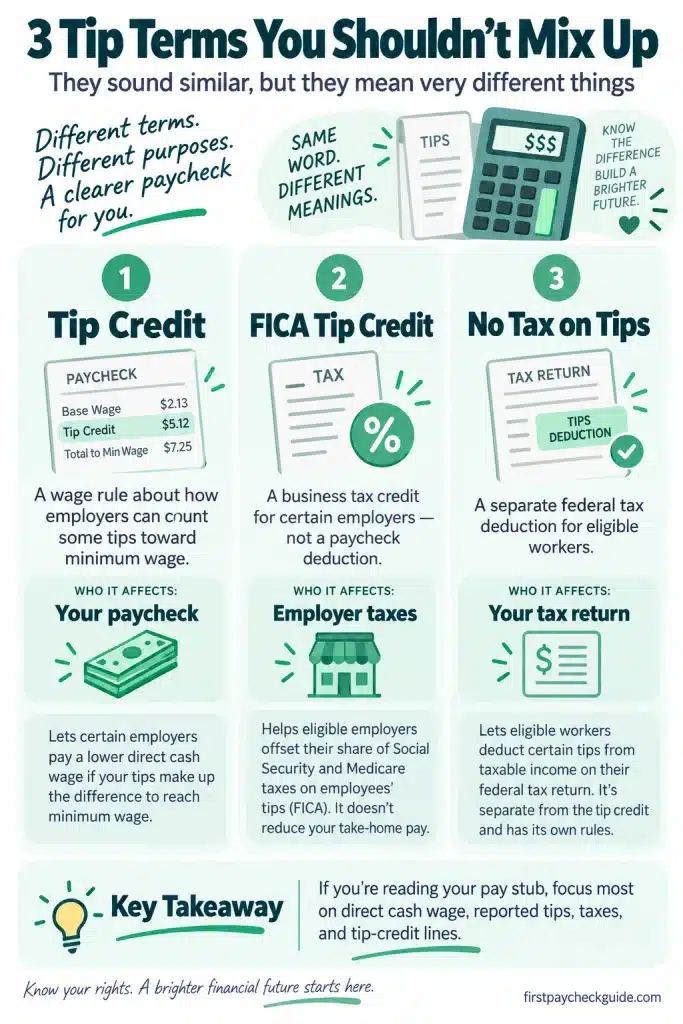
Search results often mix together two different concepts. The wage tip credit discussed in this article is part of minimum-wage law and affects how an employer may satisfy wage obligations to a tipped worker. The FICA Tip Credit is a separate federal business tax credit that certain employers may claim for the employer share of Social Security and Medicare taxes on qualifying tips; the IRS explains it on its FICA Tip Credit for employers page.
If you see “FICA Tip Credit” online
That employer tax credit is not a line item being taken from your paycheck. For your own paycheck, focus on your direct cash wage, reported tips, tip-pool deductions or distributions, taxes, and any tip-makeup adjustment.
Does the 2026 “No Tax on Tips” deduction change tip-credit rules?
No. The federal “No Tax on Tips” provision is an income-tax deduction for eligible qualified tips; it does not replace minimum-wage, tip-credit, tip-pooling, or overtime rules. The IRS says the deduction applies for tax years 2025 through 2028, with a maximum annual deduction of $25,000 for eligible taxpayers, subject to occupation, reporting, income, filing-status, and other requirements. See the IRS explanation of the No Tax on Tips deduction.
Tips still need to be properly reported, and tips are generally still subject to Social Security and Medicare taxes when the federal reporting threshold applies. So a smaller federal income-tax bill does not mean the tip-credit line on your paycheck disappears.
How to check your employer is doing this correctly
✅ Quick check for your own paycheck
- Find your direct cash wage. Compare it with the current tipped cash-wage rule for your state and city.
- Match the workweek and hours. Make sure the hours on your stub line up with the workweek you are checking.
- Review reported tips. Compare payroll’s tip figure with your own records, including tip-pool amounts when relevant.
- Look for a tip-makeup or shortfall adjustment. If direct cash wages plus allowable tips do not meet the applicable minimum for the workweek, ask how the difference was corrected.
- Confirm you received tip-credit notice. If the employer is using a federal tip credit, you should have been informed of the required tip-credit provisions.
- Check any tip pool. If a manager, supervisor, or owner is receiving employee tip-pool distributions, that deserves immediate review.
- Check overtime separately. Overtime should not be calculated from only the reduced tipped cash wage.
If something still looks wrong, keep copies of your pay stub, schedule, time records, tip reports, and messages with payroll or your manager. You can compare the federal rules with the U.S. Department of Labor’s Fact Sheet #15 and your state labor agency. If earned wages remain unpaid, the DOL Wage and Hour Division also accepts wage complaints. Federal law prohibits retaliation against workers for asserting protected FLSA rights or filing protected wage complaints, and DOL says Wage and Hour Division complaints are generally confidential.
Frequently Asked Questions
What is a tip credit?
A tip credit is the amount of qualifying tips an employer may count toward its minimum-wage obligation for a tipped employee. Under the federal FLSA, the maximum tip credit is currently $5.12 per hour when the employer pays at least $2.13 per hour in direct cash wages toward the $7.25 federal minimum wage.
What does tip credit mean on my paycheck or pay stub?
A tip-credit line usually shows how tips are being counted toward the employer’s wage obligation. It is not automatically a deduction from your tips. Payroll systems use different labels, so compare the line with your cash wage, reported tips, tip-pool amounts, taxes, and any tip-makeup adjustment.
What happens if my tips don’t add up to minimum wage?
Under the federal rule, the employer must make up the difference if your direct cash wages plus allowable tips do not satisfy the applicable federal minimum-wage requirement for the workweek. State or local law may require a higher amount.
Which states don’t allow tip credits?
The U.S. Department of Labor’s July 1, 2026 tipped-wage table identifies Alaska, California, Minnesota, Montana, Nevada, Oregon, and Washington as states requiring the full applicable state minimum wage before tips. DOL also lists Guam, a U.S. territory, as requiring the applicable minimum wage in cash before tips. State and local rules can change, so verify the current rate where you work.
Can my manager take a cut of the tip pool?
Under the federal FLSA, employers, managers, and supervisors may not keep employees’ tips or receive distributions from an employee tip pool. A manager or supervisor may keep only tips received directly from a customer for service they directly and solely provided.
How much do I have to earn in tips to be a tipped employee?
Under the federal FLSA, a tipped employee is someone engaged in an occupation in which they customarily and regularly receive more than $30 a month in tips.
Is the federal 80/20 tip rule still in effect?
The 2021 federal dual-jobs rule that included the 80/20 and 30-minute limits was vacated in the Fifth Circuit’s superseding October 29, 2024 decision, after the court withdrew its earlier August 23 opinion. The Department of Labor restored the earlier dual-jobs regulatory text in December 2024. State rules may still be different or more protective.
How does tip credit work with overtime?
An employer taking a federal tip credit cannot calculate overtime using only the reduced cash wage. The overtime calculation must start from the employee’s full regular rate under the FLSA, and the employer generally cannot take a larger ordinary tip credit simply because the hour is overtime.
Is FICA Tip Credit the same as the wage tip credit?
No. The wage tip credit is part of minimum-wage law. The FICA Tip Credit is a separate business tax credit that certain employers may claim for the employer share of Social Security and Medicare taxes on qualifying tips.
Does No Tax on Tips mean tips are no longer taxed in 2026?
No. The federal provision is an income-tax deduction for eligible qualified tips for tax years 2025 through 2028, subject to eligibility rules. Tips still have reporting requirements and are generally still subject to Social Security and Medicare taxes when the federal threshold applies.
Is $20 or $30 the real tip threshold?
Both, for different purposes. Under federal wage law, a tipped employee is someone who customarily and regularly receives more than $30 a month in tips. Separately, the IRS generally requires you to report cash tips to your employer when you receive $20 or more in a calendar month while working for that employer. The two thresholds answer different questions.
📚 What to read next
- Need help with the rest of your stub? How to Read a Pay Stub for the First Time
- Starting a tipped or tip-adjacent coffee job? Starbucks First Paycheck Guide
- Working your first restaurant job? McDonald’s First Paycheck Guide
- At an independently operated restaurant location? Chick-fil-A First Paycheck Guide
- Ready to plan the money that actually reaches you? The 50/30/20 Rule for Your First Paycheck
Sources and verification: U.S. Department of Labor Fact Sheet #15; DOL Tip Regulations under the FLSA; DOL Minimum Wages for Tipped Employees; Unified Agenda RIN 1235-AA54; IRS Topic No. 761; IRS FICA Tip Credit for Employers; and IRS No Tax on Tips guidance. Federal and state wage rules can change; always verify the current rule for your location. Reviewed September 2026.
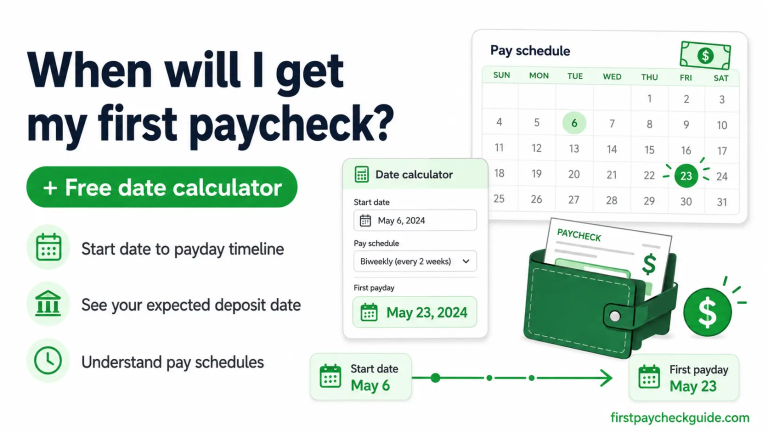
Know when your next paycheck lands?
Get a specific estimate based on your start date and pay schedule.

About the Author
Ashief Mahmood is the Founder and Editor of First Paycheck Guide. He researches and explains first-paycheck topics for U.S. first-time workers using IRS publications, U.S. Department of Labor resources, official employer documentation, payroll sources, and carefully labeled estimates.
Ashief is not a financial advisor, tax professional, payroll provider, lawyer, or employer representative. First Paycheck Guide is an independent educational website.
Tipped minimum wage rates, tip credit rules, overtime requirements, and tip-pooling rules vary by state and can change. This article is a general educational overview based on federal and state guidance reviewed in September 2026 and is not legal advice. Confirm the current wage and tip rules for your specific state and locality before relying on them.