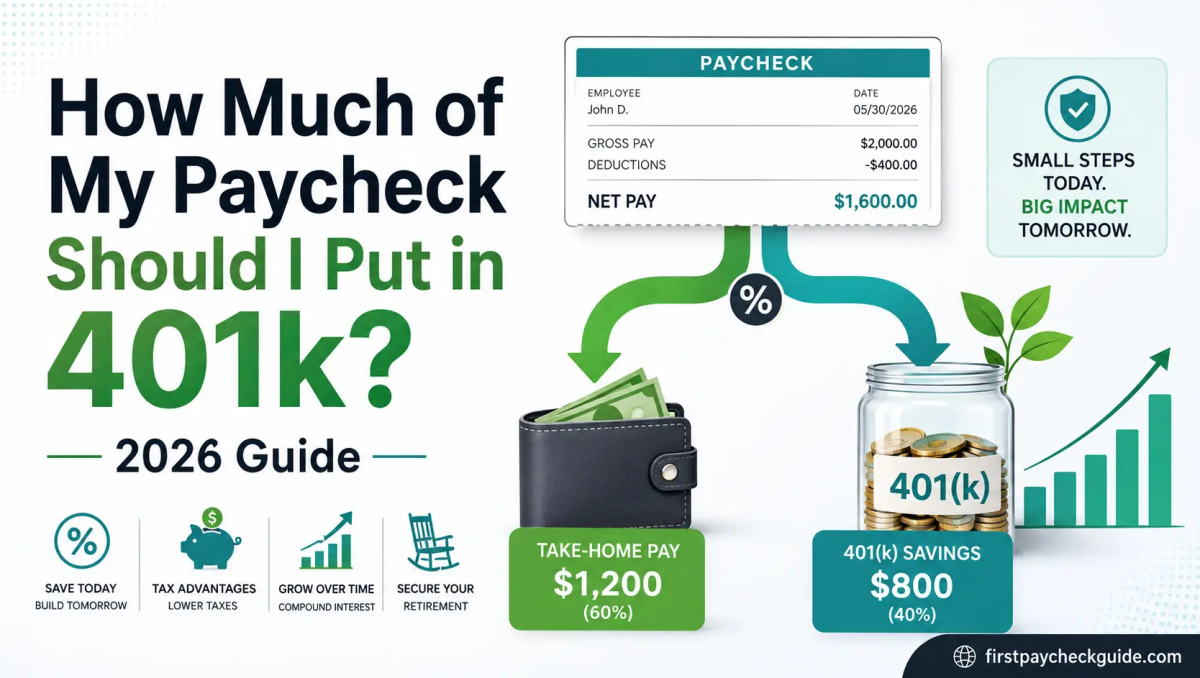
How Much of My Paycheck Should I Put in 401k? (2026 Guide)
⚡ How much of my paycheck should I put in my 401(k)? — quick answer
Yes — if your employer offers a match, contribute at least enough to get the full match on day one. That match is free money and the best guaranteed return on any investment you will ever find. If there is no match, contribute what you can afford after building a small emergency fund first.
- Employer match — if your employer matches contributions, get the full match before anything else. A 50% match on 6% contributions is an instant 50% return.
- How much of your paycheck — most first-job workers put 3–6% of each paycheck into their 401(k). Enough to get the full employer match is the minimum target.
- Tax benefit — traditional 401(k) contributions reduce your federal taxable income immediately. A $100 contribution costs you less than $100 out of pocket.
- FICA note — 401(k) contributions do not reduce Social Security or Medicare taxes. Only federal and state income tax is affected.
Somewhere in your new-hire paperwork — or sitting unread in your work email — is a 401(k) enrollment form. Most people starting their first real job ignore it, close the tab, and tell themselves they will figure it out later.
Later is costing you money right now.
Every pay period you delay enrolling — especially if your employer offers a match — is free compensation you are permanently leaving on the table. You cannot go back and claim missed match contributions from previous pay periods.
Here is exactly what a 401(k) is, how much of your paycheck to put in, why the employer match changes everything, and what happens if you do nothing.
Table of Contents
What is a 401(k)?
A 401(k) is a retirement savings account offered through your employer. The name comes from the section of the IRS tax code that created it — Section 401(k). You contribute a percentage of each paycheck into the account before federal income tax is calculated, and the money grows tax-deferred until you withdraw it in retirement.
Three things make a 401(k) different from a regular savings account:
1. Pre-tax contributions
Your contributions come out of your paycheck before federal income tax is calculated. If you earn $50,000 and contribute $3,000 to your 401(k), you only pay federal income tax on $47,000. This reduces your tax bill today.
2. Tax-deferred growth
Any investment gains inside your 401(k) are not taxed while the money sits in the account. You only pay tax when you withdraw the money in retirement — ideally at a lower tax rate than you pay now.
3. Employer match
Many employers add free money to your account when you contribute. If your employer matches 50% of your contributions up to 6% of your salary, contributing 6% means your employer adds another 3% — for free.
What it is not
A 401(k) is not a bank account you can access freely. Withdrawing money before age 59½ triggers a 10% penalty plus income tax on the amount withdrawn. Think of it as locked away until retirement.
First — check when you can actually enroll
Some employers let you join the 401(k) immediately on day one. Others require a waiting period of 30, 60, or 90 days — some up to a full year. Your employer match may also start later than your first day. Before anything else, ask HR: “When am I eligible to enroll in the 401(k) and when does the employer match begin?”
The employer match — why this changes everything
If your employer offers a 401(k) match, contributing enough to get the full match is the single best financial move you can make at your first job. No investment, no savings account, and no financial product on the planet offers a guaranteed instant return the way an employer match does.
💡 The employer match in plain numbers
Your salary: $50,000. Your employer matches 50% of contributions up to 6% of salary.
If you contribute 6% ($3,000/year), your employer adds $1,500 — free. That is an instant 50% return before the money even gets invested. A savings account pays 4–5%. The stock market averages 7–10% annually. Nothing beats a guaranteed 50% instant return.
If you contribute 0%, your employer contributes 0%. Skipping the match is leaving part of your compensation on the table permanently. You cannot go back and claim it later.
Common employer match structures in 2026
Employer match formulas vary. Here are the most common:
- 100% match up to 3% — contribute 3%, employer adds 3%
- 50% match up to 6% — contribute 6%, employer adds 3%
- 100% match up to 4% — contribute 4%, employer adds 4%
- No match — employer does not contribute regardless of what you put in
Check your offer letter or ask HR: “What is the 401(k) match formula and when am I eligible?”
Is my employer’s 401(k) match good?
If you are staring at your offer letter and wondering whether the match is generous or stingy, here is how it compares to the national average:
| Match formula | What it means on a $45,000 salary | How it rates |
|---|---|---|
| No match | Employer contributes $0 | Below average — but still worth contributing for the tax benefit |
| 50% up to 3% | You contribute $1,350, employer adds $675 | Below average |
| 50% up to 6% | You contribute $2,700, employer adds $1,350 | Average — most common formula in the US |
| 100% up to 3% | You contribute $1,350, employer adds $1,350 | Average to good |
| 100% up to 4% | You contribute $1,800, employer adds $1,800 | Good |
| 100% up to 6% | You contribute $2,700, employer adds $2,700 | Excellent — above average |
What is the average 401(k) match in the US?
According to Vanguard’s How America Saves 2025 report covering nearly 5 million participants, the average promised employer match is 4.6% of pay with a median of 4.0%. A 50% match up to 6% produces a 3% employer contribution — common, but technically below the average promised match value. A 100% match up to 4% or more is above average.
⚠️ If you plan to leave in 1–3 years — read this first
Your own contributions are always 100% yours from day one. But your employer’s matching contributions are usually subject to a vesting schedule — meaning you only keep the employer match if you stay long enough.
Common vesting schedules:
- 3-year cliff vesting — you keep 0% of the employer match if you leave before year 3, then 100% after year 3
- Graded vesting — you earn a percentage each year (e.g. 20% per year over 5 years)
- Immediate vesting — you keep 100% of the employer match from day one (less common)
If you leave after 18 months under a 3-year cliff schedule, you keep everything you contributed — but none of the employer match. Still worth contributing for the tax benefit and your own savings — but do not count on the employer match money if you plan to move on before vesting. Ask HR: “What is the vesting schedule for employer contributions and when does it start?”
How much does a 401(k) actually reduce your take-home pay?
One reason people hesitate to contribute is they assume the full contribution amount disappears from their take-home pay. It does not — because the contribution reduces your federal taxable income first.
| Annual salary | Per biweekly check cost (6% contribution) | Federal tax saved per check (est. 12% bracket) | Actual take-home reduction per check | Annual 401(k) contribution |
|---|---|---|---|---|
| $35,000 | $80.77 | ~$9.69 | ~$71 per check | $2,100/year |
| $40,000 | $92.31 | ~$11.08 | ~$81 per check | $2,400/year |
| $45,000 | $103.85 | ~$12.46 | ~$91 per check | $2,700/year |
| $50,000 | $115.38 | ~$13.85 | ~$101 per check | $3,000/year |
| $55,000 | $126.92 | ~$15.23 | ~$112 per check | $3,300/year |
On a $40,000 salary, contributing 6% costs you about $81 per biweekly check — not $92. The federal tax savings offset roughly $11 per check. On a $45,000 salary it costs about $91 per check. The contribution hurts your take-home pay less than most people expect once you factor in the tax reduction.
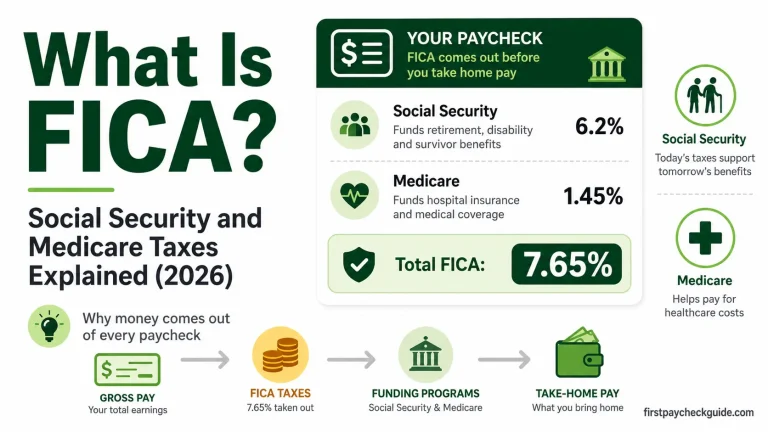
401(k) contributions do not reduce FICA
Your 401(k) contribution lowers your federal income tax and usually your state income tax — but it does not lower Social Security or Medicare taxes. FICA is calculated on your full gross wages before any 401(k) deduction. This is why the take-home reduction is not as small as it might seem — FICA still comes out of the full gross amount regardless of how much you contribute.
How much of your paycheck should you put in your 401(k)?
The right contribution amount depends on whether your employer offers a match and where you are financially. Here is a simple framework:
- Start by putting enough of your paycheck in to get the full employer match. If your employer matches contributions up to 6%, put at least 6% of each paycheck into your 401(k). This is non-negotiable — it is free compensation. Do this before anything else.
- Build a small emergency fund. Before contributing beyond the match, make sure you have 1–3 months of expenses in a regular savings account. A 401(k) has a 10% early withdrawal penalty — you do not want to be forced to raid it for an unexpected expense.
- Increase contributions over time. If you cannot afford more than the match right now, that is fine. Increase your contribution by 1% every time you get a raise. You will never miss money you never saw in your paycheck.
- Work toward 10–15% long term. Most financial planners suggest saving 10–15% of your income for retirement including the employer match. At your first job, even 3–6% is a strong start that puts you ahead of most people your age.
Your 401(k) contribution doesn’t have to compete with the rest of your budget if you plan around it from the start. The 50/30/20 rule for your first paycheck shows where retirement contributions fit alongside rent, groceries, and everything else you’re paying for, and how to prioritize a match against an emergency fund.
How much of my paycheck should I put in my 401(k) in my 20s?
In your 20s, the goal is not to maximize contributions immediately — it is to start the habit and capture any employer match. A realistic target for most people in their 20s is 6–10% of salary including the employer match. If your employer matches 3%, contributing 3% yourself means 6% total going into your retirement account each month. That is a strong foundation. Increase by 1% each year as your salary grows and you will reach 10–15% without feeling the pinch.
2026 401(k) contribution limits — your limit vs the total limit
The IRS sets two separate limits for 2026:
- Employee contribution limit: $24,500 — this is the maximum you personally can contribute from your paycheck
- Total combined limit: $72,000 — this covers your contributions plus your employer’s match combined
Most first-job workers contribute well below the $24,500 limit — 3–6% of salary is a typical starting point. Workers aged 50 and over can contribute an additional $8,000 catch-up contribution for a total of $32,500. Workers aged 60–63 have a higher “super catch-up” limit of $11,250 under SECURE 2.0 if their plan allows it.
⚠️ Does employer match count toward your $24,500 limit?
No — and this is one of the most common 401(k) misconceptions. The $24,500 employee contribution limit applies only to what you contribute from your paycheck. Your employer’s matching contributions are on top of that limit and do not reduce how much you can put in. If you contribute $5,000 and your employer matches $2,500, your total 401(k) balance grows by $7,500 — but only $5,000 counts against your personal $24,500 annual limit.
What if your employer does not offer a 401(k) match?
If your employer offers a 401(k) but no match, the decision is less urgent but still worth considering. The tax benefit is still real — contributions reduce your federal taxable income — but the math is less compelling without the free money from the match.
Still worth contributing if:
You are in the 22% tax bracket or higher. You want to build the habit of automatic savings early. You have an emergency fund already and can afford to lock money away. Your employer’s 401(k) has low-fee index fund options.
Consider a Roth IRA first if:
You are in the 10% or 12% tax bracket (most first-job workers). A Roth IRA lets you contribute after-tax money that grows tax-free — meaning you pay no tax on withdrawals in retirement. At low income levels, paying tax now at 12% and never paying tax again is often better than deferring tax at 12% and paying it later. Roth IRA 2026 limit: $7,500 per year, subject to income limits.
401(k) pre-tax vs Roth — which should you choose at your first job?
Some employers offer a Roth 401(k) option alongside the traditional 401(k). Traditional = pre-tax contributions, taxed on withdrawal. Roth = after-tax contributions, tax-free on withdrawal. For most first-job workers in the 12% bracket, the Roth option is usually the better long-term choice if available. Ask HR which options your plan includes.
What happens if you put nothing in your 401(k)?
Many employers now use automatic enrollment — meaning you are opted in to the 401(k) at a default contribution rate (usually 3%) unless you actively opt out. If your employer does this, doing nothing means you are already contributing, which is actually the right default.
⚠️ The auto-enrollment trap — check your default rate
The default auto-enrollment rate is usually 3%. But if your employer matches contributions up to 6%, a 3% contribution means you are only capturing half the available match. Log into your HR portal or benefits system and confirm your contribution percentage. If it is below the match threshold, increase it immediately to capture the full match.
However, if your employer does not auto-enroll and you do nothing:
The cost of waiting:
- You miss the employer match permanently — you cannot go back and claim missed match contributions from previous pay periods
- You lose compounding time — money invested at 22 has 40+ years to grow. Money invested at 32 has 30 years. That 10-year difference is enormous due to compound interest
💡 The true cost of waiting 10 years — same $1,000, very different result
At 7% average annual return, a single $1,000 investment grows to:
| When you invest | Years of growth | Value at age 62 | Difference |
|---|---|---|---|
| Age 22 | 40 years | $14,974 | — |
| Age 32 | 30 years | $7,612 | − $7,362 lost |
By waiting just 10 years to invest that same $1,000, you lose $7,362 in pure growth. Your money ends up worth roughly half — not because you invested less, but because you gave up a decade of compounding time.
What should you invest in inside your first 401(k)?
Enrolling is step one. Choosing where your money goes inside the 401(k) is step two — and most first-time workers have no idea what to pick.
💡 The simplest beginner choice — the target-date fund
Look for a fund with a year in the name that is close to when you plan to retire. If you are 22 and expect to retire around 65, look for something like “Target Date 2065” or “Target Date 2070.” These funds automatically hold a mix of stocks and bonds and gradually shift to more conservative investments as you get closer to retirement. You do not need to manage anything.
Vanguard reports that 96% of retirement plans offer target-date funds and 84% of participants use them. If you are unsure what to choose, a target-date fund is almost always better than leaving money in a cash or money market default, or randomly picking funds you do not understand.
What happens to your 401(k) when you leave your first job?
Your own contributions are always yours. The employer match depends on vesting. When you leave a job you have four options for what to do with the 401(k) balance:
Roll it into your new employer’s 401(k)
If your new job has a 401(k) that accepts rollovers, you can move the money directly. No taxes, no penalties. Keeps everything in one place.
Roll it into an IRA
Open a traditional IRA and roll the balance in. More investment options than most employer plans. No taxes or penalties if done correctly as a direct rollover.
Leave it in the old plan
If your balance is above $5,000, most plans let you leave it there. Fine short-term but easy to forget and harder to manage across multiple employers.
Cash it out — usually the worst option
You pay income tax on the full amount plus a 10% early withdrawal penalty. On a $5,000 balance in the 12% bracket, you could lose $1,100 or more immediately. Avoid this unless absolutely necessary.
Should you put money in your 401(k) or pay off student loans first?
This is one of the most common questions from first-job workers carrying student debt. The simple framework:
- Contribute enough to get the full employer match — regardless of student loans. The match is an immediate guaranteed return that almost always beats the interest rate on federal student loans.
- If you have high-interest private student loans (7%+) or credit card debt, pay those down before increasing 401(k) contributions beyond the match. A 7% guaranteed return from debt payoff beats an uncertain market return.
- If your student loans are federal with rates under 6%, increase 401(k) contributions toward 10–15% while making required loan payments. The compound growth from starting early usually outweighs the interest cost of lower-rate federal loans.
✅ Questions to ask HR before you enroll
- “When am I eligible to enroll in the 401(k)?”
- “What is the employer match formula — how much do I need to contribute to get the full match?”
- “When does the employer match start?”
- “What is the vesting schedule for employer contributions?”
- “Does the plan offer a Roth 401(k) option?”
- “Is there a target-date fund available?”
- “If I am auto-enrolled, what is the default contribution rate?”
There is no single perfect answer to how much of your paycheck should go into your 401(k). But the framework is simple: capture the full employer match first, build a small emergency fund second, and increase your contribution rate by 1% every time you get a raise. Starting with even 3–6% of each paycheck puts you ahead of most people your age.
Frequently Asked Questions About 401(k) at Your First Job
Should I contribute to a 401(k) at my first job?
Yes; especially if your employer offers a match. Contributing enough to get the full employer match is the single best financial move you can make at your first job. If there is no match, it is still worth contributing what you can afford after building a small emergency fund, because the tax benefit is real and starting early dramatically increases your long-term retirement savings due to compound growth.
How much should I contribute to my 401(k) at my first job?
Start by contributing at least enough to get the full employer match, usually 3–6% of your salary. If your employer matches 50% up to 6%, contribute 6% minimum. Beyond the match, increase contributions over time as your salary grows. Most financial planners recommend working toward 10–15% of income including the employer match. The 2026 employee contribution limit is $24,500 per year.
What is an employer 401(k) match?
An employer match is free money your employer adds to your 401(k) when you contribute. For example, if your employer matches 50% of contributions up to 6% of your salary, and you contribute 6%, your employer adds another 3% for free. This is part of your total compensation package. If you do not contribute enough to get the full match, you are leaving part of your pay on the table permanently.
Does a 401(k) contribution reduce my FICA taxes?
No. Traditional 401(k) contributions reduce your federal income tax and usually your state income tax, but they do not lower Social Security or Medicare taxes. FICA is calculated on your full gross wages before any 401(k) deduction is applied. This means your 401(k) contribution lowers your take-home pay less than you might expect, the federal tax savings partially offset the contribution, but FICA still comes out of the full gross amount.
What is the 401(k) contribution limit for 2026?
The 2026 employee 401(k) contribution limit is $24,500 per year. Workers aged 50 and over can contribute an additional $8,000 catch-up contribution for a total of $32,500. Workers aged 60–63 have a higher super catch-up limit of $11,250 under SECURE 2.0 if their plan allows it. Most first-job workers contribute 3–6% of salary, well below the $24,500 limit.
What is the difference between a traditional 401(k) and a Roth 401(k)?
A traditional 401(k) uses pre-tax contributions, you get a tax deduction now and pay tax when you withdraw in retirement. A Roth 401(k) uses after-tax contributions, you pay tax now and withdrawals in retirement are completely tax-free. For many first-job workers in the 10–12% tax bracket, the Roth option can be a strong long-term choice because you pay tax now at a relatively low rate and qualified withdrawals in retirement are tax-free. The best choice depends on your current bracket, expected future tax rate, and whether you need the immediate paycheck tax break. Not all employers offer both options, check with HR.
Can I withdraw my 401(k) if I need the money?
You can, but it is expensive. Withdrawing from a 401(k) before age 59½ triggers a 10% early withdrawal penalty plus you owe income tax on the amount withdrawn. On a $5,000 withdrawal in the 12% bracket, you would pay $500 penalty plus $600 in taxes, keeping only $3,900. This is why building a separate emergency fund before maxing your 401(k) contributions is recommended. Some plans allow loans against your balance as an alternative to withdrawal. Several exceptions to the penalty exist including disability, certain medical expenses, and emergency personal expenses, but cashing out should generally be a last resort.
What happens to my 401(k) if I leave my first job?
Your own contributions are always yours. The employer match depends on your vesting schedule. When you leave, you have four options: roll it into your new employer’s 401(k), roll it into an IRA to keep it invested and avoid taxes and penalties, leave it in the old plan if the balance is high enough, or cash it out, which is usually the worst option due to taxes and the 10% early withdrawal penalty. Do not cash it out unless absolutely necessary.
Does employer match count toward the 401(k) contribution limit?
No. The $24,500 employee contribution limit applies only to what you personally contribute from your paycheck. Your employer’s match is on top of that, completely separate. If you contribute $6,000 and your employer matches $3,000, only $6,000 counts against your $24,500 annual personal limit. The combined employee plus employer limit is $72,000, which virtually no first-job worker comes close to hitting.
What is a good 401(k) match?
Vanguard’s 2025 report found the average promised employer match is 4.6% of pay with a median of 4.0%. A 50% match up to 6% produces a 3% employer contribution, common but below average by match value. A 100% match up to 4% is good. A 100% match up to 6% is excellent. Any match is better than none. If your employer matches even 50 cents per dollar, that is an immediate 50% return on those specific dollars, something no savings account or investment can match.
What are the 401(k) contribution limits for 2026?
For 2026, the IRS employee contribution limit is $24,500, up from $23,500 in 2025. The combined employee plus employer limit is $72,000. Workers aged 50 and over can contribute an additional $8,000 catch-up for a personal total of $32,500. Workers aged 60–63 have a higher catch-up limit of $11,250 under SECURE 2.0 if the plan allows. Employer match never counts toward your personal $24,500 limit. Most first-job workers contribute 3–6% of salary, well below the limit.
Is contributing 3% to a 401(k) good?
Yes, contributing 3% is a meaningful start, especially at your first job. If your employer matches contributions up to 3% and you contribute exactly 3%, you are capturing the full match and effectively saving 6% of your salary for retirement. Even without a match, 3% builds the savings habit and gives compound growth decades to work. The key is to start at whatever percentage you can afford and increase it over time. Starting at 3% is far better than contributing nothing while you wait until you can afford more.
Is contributing 20% to a 401(k) too much?
Mathematically no, 20% is not too much for long-term retirement savings. But for most first-job workers, it is likely too aggressive at the start. Before contributing beyond the employer match, you should have a 1–3 month emergency fund in a regular savings account. A 401(k) has a 10% early withdrawal penalty, if you over-contribute and then face an unexpected expense, you may be forced to withdraw at a high cost. The priority order is: capture full employer match first, build emergency fund second, increase 401(k) contributions toward 10–15% third, consider maxing at $24,500 once financially stable.
How much of my paycheck should I put in my 401(k) in my 20s?
In your 20s, the goal is to start early and capture any employer match, not to maximize contributions immediately. A realistic target is 6–10% of salary total including the employer match. If your employer matches 3% and you contribute 3%, that is already 6% going into retirement savings each month. The most powerful thing you can do in your 20s is simply start, even at 3–5%, because contributions invested at 22 have 40 or more years of compound growth ahead of them. Increase your contribution rate by 1% each time you get a raise and you will reach 10–15% without significantly changing your lifestyle.
The bottom line — how much of your paycheck to put in your 401(k)
If your employer matches contributions — enroll today and put at least enough of your paycheck into your 401(k) to get the full match. Every pay period you delay is free money permanently left on the table.
If there is no match — contribute what you can after building a 1–3 month emergency fund. Even small contributions at 22 grow significantly over 40 years due to compound interest.
The 401(k) enrollment form sitting in your new-hire paperwork is not something to ignore or put off until next month. It is one of the highest-impact financial decisions of your career — and the best time to make it is now.
See Exactly How Much of Your Paycheck Goes to Your 401(k)
Enter your salary and a 401(k) contribution percentage to see exactly how much your take-home pay changes — and how much you save in federal taxes — using 2026 IRS figures.

About the Author
Ashief Mahmood is the Founder and Editor of First Paycheck Guide. He researches and explains first-paycheck topics for U.S. first-time workers using IRS publications, U.S. Department of Labor resources, official employer documentation, payroll sources, and carefully labeled estimates.
Ashief is not a financial advisor, tax professional, payroll provider, lawyer, or employer representative. First Paycheck Guide is an independent educational website.
The information in this article is for educational purposes only and does not constitute financial, tax, or investment advice. 401(k) contribution limits confirmed via IRS Retirement Topics. Tax calculations are estimates based on 2026 IRS brackets and standard deductions. Employer match formulas, vesting schedules, and plan options vary by employer. Consult a qualified financial advisor for advice specific to your situation.